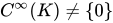
Spaces of test functions and distributions
Topological vector spaces
In mathematical analysis, the spaces of test functions and distributions are topological vector spaces (TVSs) that are used in the definition and application of distributions.
Test functions are usually infinitely differentiable complex-valued (or sometimes real-valued) functions on a non-empty open subset that have compact support.
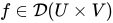
The space of all test functions, denoted by
, is endowed with a certain topology, called the canonical LF-topology, that makes
into a complete Hausdorff locally convex TVS.
The strong dual space of
is called the space of distributions on
and is denoted by
where the "
" subscript indicates that the continuous dual space of
denoted by
is endowed with the strong dual topology.
There are other possible choices for the space of test functions, which lead to other different spaces of distributions. If then the use of Schwartz functions as test functions gives rise to a certain subspace of
whose elements are called tempered distributions. These are important because they allow the Fourier transform to be extended from "standard functions" to tempered distributions. The set of tempered distributions forms a vector subspace of the space of distributions
and is thus one example of a space of distributions; there are many other spaces of distributions.
There also exist other major classes of test functions that are not subsets of , such as spaces of analytic test functions, which produce very different classes of distributions. The theory of such distributions has a different character from the previous one because there are no analytic functions with non-empty compact support. Use of analytic test functions leads to Sato's theory of hyperfunctions.
01Notation
The following notation will be used throughout this article:
is a fixed positive integer and
is a fixed non-empty open subset of Euclidean space
denotes the natural numbers.
will denote a non-negative integer or
- If
is a function then
will denote its domain and the support of
denoted by
is defined to be the closure of the set
in
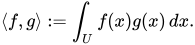
- For two functions
, the following notation defines a canonical pairing:
- A multi-index of size
is an element in
(given that
is fixed, if the size of multi-indices is omitted then the size should be assumed to be
). The length of a multi-index
is defined as
and denoted by
Multi-indices are particularly useful when dealing with functions of several variables, in particular we introduce the following notations for a given multi-index
:
We also introduce a partial order of all multi-indices by
if and only if
for all
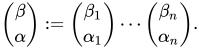
When
we define their multi-index binomial coefficient as:
will denote a certain non-empty collection of compact subsets of
(described in detail below).

02Definitions of test functions and distributions
In this section, we will formally define real-valued distributions on U. With minor modifications, one can also define complex-valued distributions, and one can replace with any (paracompact) smooth manifold.
- Let
- Let
denote the vector space of all k-times continuously differentiable real or complex-valued functions on U.
- For any compact subset
let
and
both denote the vector space of all those functions
such that
.
- If
then the domain of
is U and not K. So although
depends on both K and U, only K is typically indicated. The justification for this common practice is detailed below. The notation
will only be used when the notation
risks being ambiguous.
- Every
contains the constant 0 map, even if
- If
- Let
denote the set of all
such that
for some compact subset K of U.
- Equivalently,
is the set of all
such that
has compact support.
is equal to the union of all
as
ranges over
.
- If
is a real-valued function on U, then
is an element of
if and only if
is a
bump function. Every real-valued test function on
is always also a complex-valued test function on
- Equivalently,
Note that for all and any compact subsets K and L of U, we have:

Distributions on U are defined to be the continuous linear functionals on when this vector space is endowed with a particular topology called the canonical LF-topology.
This topology is unfortunately not easy to define but it is nevertheless still possible to characterize distributions in a way so that no mention of the canonical LF-topology is made.
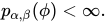
Proposition: If T is a linear functional on then the T is a distribution if and only if the following equivalent conditions are satisfied:
- For every compact subset
there exist constants
and
(dependent on
) such that for all
- For every compact subset
there exist constants
and
such that for all
with support contained in
- For any compact subset
and any sequence
in
if
converges uniformly to zero on
for all multi-indices
, then
The above characterizations can be used to determine whether or not a linear functional is a distribution, but more advanced uses of distributions and test functions (such as applications to differential equations) is limited if no topologies are placed on and
.
To define the space of distributions we must first define the canonical LF-topology, which in turn requires that several other locally convex topological vector spaces (TVSs) be defined first. First, a (non-normable) topology on
will be defined, then every
will be endowed with the subspace topology induced on it by
, and finally the (non-metrizable) canonical LF-topology on
will be defined.
The space of distributions, being defined as the continuous dual space of
, is then endowed with the (non-metrizable) strong dual topology induced by
and the canonical LF-topology (this topology is a generalization of the usual operator norm induced topology that is placed on the continuous dual spaces of normed spaces).
This finally permits consideration of more advanced notions such as convergence of distributions (both sequences and nets), various (sub)spaces of distributions, and operations on distributions, including extending differential equations to distributions.
Choice of compact sets K
Throughout, will be any collection of compact subsets of
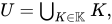
such that (1)
and (2) for any compact
there exists some
such that
The most common choices for
are:
- The set of all compact subsets of
, or
- A set
where
and for all i,
and
is a relatively compact non-empty open subset of
(here, "relatively compact" means that the closure of
, in either U or
, is compact).
We make into a directed set by defining
if and only if
Note that although the definitions of the subsequently defined topologies explicitly reference
, in reality they do not depend on the choice of
that is, if
and
are any two such collections of compact subsets of
then the topologies defined on
and
by using
in place of
are the same as those defined by using
in place of
Topology on Ck(U)
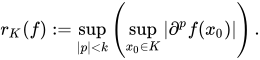
We now introduce the seminorms that will define the topology on Different authors sometimes use different families of seminorms so we list the most common families below. However, the resulting topology is the same no matter which family is used.
All of the functions above are non-negative -valued seminorms on
As explained in this article, every set of seminorms on a vector space induces a locally convex vector topology.
Each of the following sets of seminorms
generate the same locally convex vector topology on
.
With this topology, becomes a locally convex Fréchet space that is not normable. Every element of
is a continuous seminorm on
.
Under this topology, a net
in
converges to
if and only if for every multi-index
with
and every compact
, the net of partial derivatives
converges uniformly to
on
For any
any (von Neumann) bounded subset of
is a relatively compact subset of
In particular, a subset of
is bounded if and only if it is bounded in
for all
The space
is a Montel space if and only if
The topology on is the superior limit of the subspace topologies induced on
by the TVSs
as i ranges over the non-negative integers. A subset
of
is open in this topology if and only if there exists
such that
is open when
is endowed with the subspace topology induced on it by
.
Metric defining the topology
If the family of compact sets satisfies
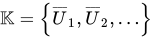
and
for all
then a complete translation-invariant metric on
can be obtained by taking a suitable countable Fréchet combination of any one of the above defining families of seminorms (A, B, C). For example, using the seminorms
results in the metric
Often, it is easier to just consider seminorms (avoiding any metric) and use the tools of functional analysis.
Topology on Ck(K)
As before, fix Recall that if

is any compact subset of
then
For any compact subset
is a closed subspace of the Fréchet space
and is thus also a Fréchet space. For all compact
satisfying
denote the inclusion map by
Then this map is a linear embedding of TVSs (that is, it is a linear map that is also a topological embedding) whose image (or "range") is closed in its codomain; said differently, the topology on
is identical to the subspace topology it inherits from
and also
is a closed subset of
The interior of
relative to
is empty.
If is finite then
is a Banach space with a topology that can be defined by the norm
And when then
is even a Hilbert space. The space
is a distinguished Schwartz Montel space so if
then it is not normable and thus not a Banach space (although like all other
it is a Fréchet space).
Trivial extensions and independence of Ck(K)'s topology from U
The definition of depends on U so we will let
denote the topological space
which by definition is a topological subspace of
Suppose
is an open subset of
containing
and for any compact subset
, let
is the vector subspace of
consisting of maps with support contained in
Given
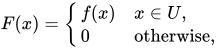
, its trivial extension to V is by definition, the function
defined by:
so that
Let
denote the map that sends a function in
to its trivial extension on V. This map is a linear injection and for every compact subset
(where
is also a compact subset of
since
) we have
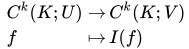
If I is restricted to
then the following induced linear map is a homeomorphism (and thus a TVS-isomorphism):
and thus the next two maps (which like the previous map are defined by
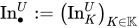
) are topological embeddings:
(the topology on
is the canonical LF topology, which is defined later).
Using the injection
the vector space
is canonically identified with its image in
(however, if
then
is not a topological embedding when these spaces are endowed with their canonical LF topologies, although it is continuous).
Because
, through this identification,
can also be considered as a subset of
Importantly, the subspace topology
inherits from
(when it is viewed as a subset of
) is identical to the subspace topology that it inherits from
(when
is viewed instead as a subset of
via the identification). Thus the topology on
is independent of the open subset U of
that contains K. This justifies the practice of writing
instead of
.
Canonical LF topology
Recall that denote all those functions in
that have compact support in
where note that
is the union of all
as K ranges over
Moreover, for every k,
is a dense subset of
The special case when
gives us the space of test functions.
This section defines the canonical LF topology as a direct limit. It is also possible to define this topology in terms of its neighborhoods of the origin, which is described afterwards.
Topology defined by direct limits
For any two sets K and L, we declare that if and only if
, which in particular makes the collection
of compact subsets of U into a directed set (we say that such a collection is directed by subset inclusion). For all compact
satisfying
there are inclusion maps
Recall from above that the map is a topological embedding. The collection of maps
forms a direct system in the category of locally convex topological vector spaces that is directed by
(under subset inclusion). This system's direct limit (in the category of locally convex TVSs) is the pair
where
are the natural inclusions and where
is now endowed with the (unique) strongest locally convex topology making all of the inclusion maps
continuous.
Topology defined by neighborhoods of the origin
If is a convex subset of
, then
is a neighborhood of the origin in the canonical LF topology if and only if it satisfies the following condition:
| For all | CN |
Note that any convex set satisfying this condition is necessarily absorbing in . Since the topology of any topological vector space is translation-invariant, any TVS-topology is completely determined by the set of neighborhood of the origin. This means that one could actually define the canonical LF topology by declaring that a convex balanced subset U is a neighborhood of the origin if and only if it satisfies condition CN.
Topology defined via differential operators
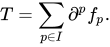
A linear differential operator in U with smooth coefficients is a sum
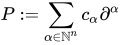
where
and all but finitely many of
are identically 0. The integer
is called the order of the differential operator
If
is a linear differential operator of order k then it induces a canonical linear map
defined by
where we shall reuse notation and also denote this map by
For any the canonical LF topology on
is the weakest locally convex TVS topology making all linear differential operators in
of order
into continuous maps from
into
.
Properties of the canonical LF topology
Canonical LF topology's independence from K
One benefit of defining the canonical LF topology as the direct limit of a direct system is that we may immediately use the universal property of direct limits. Another benefit is that we can use well-known results from category theory to deduce that the canonical LF topology is actually independent of the particular choice of the directed collection of compact sets. And by considering different collections
(in particular, those
mentioned at the beginning of this article), we may deduce different properties of this topology. In particular, we may deduce that the canonical LF topology makes
into a Hausdorff locally convex strict LF-space (and also a strict LB-space if
), which of course is the reason why this topology is called "the canonical LF topology" (see this footnote for more details).
Universal property
From the universal property of direct limits, we know that if is a linear map into a locally convex space Y (not necessarily Hausdorff), then u is continuous if and only if u is bounded if and only if for every
, the restriction of u to
is continuous (or bounded).
Dependence of the canonical LF topology on U
Suppose V is an open subset of containing
Let
denote the map that sends a function in
to its trivial extension on V (which was defined above). This map is a continuous linear map. If (and only if)
then
is not a dense subset of
and
is not a topological embedding. Consequently, if
then the transpose of
is neither one-to-one nor onto.
Bounded subsets
A subset is bounded in
if and only if there exists some
such that
and
is a bounded subset of
Moreover, if
is compact and
then
is bounded in
if and only if it is bounded in
For any
any bounded subset of
(resp.
) is a relatively compact subset of
(resp.
), where
.
Non-metrizability
For all compact , the interior of
in
is empty so that
is of the first category in itself. It follows from Baire's theorem that
is not metrizable and thus also not normable (see this footnote for an explanation of how the non-metrizable space
can be complete even though it does not admit a metric). The fact that
is a nuclear Montel space makes up for the non-metrizability of
(see this footnote for a more detailed explanation).
Relationships between spaces
Using the universal property of direct limits and the fact that the natural inclusions are all topological embedding, one may show that all of the maps
are also topological embeddings. Said differently, the topology on
is identical to the subspace topology that it inherits from
, where recall that
's topology was defined to be the subspace topology induced on it by
. In particular, both
and
induces the same subspace topology on
. However, this does not imply that the canonical LF topology on
is equal to the subspace topology induced on
by
; these two topologies on
are in fact never equal to each other since the canonical LF topology is never metrizable while the subspace topology induced on it by
is metrizable (since recall that
is metrizable). The canonical LF topology on
is actually strictly finer than the subspace topology that it inherits from
(thus the natural inclusion
is continuous but not a topological embedding).
Indeed, the canonical LF topology is so fine that if denotes some linear map that is a "natural inclusion" (such as
, or
, or other maps discussed below) then this map will typically be continuous, which (as is explained below) is ultimately the reason why locally integrable functions, Radon measures, etc. all induce distributions (via the transpose of such a "natural inclusion"). Said differently, the reason why there are so many different ways of defining distributions from other spaces ultimately stems from how very fine the canonical LF topology is. Moreover, since distributions are just continuous linear functionals on
, the fine nature of the canonical LF topology means that more linear functionals on
end up being continuous ("more" means as compared to a coarser topology that we could have placed on
such as for instance, the subspace topology induced by some
, which although it would have made
metrizable, it would have also resulted in fewer linear functionals on
being continuous and thus there would have been fewer distributions; moreover, this particular coarser topology also has the disadvantage of not making
into a complete TVS).
Other properties
- The differentiation map
is a continuous linear operator.
- The bilinear multiplication map
given by
is not continuous; it is however, hypocontinuous.
Distributions
As discussed earlier, continuous linear functionals on a are known as distributions on U. Thus the set of all distributions on U is the continuous dual space of
, which when endowed with the strong dual topology is denoted by
.
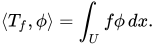
We have the canonical duality pairing between a distribution T on U and a test function , which is denoted using angle brackets by
One interprets this notation as the distribution T acting on the test function to give a scalar, or symmetrically as the test function
acting on the distribution T.
Characterizations of distributions
Proposition. If T is a linear functional on then the following are equivalent:
- T is a distribution;
- Definition : T is a continuous function.
- T is continuous at the origin.
- T is uniformly continuous.
- T is a bounded operator.
- T is sequentially continuous.
- explicitly, for every sequence
in
that converges in
to some
- explicitly, for every sequence
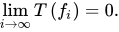
- T is sequentially continuous at the origin; in other words, T maps null sequences to null sequences.
- explicitly, for every sequence
in
that converges in
to the origin (such a sequence is called a null sequence),
- a null sequence is by definition a sequence that converges to the origin.
- explicitly, for every sequence
- T maps null sequences to bounded subsets.
- explicitly, for every sequence
in
that converges in
to the origin, the sequence
is bounded.
- explicitly, for every sequence
- T maps Mackey convergent null sequences to bounded subsets;
- explicitly, for every Mackey convergent null sequence
in
, the sequence
is bounded.
- a sequence
is said to be Mackey convergent to 0 if there exists a divergent sequence
of positive real number such that the sequence
is bounded; every sequence that is Mackey convergent to 0 necessarily converges to the origin (in the usual sense).
- explicitly, for every Mackey convergent null sequence
- The kernel of T is a closed subspace of
.
- The graph of T is closed.
- There exists a continuous seminorm
on
such that
- There exists a constant
a collection of continuous seminorms,
that defines the canonical LF topology of
and a finite subset
such that
- For every compact subset
there exist constants
and
such that for all
- For every compact subset
there exist constants
and
such that for all
with support contained in
- For any compact subset
and any sequence
in
if
converges uniformly to zero for all multi-indices
then
- Any of the three statements immediately above (that is, statements 14, 15, and 16) but with the additional requirement that compact set
belongs to
Topology on the space of distributions
Definition and notation: The space of distributions on U, denoted by The topology of uniform convergence on bounded subsets is also called the strong dual topology. This topology is chosen because it is with this topology that becomes a nuclear Montel space and it is with this topology that the Schwartz kernel theorem holds. No matter what dual topology is placed on
a sequence of distributions converges in this topology if and only if it converges pointwise (although this need not be true of a net). No matter which topology is chosen,
will be a non-metrizable, locally convex topological vector space. The space
is separable and has the strong Pytkeev property but it is neither a k-space nor a sequential space, which in particular implies that it is not metrizable and also that its topology can not be defined using only sequences.
Topological properties
Topological vector space categories
The canonical LF topology makes into a complete distinguished strict LF-space (and a strict LB-space if and only if
), which implies that
is a meager subset of itself. Furthermore,
, as well as its strong dual space, is a complete Hausdorff locally convex barrelled bornological Mackey space. The strong dual of
is a Fréchet space if and only if
so in particular, the strong dual of
, which is the space
of distributions on U, is not metrizable (note that the weak-* topology on
also is not metrizable and moreover, it further lacks almost all of the nice properties that the strong dual topology gives
).
The three spaces ,
, and the Schwartz space
, as well as the strong duals of each of these three spaces, are complete nuclear Montel bornological spaces, which implies that all six of these locally convex spaces are also paracompact reflexive barrelled Mackey spaces. The spaces
and
are both distinguished Fréchet spaces. Moreover, both
and
are Schwartz TVSs.
Convergent sequences
Convergent sequences and their insufficiency to describe topologies
The strong dual spaces of and
are sequential spaces but not Fréchet-Urysohn spaces. Moreover, neither the space of test functions
nor its strong dual
is a sequential space (not even an Ascoli space), which in particular implies that their topologies can not be defined entirely in terms of convergent sequences.
A sequence in
converges in
if and only if there exists some
such that
contains this sequence and this sequence converges in
; equivalently, it converges if and only if the following two conditions hold:
- There is a compact set
containing the supports of all
- For each multi-index
the sequence of partial derivatives
tends uniformly to
Neither the space nor its strong dual
is a sequential space, and consequently, their topologies can not be defined entirely in terms of convergent sequences. For this reason, the above characterization of when a sequence converges is not enough to define the canonical LF topology on
. The same can be said of the strong dual topology on
.
What sequences do characterize
Nevertheless, sequences do characterize many important properties, as we now discuss. It is known that in the dual space of any Montel space, a sequence converges in the strong dual topology if and only if it converges in the weak* topology, which in particular, is the reason why a sequence of distributions converges (in the strong dual topology) if and only if it converges pointwise (this leads many authors to use pointwise convergence to actually define the convergence of a sequence of distributions; this is fine for sequences but it does not extend to the convergence of nets of distributions since a net may converge pointwise but fail to converge in the strong dual topology).
Sequences characterize continuity of linear maps valued in locally convex space. Suppose X is a locally convex bornological space (such as any of the six TVSs mentioned earlier). Then a linear map into a locally convex space Y is continuous if and only if it maps null sequences in X to bounded subsets of Y. More generally, such a linear map
is continuous if and only if it maps Mackey convergent null sequences to bounded subsets of
So in particular, if a linear map
into a locally convex space is sequentially continuous at the origin then it is continuous. However, this does not necessarily extend to non-linear maps and/or to maps valued in topological spaces that are not locally convex TVSs.
For every is sequentially dense in
. Furthermore,
is a sequentially dense subset of
(with its strong dual topology) and also a sequentially dense subset of the strong dual space of
Sequences of distributions
A sequence of distributions converges with respect to the weak-* topology on
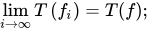
to a distribution T if and only if
for every test function
For example, if
is the function
and
is the distribution corresponding to
then
as
so
in
Thus, for large
the function
can be regarded as an approximation of the Dirac delta distribution.
Other properties
- The strong dual space of
is TVS isomorphic to
via the canonical TVS-isomorphism
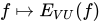
defined by sending
to value at
(that is, to the linear functional on
defined by sending
to
);
- On any bounded subset of
the weak and strong subspace topologies coincide; the same is true for
;
- Every weakly convergent sequence in
is strongly convergent (although this does not extend to nets).
03Localization of distributions
Preliminaries: Transpose of a linear operator
Operations on distributions and spaces of distributions are often defined by means of the transpose of a linear operator. This is because the transpose allows for a unified presentation of the many definitions in the theory of distributions and also because its properties are well known in functional analysis. For instance, the well-known Hermitian adjoint of a linear operator between Hilbert spaces is just the operator's transpose (but with the Riesz representation theorem used to identify each Hilbert space with its continuous dual space). In general the transpose of a continuous linear map is the linear map
or equivalently, it is the unique map satisfying
for all
and all
(the prime symbol in
does not denote a derivative of any kind; it merely indicates that
is an element of the continuous dual space
). Since
is continuous, the transpose
is also continuous when both duals are endowed with their respective strong dual topologies; it is also continuous when both duals are endowed with their respective weak* topologies (see the articles polar topology and dual system for more details).
In the context of distributions, the characterization of the transpose can be refined slightly. Let be a continuous linear map. Then by definition, the transpose of

is the unique linear operator
that satisfies:
Since is dense in
(here,
actually refers to the set of distributions
) it is sufficient that the defining equality hold for all distributions of the form
where
Explicitly, this means that a continuous linear map
is equal to
if and only if the condition below holds:
where the right hand side equals
Extensions and restrictions to an open subset
Let be open subsets of
.
Every function
can be extended by zero from its domain
to a function on
by setting it equal to
on the complement
This extension is a smooth compactly supported function called the trivial extension of
to
and it will be denoted by
.
This assignment
defines the trivial extension operator
which is a continuous injective linear map. It is used to canonically identify
as a vector subspace of
(although not as a topological subspace).
Its transpose (explained here)
is called the restriction to
of distributions in
and as the name suggests, the image
of a distribution
under this map is a distribution on
called the restriction of
to
The defining condition of the restriction
is:
If
then the (continuous injective linear) trivial extension map
is not a topological embedding (in other words, if this linear injection was used to identify
as a subset of
then
's topology would strictly finer than the subspace topology that
induces on it; importantly, it would not be a topological subspace since that requires equality of topologies) and its range is also not dense in its codomain
Consequently, if
then the restriction mapping is neither injective nor surjective. A distribution
is said to be extendible to U if it belongs to the range of the transpose of
and it is called extendible if it is extendable to
Unless , the restriction to
is neither injective nor surjective.
04Spaces of distributions
For all and all
, all of the following canonical injections are continuous and have an image/range that is a dense subset of their codomain:
where the topologies on the LB-spaces
are the canonical LF topologies as defined below (so in particular, they are not the usual norm topologies).
The range of each of the maps above (and of any composition of the maps above) is dense in the codomain. Indeed,
is even sequentially dense in every
. For every
the canonical inclusion
into the normed space
(here
has its usual norm topology) is a continuous linear injection and the range of this injection is dense in its codomain if and only if
.
Suppose that is one of the LF-spaces
(for
) or LB-spaces
(for
) or normed spaces
(for
). Because the canonical injection
is a continuous injection whose image is dense in the codomain, this map's transpose
is a continuous injection. This injective transpose map thus allows the continuous dual space
of
to be identified with a certain vector subspace of the space
of all distributions (specifically, it is identified with the image of this transpose map). This continuous transpose map is not necessarily a TVS-embedding so the topology that this map transfers from its domain to the image
is finer than the subspace topology that this space inherits from
.
A linear subspace of
carrying a locally convex topology that is finer than the subspace topology induced by
is called a space of distributions.
Almost all of the spaces of distributions mentioned in this article arise in this way (e.g. tempered distribution, restrictions, distributions of order
some integer, distributions induced by a positive Radon measure, distributions induced by an
-function, etc.) and any representation theorem about the dual space of X may, through the transpose
, be transferred directly to elements of the space
.
Compactly supported Lp-spaces
Given , the vector space
of compactly supported
functions on
and its topology are defined as direct limits of the spaces
in a manner analogous to how the canonical LF-topologies on
were defined.
For any compact
, let
denote the set of all element in
(which recall are equivalence class of Lebesgue measurable
functions on
) having a representative
whose support (which recall is the closure of
in
) is a subset of
(such an
is almost everywhere defined in
).
The set
is a closed vector subspace
and is thus a Banach space and when
even a Hilbert space.
Let
be the union of all
as
ranges over all compact subsets of
The set
is a vector subspace of
whose elements are the (equivalence classes of) compactly supported
functions defined on
(or almost everywhere on
).
Endow
with the final topology (direct limit topology) induced by the inclusion maps
as
ranges over all compact subsets of
.
This topology is called the canonical LF topology and it is equal to the final topology induced by any countable set of inclusion maps
(
) where
are any compact sets with union equal to
This topology makes
into an LB-space (and thus also an LF-space) with a topology that is strictly finer than the norm (subspace) topology that
induces on it.
Radon measures
The inclusion map is a continuous injection whose image is dense in its codomain, so the transpose
is also a continuous injection.
Note that the continuous dual space can be identified as the space of Radon measures, where there is a one-to-one correspondence between the continuous linear functionals
and integral with respect to a Radon measure; that is,
- if
then there exists a Radon measure
on U such that for all
and
- if
is a Radon measure on U then the linear functional on
defined by
is continuous.
Through the injection every Radon measure becomes a distribution on U. If
is a locally integrable function on U then the distribution
is a Radon measure; so Radon measures form a large and important space of distributions.
The following is the theorem of the structure of distributions of Radon measures, which shows that every Radon measure can be written as a sum of derivatives of locally functions in U:
Theorem., Suppose is a Radon measure, where
let
be a neighborhood of the support of
and let
There exists a family
of locally
functions on U such that
for every
, and
Furthermore,
is also equal to a finite sum of derivatives of continuous functions on
where each derivative has order
Positive Radon measures
A linear function T on a space of functions is called positive if whenever a function that belongs to the domain of T is non-negative (meaning that
is real-valued and
) then
. One may show that every positive linear functional on
is necessarily continuous (that is, necessarily a Radon measure).
Lebesgue measure is an example of a positive Radon measure.
Locally integrable functions as distributions
One particularly important class of Radon measures are those that are induced locally integrable functions. The function is called locally integrable if it is Lebesgue integrable over every compact subset K of U. This is a large class of functions which includes all continuous functions and all Lp space
functions. The topology on
is defined in such a fashion that any locally integrable function
yields a continuous linear functional on
, that is, an element of
, denoted here by
, whose value on the test function
is given by the Lebesgue integral:
Conventionally, one abuses notation by identifying with

, provided no confusion can arise, and thus the pairing between
and
is often written
If and g are two locally integrable functions, then the associated distributions
and Tg are equal to the same element of
if and only if
and g are equal almost everywhere (see, for instance, Hörmander (1983, Theorem 1.2.5)). In a similar manner, every Radon measure
on U defines an element of
whose value on the test function
is
As above, it is conventional to abuse notation and write the pairing between a Radon measure
and a test function
as
Conversely, as shown in a theorem by Schwartz (similar to the Riesz representation theorem), every distribution which is non-negative on non-negative functions is of this form for some (positive) Radon measure.
Test functions as distributions
The test functions are themselves locally integrable, and so define distributions. The space of test functions is sequentially dense in
with respect to the strong topology on
This means that for any
there is a sequence of test functions,
that converges to
(in its strong dual topology) when considered as a sequence of distributions. Or equivalently,
Furthermore, is also sequentially dense in the strong dual space of
.
Distributions with compact support
The inclusion map is a continuous injection whose image is dense in its codomain, so the transpose
is also a continuous injection. Thus the image of the transpose, denoted by
forms a space of distributions when it is endowed with the strong dual topology of
(transferred to it via the transpose map
so the topology of
is finer than the subspace topology that this set inherits from
).
The elements of can be identified as the space of distributions with compact support. Explicitly, if T is a distribution on U then the following are equivalent,
;
- the support of T is compact;
- the restriction of
to
when that space is equipped with the subspace topology inherited from
(a coarser topology than the canonical LF topology), is continuous;
- there is a compact subset K of U such that for every test function
whose support is completely outside of K, we have
Compactly supported distributions define continuous linear functionals on the space ; recall that the topology on
is defined such that a sequence of test functions
converges to 0 if and only if all derivatives of
converge uniformly to 0 on every compact subset of U. Conversely, it can be shown that every continuous linear functional on this space defines a distribution of compact support. Thus compactly supported distributions can be identified with those distributions that can be extended from
to
Distributions of finite order
Let The inclusion map
is a continuous injection whose image is dense in its codomain, so the transpose
is also a continuous injection. Consequently, the image of
denoted by
forms a space of distributions when it is endowed with the strong dual topology of
(transferred to it via the transpose map
so
's topology is finer than the subspace topology that this set inherits from
). The elements of
are the distributions of order
The distributions of order
, which are also called distributions of order
, are exactly the distributions that are Radon measures (described above).
For a distribution of order
is a distribution of order
that is not a distribution of order
A distribution is said to be of finite order if there is some integer k such that it is a distribution of order and the set of distributions of finite order is denoted by
Note that if
then
so that
is a vector subspace of
and furthermore, if and only if
.
Structure of distributions of finite order
Every distribution with compact support in U is a distribution of finite order. Indeed, every distribution in U is locally a distribution of finite order, in the following sense: If V is an open and relatively compact subset of U and if is the restriction mapping from U to V, then the image of
under
is contained in
.
The following is the theorem of the structure of distributions of finite order, which shows that every distribution of finite order can be written as a sum of derivatives of Radon measures:
Theorem, Suppose has finite order and

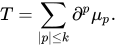
Given any open subset V of U containing the support of T, there is a family of Radon measures in U,
such that for very
and
Example. (Distributions of infinite order) Let and for every test function
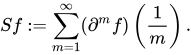
let
Then S is a distribution of infinite order on U. Moreover, S can not be extended to a distribution on ; that is, there exists no distribution T on
such that the restriction of T to U is equal to S.
Tempered distributions and Fourier transform
Defined below are the tempered distributions, which form a subspace of the space of distributions on
This is a proper subspace: while every tempered distribution is a distribution and an element of
the converse is not true. Tempered distributions are useful if one studies the Fourier transform since all tempered distributions have a Fourier transform, which is not true for an arbitrary distribution in
Schwartz space
The Schwartz space, is the space of all smooth functions that are rapidly decreasing at infinity along with all partial derivatives. Thus
is in the Schwartz space provided that any derivative of
multiplied with any power of
converges to 0 as
These functions form a complete TVS with a suitably defined family of seminorms. More precisely, for any multi-indices
and
define:
Then is in the Schwartz space if all the values satisfy:
The family of seminorms defines a locally convex topology on the Schwartz space. For
the seminorms are, in fact, norms on the Schwartz space. One can also use the following family of seminorms to define the topology:
Otherwise, one can define a norm on via

The Schwartz space is a Fréchet space (i.e. a complete metrizable locally convex space). Because the Fourier transform changes into multiplication by
and vice versa, this symmetry implies that the Fourier transform of a Schwartz function is also a Schwartz function.
A sequence in
converges to 0 in
if and only if the functions
converge to 0 uniformly in the whole of
which implies that such a sequence must converge to zero in
is dense in
The subset of all analytic Schwartz functions is dense in
as well.
The Schwartz space is nuclear and the tensor product of two maps induces a canonical surjective TVS-isomorphisms

where
represents the completion of the injective tensor product (which in this case is the identical to the completion of the projective tensor product).
Tempered distributions
The inclusion map is a continuous injection whose image is dense in its codomain, so the transpose

is also a continuous injection. Thus, the image of the transpose map, denoted by
, forms a space of distributions when it is endowed with the strong dual topology of
(transferred to it via the transpose map
, so the topology of
is finer than the subspace topology that this set inherits from
).
The space is called the space of tempered distributions. It is the continuous dual of the Schwartz space. Equivalently, a distribution T is a tempered distribution if and only if
The derivative of a tempered distribution is again a tempered distribution. Tempered distributions generalize the bounded (or slow-growing) locally integrable functions; all distributions with compact support and all square-integrable functions are tempered distributions. More generally, all functions that are products of polynomials with elements of Lp space for
are tempered distributions.
The tempered distributions can also be characterized as slowly growing, meaning that each derivative of T grows at most as fast as some polynomial. This characterization is dual to the rapidly falling behaviour of the derivatives of a function in the Schwartz space, where each derivative of decays faster than every inverse power of
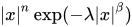
An example of a rapidly falling function is
for any positive
Fourier transform
To study the Fourier transform, it is best to consider complex-valued test functions and complex-linear distributions. The ordinary continuous Fourier transform is a TVS-automorphism of the Schwartz space, and the Fourier transform is defined to be its transpose

which (abusing notation) will again be denoted by F. So the Fourier transform of the tempered distribution T is defined by
for every Schwartz function
is thus again a tempered distribution. The Fourier transform is a TVS isomorphism from the space of tempered distributions onto itself. This operation is compatible with differentiation in the sense that
and also with convolution: if T is a tempered distribution and
is a slowly increasing smooth function on
is again a tempered distribution and
is the convolution of
and
. In particular, the Fourier transform of the constant function equal to 1 is the
distribution.
Expressing tempered distributions as sums of derivatives
If is a tempered distribution, then there exists a constant
and positive integers M and N such that for all Schwartz functions
This estimate along with some techniques from functional analysis can be used to show that there is a continuous slowly increasing function F and a multi-index such that
Restriction of distributions to compact sets
If then for any compact set
there exists a continuous function F compactly supported in
(possibly on a larger set than K itself) and a multi-index
such that
on
.
05Tensor product of distributions
Let and
be open sets. Assume all vector spaces to be over the field
where
or
For
define for every
and every
the following functions:
Given and
define the following functions:
where
and
These definitions associate every
and
with the (respective) continuous linear map:
Moreover, if either (resp.
) has compact support then it also induces a continuous linear map of
(resp.
).
Fubini's theorem for distributions, Let and
If
then
The tensor product of and
denoted by
or
is the distribution in
defined by:
Schwartz kernel theorem
The tensor product defines a bilinear map
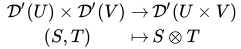
the span of the range of this map is a dense subspace of its codomain. Furthermore,
Moreover
induces continuous bilinear maps:
where
denotes the space of distributions with compact support and
is the Schwartz space of rapidly decreasing functions.
Schwartz kernel theorem, Each of the canonical maps below (defined in the natural way) are TVS isomorphisms:

Here
represents the completion of the injective tensor product (which in this case is identical to the completion of the projective tensor product, since these spaces are nuclear) and
has the topology of uniform convergence on bounded subsets.
This result does not hold for Hilbert spaces such as and its dual space. Why does such a result hold for the space of distributions and test functions but not for other "nice" spaces like the Hilbert space
? This question led Alexander Grothendieck to discover nuclear spaces, nuclear maps, and the injective tensor product. He ultimately showed that it is precisely because
is a nuclear space that the Schwartz kernel theorem holds. Like Hilbert spaces, nuclear spaces may be thought as of generalizations of finite dimensional Euclidean space.
06Using holomorphic functions as test functions
The success of the theory led to investigation of the idea of hyperfunction, in which spaces of holomorphic functions are used as test functions. A refined theory has been developed, in particular Mikio Sato's algebraic analysis, using sheaf theory and several complex variables. This extends the range of symbolic methods that can be made into rigorous mathematics, for example Feynman integrals.
Sources and credits
This article is adapted from the Wikipedia article “Spaces of test functions and distributions”, written by its contributors and licensed under CC BY-SA 4.0. Fathomly has changed the layout, removed citation markers, navigation and maintenance notices, and adjusted punctuation. This adapted version is shared under the same license. For references, see the original article.
Images, from Wikimedia Commons:
- Bump.png by JoshDif, CC BY-SA 4.0
Fathomly is not affiliated with or endorsed by the Wikimedia Foundation. Spotted a problem? Tell us.