Reference articles on history, science, culture and more
Encyclopedia

Multi-index notation

Mathematical notation

Multi-index notation is a mathematical notation that simplifies formulas used in multivariable calculus, partial differential equations and the theory of distributions, by generalising the concept of an integer index to an ordered tuple of indices.

01Definition and basic properties

An n-dimensional multi-index is an {\textstyle n-tuple

\alpha =(\alpha _{1},\alpha _{2},\ldots ,\alpha _{n})

of non-negative integers (i.e. an element of the {\textstyle n-dimensional set of natural numbers, denoted \mathbb {N} _{0}^{n}).

For multi-indices \alpha ,\beta \in \mathbb {N} _{0}^{n} and x=(x_{1},x_{2},\ldots ,x_{n})\in \mathbb {R} ^{n}, one defines:

Componentwise sum and difference
\alpha \pm \beta =(\alpha _{1}\pm \beta _{1},\,\alpha _{2}\pm \beta _{2},\ldots ,\,\alpha _{n}\pm \beta _{n})
Partial order
\alpha \leq \beta \quad \Leftrightarrow \quad \alpha _{i}\leq \beta _{i}\quad \forall \,i\in \{1,\ldots ,n\}
Sum of components (absolute value)
|\alpha |=\alpha _{1}+\alpha _{2}+\cdots +\alpha _{n}
Factorial
\alpha !=\alpha _{1}!\cdot \alpha _{2}!\cdots \alpha _{n}!
Binomial coefficient
{\binom {\alpha }{\beta }}={\binom {\alpha _{1}}{\beta _{1}}}{\binom {\alpha _{2}}{\beta _{2}}}\cdots {\binom {\alpha _{n}}{\beta _{n}}}={\frac {\alpha !}{\beta !(\alpha -\beta )!}}
Multinomial coefficient
{\binom {k}{\alpha }}={\frac {k!}{\alpha _{1}!\alpha _{2}!\cdots \alpha _{n}!}}={\frac {k!}{\alpha !}} where k:=|\alpha |\in \mathbb {N} _{0}.
Power
x^{\alpha }=x_{1}^{\alpha _{1}}x_{2}^{\alpha _{2}}\ldots x_{n}^{\alpha _{n}}.
Higher-order partial derivative
\partial ^{\alpha }=\partial _{1}^{\alpha _{1}}\partial _{2}^{\alpha _{2}}\ldots \partial _{n}^{\alpha _{n}}, where \partial _{i}^{\alpha _{i}}:=\partial ^{\alpha _{i}}/\partial x_{i}^{\alpha _{i}} (see also 4-gradient). Sometimes the notation D^{\alpha }=\partial ^{\alpha } is also used.

02Some applications

The multi-index notation allows the extension of many formulae from elementary calculus to the corresponding multi-variable case. Below are some examples. In all the following, x,y,h\in \mathbb {C} ^{n} (or \mathbb {R} ^{n}), and \alpha ,\beta ,\nu \in \mathbb {N} _{0}^{n}.

Derivative of a monomial

\partial ^{\alpha }x^{\beta }={\begin{cases}{\frac {\beta !}{(\beta -\alpha )!}}x^{\beta -\alpha },&{\text{if}}~\alpha \leq \beta ,\\0,&{\text{otherwise.}}\end{cases}}

Multinomial theorem

\left(\sum _{i=1}^{n}x_{i}\right)^{k}=\sum _{|\alpha |=k}{\binom {k}{\alpha }}\,x^{\alpha }.

Multi-binomial theorem

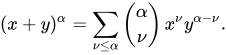
(x+y)^{\alpha }=\sum _{\nu \leq \alpha }{\binom {\alpha }{\nu }}\,x^{\nu }y^{\alpha -\nu }. Note that, since x + y is a vector and α is a multi-index, the expression on the left is short for (x1 + y1)α1⋯(xn + yn)αn.

Leibniz formula

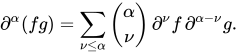
For smooth functions {\textstyle f and {\textstyle g,\partial ^{\alpha }(fg)=\sum _{\nu \leq \alpha }{\binom {\alpha }{\nu }}\,\partial ^{\nu }f\,\partial ^{\alpha -\nu }g.

Taylor series

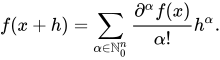
For an analytic function {\textstyle f in {\textstyle n variables one has f(x+h)=\sum _{\alpha \in \mathbb {N} _{0}^{n}}{{\frac {\partial ^{\alpha }f(x)}{\alpha !}}h^{\alpha }}. In fact, for a smooth enough function, we have the similar Taylor expansion f(x+h)=\sum _{|\alpha |\leq n}{{\frac {\partial ^{\alpha }f(x)}{\alpha !}}h^{\alpha }}+R_{n}(x,h), where the last term (the remainder) depends on the exact version of Taylor's formula. For instance, for the Cauchy formula (with integral remainder), one gets R_{n}(x,h)=(n+1)\sum _{|\alpha |=n+1}{\frac {h^{\alpha }}{\alpha !}}\int _{0}^{1}(1-t)^{n}\partial ^{\alpha }f(x+th)\,dt.
Integration by parts

For smooth functions u and v with compact support in \mathbb {R} ^{n}, \int _{\mathbb {R} ^{n}}u(\partial ^{\alpha }v)\,dx=(-1)^{|\alpha |}\int _{\mathbb {R} ^{n}}{(\partial ^{\alpha }u)v\,dx}. This formula is used for the definition of weak derivatives of distributions.

Watch videos about Multi-index notationExplainers and documentaries on YouTube (opens in a new tab)

Sources and credits

This article is adapted from the Wikipedia article Multi-index notation, written by its contributors and licensed under CC BY-SA 4.0. Fathomly has changed the layout, removed citation markers, navigation and maintenance notices, and adjusted punctuation. This adapted version is shared under the same license. For references, see the original article.

Fathomly is not affiliated with or endorsed by the Wikimedia Foundation. Spotted a problem? Tell us.