Einstein notation
Shorthand notation for tensor operations
In mathematics, especially the usage of linear algebra in mathematical physics and differential geometry, Einstein notation (also known as the Einstein summation convention or Einstein summation notation) is a notational convention that implies summation over a set of indexed terms in a formula, thus achieving brevity. As part of mathematics it is a notational subset of Ricci calculus; however, it is often used in physics applications that do not distinguish between tangent and cotangent spaces. It was introduced to physics by Albert Einstein in 1916.
01Introduction
Statement of convention
According to this convention, when an index variable appears twice in a single term and is not otherwise defined (see Free and bound variables), it implies summation of that term over all the values of the index. So where the indices can range over the set 


The upper indices are not exponents but are indices of coordinates, coefficients or basis vectors. That is, in this context 


In general relativity, a common convention is that
- the Greek alphabet is used for space and time components, where indices take on values 0, 1, 2, or 3 (frequently used letters include
,
, etc.),
- the Latin alphabet is used for spatial components only, where indices take on values 1, 2, or 3 (frequently used letters are
,
,...),
In general, indices can range over any indexing set, including an infinite set. This should not be confused with a typographically similar convention used to distinguish between tensor index notation and the closely related but distinct basis-independent abstract index notation.
An index that is summed over is a summation index, in this case "
An index that is not summed over is a free index and should appear only once per term. If such an index does appear, it usually also appears in every other term in an equation. An example of a free index is the "
Application
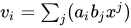
Einstein notation can be applied in slightly different ways. Typically, each index occurs once in an upper (superscript) and once in a lower (subscript) position in a term; however, the convention can be applied more generally to any repeated indices within a term. When dealing with covariant and contravariant vectors, where the position of an index indicates the type of vector, the first case usually applies; a covariant vector can only be contracted with a contravariant vector, corresponding to summation of the products of coefficients. On the other hand, when there is a fixed coordinate basis (or when not considering coordinate vectors), one may choose to use only subscripts; see § Superscripts and subscripts versus only subscripts below.
02Vector representations
Superscripts and subscripts versus only subscripts
In terms of covariance and contravariance of vectors,
- upper indices represent components of contravariant vectors (vectors),
- lower indices represent components of covariant vectors (covectors).
They transform contravariantly or covariantly, respectively, with respect to change of basis.
In recognition of this fact, the following notation uses the same symbol both for a vector or covector and its components, as in:

where 


In the presence of a non-degenerate form (an isomorphism 
A basis gives such a form (via the dual basis), hence when working on 
However, if one changes coordinates, the way that coefficients change depends on the variance of the object, and one cannot ignore the distinction; see Covariance and contravariance of vectors.
Mnemonics
In the above example, vectors are represented as 

When using the column vector convention:
- "Upper indices go up to down; lower indices go left to right."
- "Covariant tensors are row vectors that have indices that are below (co-row-below)."
- Covectors are row vectors:
Hence the lower index indicates which column you are in.
- Contravariant vectors are column vectors:
Hence the upper index indicates which row you are in.
Abstract description
The virtue of Einstein notation is that it represents the invariant quantities with a simple notation.
In physics, a scalar is invariant under transformations of basis. In particular, a Lorentz scalar is invariant under a Lorentz transformation. The individual terms in the sum are not. When the basis is changed, the components of a vector change by a linear transformation described by a matrix. This led Einstein to propose the convention that repeated indices imply the summation is to be done.
As for covectors, they change by the inverse matrix. This is designed to guarantee that the linear function associated with the covector, the sum above, is the same no matter what the basis is.
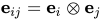
The value of the Einstein convention is that it applies to other vector spaces built from 



The dual space 



03Common operations in this notation
In Einstein notation, the usual element reference 


Inner product
The inner product of two vectors is the sum of the products of their corresponding components, with the indices of one vector lowered (see #Raising and lowering indices):


Vector cross product
In three dimensions, the cross product of two vectors with respect to a positively oriented orthonormal basis, meaning that 

Here, 

Matrix-vector multiplication
The product of a matrix 

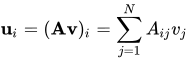

This is a special case of matrix multiplication.
Matrix multiplication
The matrix product of two matrices 
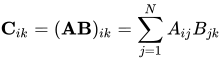
equivalent to
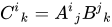
Trace
For a square matrix 

Outer product
The outer product of the column vector 



Since
Raising and lowering indices
Given a tensor, one can raise an index or lower an index by contracting the tensor with the metric tensor, 

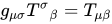
Or one can raise an index:

Sources and credits
This article is adapted from the Wikipedia article “Einstein notation”, written by its contributors and licensed under CC BY-SA 4.0. Fathomly has changed the layout, removed citation markers, navigation and maintenance notices, and adjusted punctuation. This adapted version is shared under the same license. For references, see the original article.
Fathomly is not affiliated with or endorsed by the Wikimedia Foundation. Spotted a problem? Tell us.
