Direct limit
Special case of colimit in category theory
In mathematics, a direct limit is a way to construct a (typically large) object from many (typically smaller) objects that are put together in a specific way. These objects may be groups, rings, vector spaces or in general objects from any category. The way they are put together is specified by a system of homomorphisms (group homomorphism, ring homomorphism, or in general morphisms in the category) between those smaller objects. The direct limit of the objects 


Direct limits are a special case of the concept of colimit in category theory. Direct limits are dual to inverse limits, which are a special case of limits in category theory.
01Formal definition
We will first give the definition for algebraic structures like groups and modules, and then the general definition, which can be used in any category.
Direct limits of algebraic objects
In this section objects are understood to consist of underlying sets equipped with a given algebraic structure, such as groups, rings, modules (over a fixed ring), algebras (over a fixed field), etc. With this in mind, homomorphisms are understood in the corresponding setting (group homomorphisms, etc.).
Let 


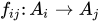

is the identity on
, and
for all
.
Then the pair 
The direct limit of the direct system 
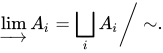
Here, if 




One obtains from this definition canonical functions 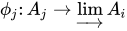

Direct limits in an arbitrary category
The direct limit can be defined in an arbitrary category 


will then commute for all i, j.
The direct limit is often denoted

with the direct system 

Unlike for algebraic objects, not every direct system in an arbitrary category has a direct limit. If it does, however, the direct limit is unique in a strong sense: given another direct limit X′ there exists a unique isomorphism X′ → X that commutes with the canonical morphisms.
02Examples
- A collection of subsets
of a set
can be partially ordered by inclusion. If the collection is directed, its direct limit is the union
.
- Similarly, the collection of finitely generated subgroups
of a given group
can be partially ordered by inclusion. Finite sets of finitely generated subgroups
are containined in the finitely generated subgroup
, so the index set is indeed directed. With the inclusion morphisms
, the direct limit is simply (isomorphic to)
- The weak topology of a CW complex is defined as a direct limit.
- Let
. The direct limit
of any corresponding direct system is isomorphic to
and the canonical morphism
is an isomorphism.
- Let K be a field. For a positive integer n, consider the general linear group GL(n;K) consisting of invertible n x n - matrices with entries from K. We have a group homomorphism GL(n;K) → GL(n+1;K) that enlarges matrices by putting a 1 in the lower right corner and zeros elsewhere in the last row and column. The direct limit of this system is the general linear group of K, written as GL(K). An element of GL(K) can be thought of as an infinite invertible matrix that differs from the infinite identity matrix in only finitely many entries. The group GL(K) is of vital importance in algebraic K-theory.
- Let p be a prime number. Consider the direct system composed of the factor groups
and the homomorphisms
induced by multiplication by
. The direct limit of this system consists of all the roots of unity of order some power of
.
- There is a (non-obvious) injective ring homomorphism from the ring of symmetric polynomials in
variables to the ring of symmetric polynomials in
variables. Forming the direct limit of this direct system yields the ring of symmetric functions.
- Let F be a C-valued sheaf on a topological space X. Fix a point x in X. The open neighborhoods of x form a directed set ordered by inclusion (U ≤ V if and only if U contains V). The corresponding direct system is (F(U), rU,V) where r is the restriction map. The direct limit of this system is called the stalk of F at x, denoted Fx. For each neighborhood U of x, the canonical morphism F(U) → Fx associates to a section s of F over U an element sx of the stalk Fx called the germ of s at x.
- Direct limits in the category of topological spaces are given by placing the final topology on the underlying set-theoretic direct limit.
- An ind-scheme is an inductive limit of schemes.
03Properties
Direct limits are linked to inverse limits via

An important property is that taking direct limits in the category of modules is an exact functor. This means that for any directed system of short exact sequences 

04Related constructions and generalizations
We note that a direct system in a category 


A notion closely related to direct limits are the filtered colimits. Here we start with a covariant functor 

Given an arbitrary category 
The categorical dual of the direct limit is called the inverse limit. As above, inverse limits can be viewed as limits of certain functors and are closely related to limits over cofiltered categories.
05Terminology
In the literature, one finds the terms "directed limit", "direct inductive limit", "directed colimit", "direct colimit" and "inductive limit" for the concept of direct limit defined above. The term "inductive limit" is ambiguous however, as some authors use it for the general concept of colimit.
Sources and credits
This article is adapted from the Wikipedia article “Direct limit”, written by its contributors and licensed under CC BY-SA 4.0. Fathomly has changed the layout, removed citation markers, navigation and maintenance notices, and adjusted punctuation. This adapted version is shared under the same license. For references, see the original article.
Fathomly is not affiliated with or endorsed by the Wikimedia Foundation. Spotted a problem? Tell us.