Homomorphism
Structure-preserving map between two algebraic structures of the same type
In algebra, a homomorphism is a structure-preserving map between two algebraic structures of the same type (such as two groups, two rings, or two vector spaces). The word homomorphism comes from the Ancient Greek language: ὁμός (homos) meaning "same" and μορφή (morphe) meaning "form" or "shape". However, the word was apparently introduced to mathematics due to a (mis)translation of German ähnlich meaning "similar" to ὁμός meaning "same". The term "homomorphism" appeared as early as 1892, when it was attributed to the German mathematician Felix Klein (1849-1925).
Homomorphisms of vector spaces are also called linear maps, and their study is the subject of linear algebra.
The concept of homomorphism has been generalized, under the name of morphism, to many other structures that either do not have an underlying set, or are not algebraic. This generalization is the starting point of category theory.
A homomorphism may also be an isomorphism, an endomorphism, an automorphism, etc. (see below). Each of those can be defined in a way that may be generalized to any class of morphisms.
01Definition
A homomorphism is a map between two algebraic structures of the same type (e.g. two groups, two fields, two vector spaces), that preserves the operations of the structures. This means a map 



for every pair 


Formally, a map 


for all elements 
The operations that must be preserved by a homomorphism include 0-ary operations, that is the constants. In particular, when an identity element is required by the type of structure, the identity element of the first structure must be mapped to the corresponding identity element of the second structure.
For example:
- A semigroup homomorphism is a map between semigroups that preserves the semigroup operation.
- A monoid homomorphism is a map between monoids that preserves the monoid operation and maps the identity element of the first monoid to that of the second monoid (the identity element is a 0-ary operation).
- A group homomorphism is a map between groups that preserves the group operation. This implies that the group homomorphism maps the identity element of the first group to the identity element of the second group, and maps the inverse of an element of the first group to the inverse of the image of this element. Thus a semigroup homomorphism between groups is necessarily a group homomorphism.
- A ring homomorphism is a map between rings that preserves the ring addition, the ring multiplication, and the multiplicative identity. Whether the multiplicative identity is to be preserved depends upon the definition of ring in use. If the multiplicative identity is not preserved, one has a rng homomorphism.
- A linear map is a homomorphism of vector spaces; that is, a group homomorphism between vector spaces that preserves the abelian group structure and scalar multiplication.
- A module homomorphism, also called a linear map between modules, is defined similarly.
- An algebra homomorphism is a map that preserves the algebra operations.
An algebraic structure may have more than one operation, and a homomorphism is required to preserve each operation. Thus a map that preserves only some of the operations is not a homomorphism of the structure, but only a homomorphism of the substructure obtained by considering only the preserved operations. For example, a map between monoids that preserves the monoid operation and not the identity element, is not a monoid homomorphism, but only a semigroup homomorphism.
The notation for the operations does not need to be the same in the source and the target of a homomorphism. For example, the real numbers form a group for addition, and the positive real numbers form a group for multiplication. The exponential function

satisfies
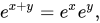
and is thus a homomorphism between these two groups. It is even an isomorphism (see below), as its inverse function, the natural logarithm, satisfies


02Examples
The real numbers are a ring, having both addition and multiplication. The set of all 2×2 matrices is also a ring, under matrix addition and matrix multiplication. If we define a function between these rings as follows:
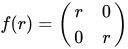
where r is a real number, then f is a homomorphism of rings, since f preserves both addition:

and multiplication:

For another example, the nonzero complex numbers form a group under the operation of multiplication, as do the nonzero real numbers. (Zero must be excluded from both groups since it does not have a multiplicative inverse, which is required for elements of a group.) Define a function

That is, 

Note that f cannot be extended to a homomorphism of rings (from the complex numbers to the real numbers), since it does not preserve addition:

As another example, the diagram shows a monoid homomorphism 



A composition algebra 

03Special homomorphisms
Several kinds of homomorphisms have a specific name, which is also defined for general morphisms.
Isomorphism
An isomorphism between algebraic structures of the same type is commonly defined as a bijective homomorphism.
In the more general context of category theory, an isomorphism is defined as a morphism that has an inverse that is also a morphism. In the specific case of algebraic structures, the two definitions are equivalent, although they may differ for non-algebraic structures, which have an underlying set.
More precisely, if
is a (homo)morphism, it has an inverse if there exists a homomorphism
such that

If 



Conversely, if 





and 
This proof does not work for non-algebraic structures. For example, for topological spaces, a morphism is a continuous map, and the inverse of a bijective continuous map is not necessarily continuous. An isomorphism of topological spaces, called homeomorphism or bicontinuous map, is thus a bijective continuous map, whose inverse is also continuous.
Endomorphism
An endomorphism is a homomorphism whose domain equals the codomain, or, more generally, a morphism whose source is equal to its target.
The endomorphisms of an algebraic structure, or of an object of a category, form a monoid under composition.
The endomorphisms of a vector space or of a module form a ring. In the case of a vector space or a free module of finite dimension, the choice of a basis induces a ring isomorphism between the ring of endomorphisms and the ring of square matrices of the same dimension.
Automorphism
An automorphism is an endomorphism that is also an isomorphism.
The automorphisms of an algebraic structure or of an object of a category form a group under composition, which is called the automorphism group of the structure.
Many groups that have received a name are automorphism groups of some algebraic structure. For example, the general linear group 

The automorphism groups of fields were introduced by Évariste Galois for studying the roots of polynomials, and are the basis of Galois theory.
Monomorphism
For algebraic structures, monomorphisms are commonly defined as injective homomorphisms.
In the more general context of category theory, a monomorphism is defined as a morphism that is left cancelable. This means that a (homo)morphism 

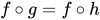

These two definitions of monomorphism are equivalent for all common algebraic structures. More precisely, they are equivalent for fields, for which every homomorphism is a monomorphism, and for varieties of universal algebra, that is algebraic structures for which operations and axioms (identities) are defined without any restriction (the fields do not form a variety, as the multiplicative inverse is defined either as a unary operation or as a property of the multiplication, which are, in both cases, defined only for nonzero elements).
In particular, the two definitions of a monomorphism are equivalent for sets, magmas, semigroups, monoids, groups, rings, fields, vector spaces and modules.
A split monomorphism is a homomorphism that has a left inverse and thus it is itself a right inverse of that other homomorphism. That is, a homomorphism 


| Proof of the equivalence of the two definitions of monomorphisms |
|---|
|
An injective homomorphism is left cancelable: If For proving that, conversely, a left cancelable homomorphism is injective, it is useful to consider a free object on If a free object over Existence of a free object on |
 one has
  for every
  , and thus
  of this variety and an element
  of the variety, and every element
  of
of  such that
  . For example, for sets, the free object on
  ; for
; for  which, as, a semigroup, is isomorphic to the additive semigroup of the positive integers; for
  which, as, a monoid, is isomorphic to the additive monoid of the nonnegative integers; for
  which, as, a group, is isomorphic to the additive group of the integers; for
 ![\mathbb {Z} [x];](https://wikimedia.org/api/rest_v1/media/math/render/svg/568ff090582d151fc35f9fc40684023ac3a4b75d) for
for  and
and  be two elements of
  and
and  . As
. As  . Therefore,
  of the
 Epimorphism
In algebra, epimorphisms are often defined as surjective homomorphisms. On the other hand, in category theory, epimorphisms are defined as right cancelable morphisms. This means that a (homo)morphism 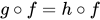
A surjective homomorphism is always right cancelable, but the converse is not always true for algebraic structures. However, the two definitions of epimorphism are equivalent for sets, vector spaces, abelian groups, modules (see below for a proof), and groups. The importance of these structures in all mathematics, especially in linear algebra and homological algebra, may explain the coexistence of two non-equivalent definitions.
Algebraic structures for which there exist non-surjective epimorphisms include semigroups and rings. The most basic example is the inclusion of integers into rational numbers, which is a homomorphism of rings and of multiplicative semigroups. For both structures it is a monomorphism and a non-surjective epimorphism, but not an isomorphism.
A wide generalization of this example is the localization of a ring by a multiplicative set. Every localization is a ring epimorphism, which is not, in general, surjective. As localizations are fundamental in commutative algebra and algebraic geometry, this may explain why in these areas, the definition of epimorphisms as right cancelable homomorphisms is generally preferred.
A split epimorphism is a homomorphism that has a right inverse and thus it is itself a left inverse of that other homomorphism. That is, a homomorphism 
In summary, one has

the last implication is an equivalence for sets, vector spaces, modules, abelian groups, and groups; the first implication is an equivalence for sets and vector spaces.
| Equivalence of the two definitions of epimorphism |
|---|
|
Let In the case of sets, let In the case of vector spaces, abelian groups and modules, the proof relies on the existence of cokernels and on the fact that the zero maps are homomorphisms: let |
 , and define
  such that
  for every
  except that
  is any other element of
  and
and 
 be the canonical map, such that
  . Let
. Let  be the zero map. If
  , and thus
 04Kernel
Any homomorphism 


![[x]\ast [y]=[x\ast y]](https://wikimedia.org/api/rest_v1/media/math/render/svg/8eae43c9e78efb8d7d20d28c28b73805f76b3f02)


When the algebraic structure is a group for some operation, the equivalence class 


05Relational structures
In model theory, the notion of an algebraic structure is generalized to structures involving both operations and relations. Let L be a signature consisting of function and relation symbols, and A, B be two L-structures. Then a homomorphism from A to B is a mapping h from the domain of A to the domain of B such that
- h(FA(a1,...,an)) = FB(h(a1),...,h(an)) for each n-ary function symbol F in L,
- RA(a1,...,an) implies RB(h(a1),...,h(an)) for each n-ary relation symbol R in L.
In the special case with just one binary relation, we obtain the notion of a graph homomorphism.
06Formal language theory
Homomorphisms are also used in the study of formal languages and are often briefly referred to as morphisms. Given alphabets 





A homomorphism 


The set 

Sources and credits
This article is adapted from the Wikipedia article “Homomorphism”, written by its contributors and licensed under CC BY-SA 4.0. Fathomly has changed the layout, removed citation markers, navigation and maintenance notices, and adjusted punctuation. This adapted version is shared under the same license. For references, see the original article.
Images, from Wikimedia Commons:
- Exponentiation as monoid homomorphism svg.svg by Jochen Burghardt, CC BY-SA 3.0
- Venn Diagram of Homomorphisms.jpg by AbelDrinkingCoffee, CC BY-SA 4.0
Fathomly is not affiliated with or endorsed by the Wikimedia Foundation. Spotted a problem? Tell us.
