Injective function
Function that preserves distinctness
In mathematics, an injective function (also known as injection, or one-to-one function) is a function f that maps distinct elements of its domain to distinct elements of its codomain; that is, x1 ≠ x2 implies f(x1) ≠ f(x2) (equivalently by contraposition, f(x1) = f(x2) implies x1 = x2). In other words, every element of the function's codomain is the image of at most one element of its domain. The term one-to-one function must not be confused with one-to-one correspondence that refers to bijective functions, which are functions such that each element in the codomain is an image of exactly one element in the domain.
A homomorphism between algebraic structures is a function that is compatible with the operations of the structures. For all common algebraic structures, and, in particular for vector spaces, an injective homomorphism is also called a monomorphism. However, in the more general context of category theory, the definition of a monomorphism differs from that of an injective homomorphism. This is thus a theorem that they are equivalent for algebraic structures; see Homomorphism § Monomorphism for more details.
A function 
01Definition
Let 


Symbolically,



02Examples
For visual examples, readers are directed to the gallery section.
- For any set
, the inclusion map
(which sends any element
to itself) is injective. In particular, the identity function
is always injective (and in fact bijective).
- If the domain of a function is the empty set, then the function is the empty function, which is injective.
- If the domain of a function has one element (that is, it is a singleton set), then the function is always injective.
- The function
defined by
is injective.
- The function
defined by
is not injective, because (for example)
However, if
is redefined so that its domain is the non-negative real numbers [0, +∞), then
- The exponential function
defined by
is injective (but not surjective, as no real value maps to a negative number).
- The natural logarithm function
defined by
is injective.
- The function
is not injective, since, for example,
.
More generally, when 

03Injections can be undone
Functions with left inverses are always injections. That is, given 


In this case, 

Conversely, every injection 
![f^{-1}[y]](https://wikimedia.org/api/rest_v1/media/math/render/svg/c5ffa43f26ddc0c27fedee54ea4051661d56fa21)
The left inverse 

04Injections may be made invertible
In fact, to turn an injective function 


More generally, injective partial functions are called partial bijections.

05Other properties
- If
- If
is injective, then
whenever
, then
. In other words, injective functions are precisely the monomorphisms in the category Set of sets.
- If
is a subset of
. Thus,
.
- If
are both subsets of
.
- Every function
can be decomposed as
for a suitable injection
of
as a subset of the codomain
- If
- If both
- An injective function which is a homomorphism between two algebraic structures is an embedding.
- Unlike surjectivity, which is a relation between the graph of a function and its codomain, injectivity is a property of the graph of the function alone; that is, whether a function
06Proving that functions are injective
A proof that a function 

Here is an example:
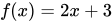
Proof: Let 

There are multiple other methods of proving that a function is injective. For example, in calculus if
A graphical approach for a real-valued function 

Sources and credits
This article is adapted from the Wikipedia article “Injective function”, written by its contributors and licensed under CC BY-SA 4.0. Fathomly has changed the layout, removed citation markers, navigation and maintenance notices, and adjusted punctuation. This adapted version is shared under the same license. For references, see the original article.
Images, from Wikimedia Commons:
- Injection.svg by Unknown author, Public domain
- Injective composition2.svg by Oleg Alexandrov, Public domain
Fathomly is not affiliated with or endorsed by the Wikimedia Foundation. Spotted a problem? Tell us.

