Directed set
Mathematical ordering with upper bounds
In mathematics, a directed set (or a directed preorder or a filtered set) is a preordered set in which every finite subset has an upper bound. In other words, it is a non-empty preordered set such that for any
and
in
there exists
in
with
and
. A directed set's preorder is called a direction.
The notion defined above is sometimes called an upward directed set. A downward directed set is defined symmetrically, meaning that every finite subset has a lower bound. Some authors (and this article) assume that a directed set is directed upward, unless otherwise stated. Other authors call a set directed if and only if it is directed both upward and downward.
Directed sets are a generalization of nonempty totally ordered sets. That is, all totally ordered sets are directed sets (contrast partially ordered sets, which need not be directed). Join-semilattices (which are partially ordered sets) are directed sets as well, but not conversely. Likewise, lattices are directed sets both upward and downward.
In topology, directed sets are used to define nets, which generalize sequences and unify the various notions of limit used in analysis. Directed sets also give rise to direct limits in abstract algebra and (more generally) category theory.
01Examples
The set of natural numbers with the ordinary order
is one of the most important examples of a directed set. Every totally ordered set is a directed set, including
and
A (trivial) example of a partially ordered set that is not directed is the set in which the only order relations are
and
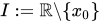
A less trivial example is like the following example of the "reals directed towards
" but in which the ordering rule only applies to pairs of elements on the same side of
(that is, if one takes an element
to the left of
and
to its right, then
and
are not comparable, and the subset
has no upper bound).
If an abstract rewriting system is confluent, then its transitive closure
is a directed set.
Product of directed sets
Let and
be directed sets. Then the Cartesian product set
can be made into a directed set by defining
if and only if
and
In analogy to the product order this is the product direction on the Cartesian product. For example, the set
of pairs of natural numbers can be made into a directed set by defining
if and only if
and
Directed towards a point
If is a real number then the set
can be turned into a directed set by defining
if
(so "greater" elements are closer to
). We then say that the reals have been directed towards
This is an example of a directed set that is neither partially ordered nor totally ordered. This is because antisymmetry breaks down for every pair
and
equidistant from
where
and
are on opposite sides of
Explicitly, this happens when
for some real
in which case
and
even though
Had this preorder been defined on
instead of
then it would still form a directed set but it would now have a (unique) greatest element, specifically
; however, it still wouldn't be partially ordered. This example can be generalized to a metric space
by defining on
or
the preorder
if and only if
Maximal and greatest elements
An element of a preordered set
is a maximal element if for every
implies
It is a greatest element if for every
Any preordered set with a greatest element is a directed set with the same preorder.
For instance, in a poset every lower closure of an element; that is, every subset of the form
where
is a fixed element from
is directed.
A preordered set is directed if and only if the (possibly empty) set of maximal elements is equal to the set of greatest elements.
Subset inclusion
The subset inclusion relation along with its dual
define partial orders on any given family of sets.
A non-empty family of sets is a directed set with respect to the partial order
(respectively,
) if and only if the intersection (respectively, union) of any two of its members contains as a subset (respectively, is contained as a subset of) some third member.
In symbols, a family
of sets is directed with respect to
(respectively,
) if and only if
- for all
there exists some
such that
and
(respectively,
and
)
or equivalently,
- for all
there exists some
such that
(respectively,
).
Many important examples of directed sets can be defined using these partial orders.
For example, by definition, a prefilter or filter base is a non-empty family of sets that is a directed set with respect to the partial order and that also does not contain the empty set (this condition prevents triviality because otherwise, the empty set would then be a greatest element with respect to
).
Every π-system, which is a non-empty family of sets that is closed under the intersection of any two of its members, is a directed set with respect to
Every λ-system is a directed set with respect to
Every filter, topology, and σ-algebra is a directed set with respect to both
and
Tails of nets
By definition, a net is a function from a directed set and a sequence is a function from the natural numbers Every sequence canonically becomes a net by endowing
with
If is any net from a directed set
then for any index
the set
is called the tail of
starting at
The family
of all tails is a directed set with respect to
in fact, it is even a prefilter.
Neighborhoods
If is a topological space and
is a point in
the set of all neighbourhoods of
can be turned into a directed set by writing
if and only if
contains
For every
and
:
since
contains itself.
- if
and
then
and
which implies
Thus
- because
and since both
and
we have
and
Finite subsets
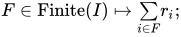
The set of all finite subsets of a set
is directed with respect to
since given any two
their union
is an upper bound of
and
in
This particular directed set is used to define the sum
of a generalized series of an
-indexed collection of numbers
(or more generally, the sum of elements in an abelian topological group, such as vectors in a topological vector space) as the limit of the net of partial sums
that is:
Logic
Let be a formal theory, which is a set of sentences with certain properties (details of which can be found in the article on the subject). For instance,
could be a first-order theory (like Zermelo-Fraenkel set theory) or a simpler zeroth-order theory. The preordered set
is a directed set because if
and if
denotes the sentence formed by logical conjunction
then
and
where
If
is the Lindenbaum-Tarski algebra associated with
then
is a partially ordered set that is also a directed set.

02Contrast with semilattices
Directed set is a more general concept than (join) semilattice: every join semilattice is a directed set, as the join or least upper bound of two elements is the desired The converse does not hold however, witness the directed set {1000,0001,1101,1011,1111} ordered bitwise (e.g.
holds, but
does not, since in the last bit 1 > 0), where {1000,0001} has three upper bounds but no least upper bound, cf. picture. (Also note that without 1111, the set is not directed.)
03Directed subsets
The order relation in a directed set is not required to be antisymmetric, and therefore directed sets are not always partial orders. However, the term directed set is also used frequently in the context of posets. In this setting, a subset of a partially ordered set
is called a directed subset if it is a directed set according to the same partial order: in other words, it is not the empty set, and every pair of elements has an upper bound. Here the order relation on the elements of
is inherited from
; for this reason, reflexivity and transitivity need not be required explicitly.
A directed subset of a poset is not required to be downward closed; a subset of a poset is directed if and only if its downward closure is an ideal. While the definition of a directed set is for an "upward-directed" set (every pair of elements has an upper bound), it is also possible to define a downward-directed set in which every pair of elements has a common lower bound. A subset of a poset is downward-directed if and only if its upper closure is a filter.
Directed subsets are used in domain theory, which studies directed-complete partial orders. These are posets in which every upward-directed set is required to have a least upper bound. In this context, directed subsets again provide a generalization of convergent sequences.
Sources and credits
This article is adapted from the Wikipedia article “Directed set”, written by its contributors and licensed under CC BY-SA 4.0. Fathomly has changed the layout, removed citation markers, navigation and maintenance notices, and adjusted punctuation. This adapted version is shared under the same license. For references, see the original article.
Images, from Wikimedia Commons:
- Directed set, but no join semi-lattice.png by Jochen Burghardt, CC BY-SA 3.0
Fathomly is not affiliated with or endorsed by the Wikimedia Foundation. Spotted a problem? Tell us.