Preorder
Reflexive and transitive binary relation

In mathematics, in particular in order theory, a preorder or quasiorder is a binary relation that is reflexive and transitive. The name preorder is meant to suggest that preorders are almost partial orders, but not quite, as they are not necessarily antisymmetric.
A natural example of a preorder is the divides relation "x divides y" between integers. This relation is reflexive as every integer divides itself. It is also transitive. But it is not antisymmetric, because e.g. 


Preorders are closely related to equivalence relations and (non-strict) partial orders. Both of these are special cases of a preorder: an antisymmetric preorder is a partial order, and a symmetric preorder is an equivalence relation. Moreover, a preorder on a set 
A preorder can be visualized as a directed graph, with elements of the set corresponding to vertices, and the order relation between pairs of elements corresponding to the directed edges between vertices. The converse is not true: most directed graphs are neither reflexive nor transitive. A preorder that is antisymmetric no longer has cycles; it is a partial order, and corresponds to a directed acyclic graph. A preorder that is symmetric is an equivalence relation; it can be thought of as having lost the direction markers on the edges of the graph. In general, a preorder's corresponding directed graph may have many disconnected components.
A preorder is often denoted 

01Definition
A binary relation
- Reflexivity:
for all
and
- Transitivity: if
for all

A set that is equipped with a preorder is called a preordered set (or proset).
02Preorders as partial orders on partitions
Given a preorder 

Using this relation, it is possible to construct a partial order on the quotient set 
![[x]\leq [y]](https://wikimedia.org/api/rest_v1/media/math/render/svg/a78f45c685464633e52a4ca73a1bbc7e7f0ca480)


Conversely, from any partial order on a partition of a set 
Example: Let 


![[p]=\{q\mid p\Leftrightarrow q\}](https://wikimedia.org/api/rest_v1/media/math/render/svg/01d86ca1595dd2c9654c220a8cf2f20dc0b25a22)


03Relationship to strict partial orders
If reflexivity is replaced with irreflexivity (while keeping transitivity) then we get the definition of a strict partial order on 
- Irreflexivity or anti-reflexivity: not
for all
that is,
is false for all
- Transitivity: if
for all
Strict partial order induced by a preorder
Any preorder 











Preorders induced by a strict partial order
Using the construction above, multiple non-strict preorders can produce the same strict preorder 

- Define
(that is, take the reflexive closure of the relation). This gives the partial order associated with the strict partial order "
" through reflexive closure; in this case the equivalence is equality
so the symbols
- Define
" (that is, take the inverse complement of the relation), which corresponds to defining
"; these relations
If 


04Examples
Graph theory
- The reachability relationship in any directed graph (possibly containing cycles) gives rise to a preorder, where
in the preorder if and only if there is a path from x to y in the directed graph. Conversely, every preorder is the reachability relationship of a directed graph (for instance, the graph that has an edge from x to y for every pair (x, y) with
- The graph-minor relation is also a preorder.
Computer science
In computer science, one can find examples of the following preorders.
- Asymptotic order causes a preorder over functions
. The corresponding equivalence relation is called asymptotic equivalence.
- Polynomial-time, many-one (mapping) and Turing reductions are preorders on complexity classes.
- Subtyping relations are usually preorders.
- Simulation preorders are preorders (hence the name).
- Reduction relations in abstract rewriting systems.
- The encompassment preorder on the set of terms, defined by
if a subterm of t is a substitution instance of s.
- Theta-subsumption, which is when the literals in a disjunctive first-order formula are contained by another, after applying a substitution to the former.
Category theory
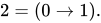
- A category with at most one morphism from any object x to any other object y is a preorder. Such categories are called thin. Here the objects correspond to the elements of
- Alternately, a preordered set can be understood as an enriched category, enriched over the category
Other
Further examples:
- Every finite topological space gives rise to a preorder on its points by defining
- A net is a directed preorder, that is, each pair of elements has an upper bound. The definition of convergence via nets is important in topology, where preorders cannot be replaced by partially ordered sets without losing important features.
- The relation defined by
where f is a function into some preorder.
- The relation defined by
- The embedding relation for countable total orderings.
Example of a total preorder:
- Preference, according to common models.
05Constructions
Every binary relation 


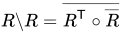
Left residual preorder induced by a binary relation
Given a binary relation 


06Related definitions
If a preorder is also antisymmetric, that is, 
On the other hand, if it is symmetric, that is, if 
A preorder is total if

A preordered class is a class equipped with a preorder. Every set is a class and so every preordered set is a preordered class.
07Uses
Preorders play a pivotal role in several situations:
- Every preorder can be given a topology, the Alexandrov topology; and indeed, every preorder on a set is in one-to-one correspondence with an Alexandrov topology on that set.
- Preorders may be used to define interior algebras.
- Preorders provide the Kripke semantics for certain types of modal logic.
- Preorders are used in forcing in set theory to prove consistency and independence results.
08Number of preorders
| Elements | Any | Transitive | Reflexive | Symmetric | Preorder | Partial order | Total preorder | Total order | Equivalence relation |
|---|---|---|---|---|---|---|---|---|---|
| 0 | 1 | 1 | 1 | 1 | 1 | 1 | 1 | 1 | 1 |
| 1 | 2 | 2 | 1 | 2 | 1 | 1 | 1 | 1 | 1 |
| 2 | 16 | 13 | 4 | 8 | 4 | 3 | 3 | 2 | 2 |
| 3 | 512 | 171 | 64 | 64 | 29 | 19 | 13 | 6 | 5 |
| 4 | 65,536 | 3,994 | 4,096 | 1,024 | 355 | 219 | 75 | 24 | 15 |
| n | 2n2 | 2n(n−1) | 2n(n+1)/2 | ∑n k=0 k!S(n, k) |
n! | ∑n k=0 S(n, k) | |||
| OEIS | A002416 | A006905 | A053763 | A006125 | A000798 | A001035 | A000670 | A000142 | A000110 |
Note that S(n, k) refers to Stirling numbers of the second kind.
As explained above, there is a 1-to-1 correspondence between preorders and pairs (partition, partial order). Thus the number of preorders is the sum of the number of partial orders on every partition. For example:
- for
- 1 partition of 3, giving 1 preorder
- 3 partitions of 2 + 1, giving
preorders
- 1 partition of 1 + 1 + 1, giving 19 preorders
- for
- 1 partition of 4, giving 1 preorder
- 7 partitions with two classes (4 of 3 + 1 and 3 of 2 + 2), giving
preorders
- 6 partitions of 2 + 1 + 1, giving
preorders
- 1 partition of 1 + 1 + 1 + 1, giving 219 preorders


09Interval
For 
![[a,b]](https://wikimedia.org/api/rest_v1/media/math/render/svg/9c4b788fc5c637e26ee98b45f89a5c08c85f7935)


Using the corresponding strict relation "


Also 
![(a,b]](https://wikimedia.org/api/rest_v1/media/math/render/svg/6a6969e731af335df071e247ee7fb331cd1a57ae)
Sources and credits
This article is adapted from the Wikipedia article “Preorder”, written by its contributors and licensed under CC BY-SA 4.0. Fathomly has changed the layout, removed citation markers, navigation and maintenance notices, and adjusted punctuation. This adapted version is shared under the same license. For references, see the original article.
Images, from Wikimedia Commons:
- Preorder.png by Caleb Stanford, CC0
Fathomly is not affiliated with or endorsed by the Wikimedia Foundation. Spotted a problem? Tell us.

