Composition of relations
Mathematical operation

In the mathematics of binary relations, the composition of relations is the forming of a new binary relation from two given binary relations
and
. In the calculus of relations, the composition of relations is called relative multiplication, and its result is called a relative product. Function composition is the special case of composition of relations where all relations involved are functions.
The word uncle indicates a compound relation: for a person to be an uncle, he must be the brother of a parent. In algebraic logic it is said that the relation "is uncle of" () is the composition of relations "is a brother of" (
) and "is a parent of" (
).
Beginning with Augustus De Morgan, the traditional form of reasoning by syllogism has been subsumed by relational logical expressions and their composition.
01Definition
If and
are two binary relations, then
their composition
is the relation
In other words, is defined by the rule that says
if and only if there is an element
such that
(that is,
and
).
Notational variations
The semicolon as an infix notation for composition of relations dates back to Ernst Schröder's textbook of 1895. Gunther Schmidt has renewed the use of the semicolon, particularly in Relational Mathematics (2011). The use of the semicolon coincides with the notation for function composition used (mostly by computer scientists) in category theory, as well as the notation for dynamic conjunction within linguistic dynamic semantics.
A small circle has been used for the infix notation of composition of relations by John M. Howie in his books considering semigroups of relations. However, the small circle is widely used to represent composition of functions
, which reverses the text sequence from the operation sequence. The small circle was used in the introductory pages of Graphs and Relations until it was dropped in favor of juxtaposition (no infix notation). Juxtaposition
is commonly used in algebra to signify multiplication, so too, it can signify relative multiplication.
Further with the circle notation, subscripts may be used. Some authors prefer to write and
explicitly when necessary, depending whether the left or the right relation is the first one applied. A further variation encountered in computer science is the Z notation:
is used to denote the traditional (right) composition, while left composition is denoted by a fat semicolon. The unicode symbols are ⨾ and ⨟.
Mathematical generalizations
Binary relations are morphisms
in the category of relations
. Its objects are sets, its morphisms are binary relations and the composition of morphisms is exactly composition of relations as defined above. The category of sets
of sets and functions is a subcategory of
where the maps
are functions
.
Given a regular category , its category of internal relations
has the same objects as
, but now the morphisms
are given by subobjects
in
. Formally, these are jointly monic spans between
and
. Categories of internal relations are allegories. In particular
. Given a field
(or more generally a principal ideal domain), the category of relations internal to matrices over
,
has morphisms
the linear subspaces
. The category of linear relations over the finite field
is isomorphic to the phase-free qubit ZX-calculus modulo scalars.
02Properties
- Composition of relations is associative:
- The converse relation of
is
This property makes the set of all binary relations on a set a semigroup with involution.
- The composition of (partial) functions (that is, functional relations) is again a (partial) function.
- If
and
are injective, then
is injective, which conversely together with the requirement that
is also left total on
implies the injectivity of only
- If
and
are surjective, then
is surjective, which conversely implies the surjectivity of only
- The set of binary relations on a set

(that is, relations from
to
) together with (left or right) relation composition forms a monoid with zero, where the identity map on
is the neutral element, and the empty set is the zero element.
03Composition in terms of matrices
Finite binary relations are represented by logical matrices. The entries of these matrices are either zero or one, depending on whether the relation represented is false or true for the row and column corresponding to compared objects. Working with such matrices involves the Boolean arithmetic with and
An entry in the matrix product of two logical matrices will be
, then, only if the row and column multiplied have a corresponding
. Thus the logical matrix of a composition of relations can be found by computing the matrix product of the matrices representing the factors of the composition. "Matrices constitute a method for computing the conclusions traditionally drawn by means of hypothetical syllogisms and sorites."
04Heterogeneous relations
Consider a heterogeneous relation , that is, where
and
may be distinct sets. Then using composition of relation
with its converse
there are homogeneous relations
(on
) and
(on
).
If for all there exists some
such that
(that is,
is a (left-)total relation), then for all
,
so that
is a reflexive relation or
where I is the identity relation
Similarly, if
is a surjective relation then
In this case
The opposite inclusion occurs for a difunctional relation.
The composition is used to distinguish relations of Ferrer's type, which satisfy
Example
Let { France, Germany, Italy, Switzerland } and
{ French, German, Italian } with the relation
given by
when
is a national language of
Since both
and
is finite,
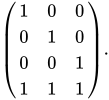
can be represented by a logical matrix, assuming rows (top to bottom) and columns (left to right) are ordered alphabetically:
The converse relation corresponds to the transposed matrix, and the relation composition
corresponds to the matrix product
when summation is implemented by logical disjunction. It turns out that the
matrix
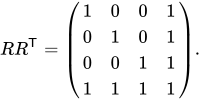
contains a 1 at every position, while the reversed matrix product computes as:
This matrix is symmetric, and represents a homogeneous relation on
Correspondingly, is the universal relation on
hence any two languages share a nation where they both are spoken (in fact: Switzerland).
Vice versa, the question whether two given nations share a language can be answered using
05Schröder rules
For a given set the collection of all binary relations on

forms a Boolean lattice ordered by inclusion
Recall that complementation reverses inclusion:
In the calculus of relations it is common to represent the complement of a set by an overbar:
If is a binary relation, let
represent the converse relation, also called the transpose. Then the Schröder rules are
Verbally, one equivalence can be obtained from another: select the first or second factor and transpose it; then complement the other two relations and permute them.
Though this transformation of an inclusion of a composition of relations was detailed by Ernst Schröder, in fact Augustus De Morgan first articulated the transformation as Theorem K in 1860. He wrote
With Schröder rules and complementation one can solve for an unknown relation in relation inclusions such as
For instance, by Schröder rule
and complementation gives
which is called the left residual of
by
.
06Quotients
Just as composition of relations is a type of multiplication resulting in a product, so some operations compare to division and produce quotients. Three quotients are exhibited here: left residual, right residual, and symmetric quotient. The left residual of two relations is defined presuming that they have the same domain (source), and the right residual presumes the same codomain (range, target). The symmetric quotient presumes two relations share a domain and a codomain.
Definitions:
- Left residual:
- Right residual:
- Symmetric quotient:
Using Schröder's rules, is equivalent to
Thus the left residual is the greatest relation satisfying
Similarly, the inclusion
is equivalent to
and the right residual is the greatest relation satisfying
One can practice the logic of residuals with Sudoku.
07Join: another form of composition
A fork operator has been introduced to fuse two relations
and
into
The construction depends on projections
and
understood as relations, meaning that there are converse relations
and
Then the fork of
and
is given by
Another form of composition of relations, which applies to general -place relations for
is the join operation of relational algebra. The usual composition of two binary relations as defined here can be obtained by taking their join, leading to a ternary relation, followed by a projection that removes the middle component. For example, in the query language SQL there is the operation join (SQL).
Sources and credits
This article is adapted from the Wikipedia article “Composition of relations”, written by its contributors and licensed under CC BY-SA 4.0. Fathomly has changed the layout, removed citation markers, navigation and maintenance notices, and adjusted punctuation. This adapted version is shared under the same license. For references, see the original article.
Images, from Wikimedia Commons:
- Relcomp ---- ---- ---1.gif by Jochen Burghardt, CC0
Fathomly is not affiliated with or endorsed by the Wikimedia Foundation. Spotted a problem? Tell us.