Reference articles on history, science, culture and more
Encyclopedia

Balanced set

Construct in functional analysis

In linear algebra and related areas of mathematics a balanced set, circled set or disk in a vector space (over a field \mathbb {K} with an absolute value function |\cdot |) is a set S such that aS\subseteq S for all scalars a satisfying |a|\leq 1.

The balanced hull or balanced envelope of a set S is the smallest balanced set containing S. The balanced core of a set S is the largest balanced set contained in S.

Balanced sets are ubiquitous in functional analysis because every neighborhood of the origin in every topological vector space (TVS) contains a balanced neighborhood of the origin and every convex neighborhood of the origin contains a balanced convex neighborhood of the origin (even if the TVS is not locally convex). This neighborhood can also be chosen to be an open set or, alternatively, a closed set.

01Definition

Let X be a vector space over the field \mathbb {K} of real or complex numbers.

Notation

If S is a set, a is a scalar, and B\subseteq \mathbb {K} then let aS=\{as:s\in S\} and BS=\{bs:b\in B,s\in S\} and for any 0\leq r\leq \infty , let B_{r}=\{a\in \mathbb {K} :|a|<r\}\qquad {\text{ and }}\qquad B_{\leq r}=\{a\in \mathbb {K} :|a|\leq r\}. denote, respectively, the open ball and the closed ball of radius r in the scalar field \mathbb {K} centered at 0 where B_{0}=\varnothing ,B_{\leq 0}=\{0\}, and B_{\infty }=B_{\leq \infty }=\mathbb {K} . Every balanced subset of the field \mathbb {K} is of the form B_{\leq r} or B_{r} for some 0\leq r\leq \infty .

Balanced set

A subset S of X is called a balanced set or balanced if it satisfies any of the following equivalent conditions:

  1. Definition: as\in S for all s\in S and all scalars a satisfying |a|\leq 1.
  2. aS\subseteq S for all scalars a satisfying |a|\leq 1.
  3. B_{\leq 1}S\subseteq S (where B_{\leq 1}:=\{a\in \mathbb {K} :|a|\leq 1\}).
  4. S=B_{\leq 1}S.
  5. For every s\in S, S\cap \mathbb {K} s=B_{\leq 1}(S\cap \mathbb {K} s).
    • \mathbb {K} s=\operatorname {span} \{s\} is a 0 (if s=0) or 1 (if s\neq 0) dimensional vector subspace of X.
    • If R:=S\cap \mathbb {K} s then the above equality becomes R=B_{\leq 1}R, which is exactly the previous condition for a set to be balanced. Thus, S is balanced if and only if for every s\in S, S\cap \mathbb {K} s is a balanced set (according to any of the previous defining conditions).
  6. For every 1-dimensional vector subspace Y of \operatorname {span} S, S\cap Y is a balanced set (according to any defining condition other than this one).
  7. For every s\in S, there exists some 0\leq r\leq \infty such that S\cap \mathbb {K} s=B_{r}s or S\cap \mathbb {K} s=B_{\leq r}s.
  8. S is a balanced subset of \operatorname {span} S (according to any defining condition of "balanced" other than this one).
    • Thus S is a balanced subset of X if and only if it is balanced subset of every (equivalently, of some) vector space over the field \mathbb {K} that contains S. So assuming that the field \mathbb {K} is clear from context, this justifies writing "S is balanced" without mentioning any vector space.

If S is a convex set then this list may be extended to include:

  1. aS\subseteq S for all scalars a satisfying |a|=1.

If \mathbb {K} =\mathbb {R} then this list may be extended to include:

  1. S is symmetric (meaning -S=S) and [0,1)S\subseteq S.

Balanced hull

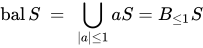
\operatorname {bal} S~=~\bigcup _{|a|\leq 1}aS=B_{\leq 1}S

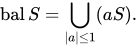
The balanced hull of a subset S of X, denoted by \operatorname {bal} S, is defined in any of the following equivalent ways:

  1. Definition: \operatorname {bal} S is the smallest (with respect to \,\subseteq \,) balanced subset of X containing S.
  2. \operatorname {bal} S is the intersection of all balanced sets containing S.
  3. \operatorname {bal} S=\bigcup _{|a|\leq 1}(aS).
  4. \operatorname {bal} S=B_{\leq 1}S.

Balanced core

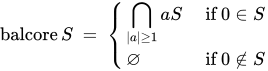
\operatorname {balcore} S~=~{\begin{cases}\displaystyle \bigcap _{|a|\geq 1}aS&{\text{ if }}0\in S\\\varnothing &{\text{ if }}0\not \in S\\\end{cases}}

The balanced core of a subset S of X, denoted by \operatorname {balcore} S, is defined in any of the following equivalent ways:

  1. Definition: \operatorname {balcore} S is the largest (with respect to \,\subseteq \,) balanced subset of S.
  2. \operatorname {balcore} S is the union of all balanced subsets of S.
  3. \operatorname {balcore} S=\varnothing if 0\not \in S while \operatorname {balcore} S=\bigcap _{|a|\geq 1}(aS) if 0\in S.

02Examples

The empty set is a balanced set. As is any vector subspace of any (real or complex) vector space. In particular, \{0\} is always a balanced set.

Any non-empty set that does not contain the origin is not balanced and furthermore, the balanced core of such a set will equal the empty set.

Normed and topological vector spaces

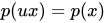
The open and closed balls centered at the origin in a normed vector space are balanced sets. If p is a seminorm (or norm) on a vector space X then for any constant c>0, the set \{x\in X:p(x)\leq c\} is balanced.

If S\subseteq X is any subset and B_{1}:=\{a\in \mathbb {K} :|a|<1\} then B_{1}S is a balanced set. In particular, if U\subseteq X is any balanced neighborhood of the origin in a topological vector space X then \operatorname {Int} _{X}U~\subseteq ~B_{1}U~=~\bigcup _{0<|a|<1}aU~\subseteq ~U.

Balanced sets in \mathbb {R} and \mathbb {C}

Let \mathbb {K} be the field real numbers \mathbb {R} or complex numbers \mathbb {C} , let |\cdot | denote the absolute value on \mathbb {K} , and let X:=\mathbb {K} denotes the vector space over \mathbb {K} . So for example, if \mathbb {K} :=\mathbb {C} is the field of complex numbers then X=\mathbb {K} =\mathbb {C} is a 1-dimensional complex vector space whereas if \mathbb {K} :=\mathbb {R} then X=\mathbb {K} =\mathbb {R} is a 1-dimensional real vector space.

The balanced subsets of X=\mathbb {K} are exactly the following:

  1. \varnothing
  2. X
  3. \{0\}
  4. \{x\in X:|x|<r\} for some real r>0
  5. \{x\in X:|x|\leq r\} for some real r>0.

Consequently, both the balanced core and the balanced hull of every set of scalars is equal to one of the sets listed above.

The balanced sets are \mathbb {C} itself, the empty set and the open and closed discs centered at zero. Contrariwise, in the two dimensional Euclidean space there are many more balanced sets: any line segment with midpoint at the origin will do. As a result, \mathbb {C} and \mathbb {R} ^{2} are entirely different as far as scalar multiplication is concerned.

Balanced sets in \mathbb {R} ^{2}

Throughout, let X=\mathbb {R} ^{2} (so X is a vector space over \mathbb {R}) and let B_{\leq 1} is the closed unit ball in X centered at the origin.

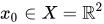
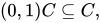
If x_{0}\in X=\mathbb {R} ^{2} is non-zero, and L:=\mathbb {R} x_{0}, then the set R:=B_{\leq 1}\cup L is a closed, symmetric, and balanced neighborhood of the origin in X. More generally, if C is any closed subset of X such that (0,1)C\subseteq C, then S:=B_{\leq 1}\cup C\cup (-C) is a closed, symmetric, and balanced neighborhood of the origin in X. This example can be generalized to \mathbb {R} ^{n} for any integer n\geq 1.

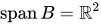
Let B\subseteq \mathbb {R} ^{2} be the union of the line segment between the points (-1,0) and (1,0) and the line segment between (0,-1) and (0,1). Then B is balanced but not convex. Nor is B is absorbing (despite the fact that \operatorname {span} B=\mathbb {R} ^{2} is the entire vector space).

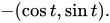
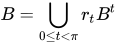
For every 0\leq t\leq \pi , let r_{t} be any positive real number and let B^{t} be the (open or closed) line segment in X:=\mathbb {R} ^{2} between the points (\cos t,\sin t) and -(\cos t,\sin t). Then the set B=\bigcup _{0\leq t<\pi }r_{t}B^{t} is a balanced and absorbing set but it is not necessarily convex.

The balanced hull of a closed set need not be closed. Take for instance the graph of xy=1 in X=\mathbb {R} ^{2}.

The next example shows that the balanced hull of a convex set may fail to be convex (however, the convex hull of a balanced set is always balanced). For an example, let the convex subset be S:=[-1,1]\times \{1\}, which is a horizontal closed line segment lying above the x-axis in X:=\mathbb {R} ^{2}. The balanced hull \operatorname {bal} S is a non-convex subset that is "hour glass shaped" and equal to the union of two closed and filled isosceles triangles T_{1} and T_{2}, where T_{2}=-T_{1} and T_{1} is the filled triangle whose vertices are the origin together with the endpoints of S (said differently, T_{1} is the convex hull of S\cup \{(0,0)\} while T_{2} is the convex hull of (-S)\cup \{(0,0)\}).

Sufficient conditions


A set T is balanced if and only if it is equal to its balanced hull \operatorname {bal} T or to its balanced core \operatorname {balcore} T, in which case all three of these sets are equal: T=\operatorname {bal} T=\operatorname {balcore} T.

The Cartesian product of a family of balanced sets is balanced in the product space of the corresponding vector spaces (over the same field \mathbb {K}).

  • The balanced hull of a compact (respectively, totally bounded, bounded) set has the same property.
  • The convex hull of a balanced set is convex and balanced (that is, it is absolutely convex). However, the balanced hull of a convex set may fail to be convex (a counter-example is given above).
  • Arbitrary unions of balanced sets are balanced, and the same is true of arbitrary intersections of balanced sets.
  • Scalar multiples and (finite) Minkowski sums of balanced sets are again balanced.
  • Images and preimages of balanced sets under linear maps are again balanced. Explicitly, if L:X\to Y is a linear map and B\subseteq X and C\subseteq Y are balanced sets, then L(B) and L^{-1}(C) are balanced sets.

Balanced neighborhoods

In any topological vector space, the closure of a balanced set is balanced. The union of the origin \{0\} and the topological interior of a balanced set is balanced. Therefore, the topological interior of a balanced neighborhood of the origin is balanced. However, \left\{(z,w)\in \mathbb {C} ^{2}:|z|\leq |w|\right\} is a balanced subset of X=\mathbb {C} ^{2} that contains the origin (0,0)\in X but whose (nonempty) topological interior does not contain the origin and is therefore not a balanced set. Similarly for real vector spaces, if T denotes the convex hull of (0,0) and (\pm 1,1) (a filled triangle whose vertices are these three points) then B:=T\cup (-T) is an (hour glass shaped) balanced subset of X:=\mathbb {R} ^{2} whose non-empty topological interior does not contain the origin and so is not a balanced set (and although the set \{(0,0)\}\cup \operatorname {Int} _{X}B formed by adding the origin is balanced, it is neither an open set nor a neighborhood of the origin).

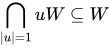
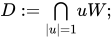
Every neighborhood (respectively, convex neighborhood) of the origin in a topological vector space X contains a balanced (respectively, convex and balanced) open neighborhood of the origin. In fact, the following construction produces such balanced sets. Given W\subseteq X, the symmetric set \bigcap _{|u|=1}uW\subseteq W will be convex (respectively, closed, balanced, bounded, a neighborhood of the origin, an absorbing subset of X) whenever this is true of W. It will be a balanced set if W is a star shaped at the origin, which is true, for instance, when W is convex and contains 0. In particular, if W is a convex neighborhood of the origin then \bigcap _{|u|=1}uW will be a balanced convex neighborhood of the origin and so its topological interior will be a balanced convex open neighborhood of the origin.

Proof

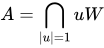
Let 0\in W\subseteq X and define A=\bigcap _{|u|=1}uW (where u denotes elements of the field \mathbb {K} of scalars). Taking u:=1 shows that A\subseteq W. If W is convex then so is A (since an intersection of convex sets is convex) and thus so is A's interior. If |s|=1 then sA=\bigcap _{|u|=1}suW\subseteq \bigcap _{|u|=1}uW=A and thus sA=A. If W is star shaped at the origin then so is every uW (for |u|=1), which implies that for any 0\leq r\leq 1, rA=\bigcap _{|u|=1}ruW\subseteq \bigcap _{|u|=1}uW=A thus proving that A is balanced. If W is convex and contains the origin then it is star shaped at the origin and so A will be balanced.

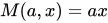
Now suppose W is a neighborhood of the origin in X. Since scalar multiplication M:\mathbb {K} \times X\to X (defined by M(a,x)=ax) is continuous at the origin (0,0)\in \mathbb {K} \times X and M(0,0)=0\in W, there exists some basic open neighborhood B_{r}\times V (where r>0 and B_{r}:=\{c\in \mathbb {K} :|c|<r\}) of the origin in the product topology on \mathbb {K} \times X such that M\left(B_{r}\times V\right)\subseteq W; the set M\left(B_{r}\times V\right)=B_{r}V is balanced and it is also open because it may be written as B_{r}V=\bigcup _{|a|<r}aV=\bigcup _{0<|a|<r}aV\qquad {\text{ (since }}0\cdot V=\{0\}\subseteq aV{\text{ )}} where aV is an open neighborhood of the origin whenever a\neq 0. Finally, A=\bigcap _{|u|=1}uW\supseteq \bigcap _{|u|=1}uB_{r}V=\bigcap _{|u|=1}B_{r}V=B_{r}V shows that A is also a neighborhood of the origin. If A is balanced then because its interior \operatorname {Int} _{X}A contains the origin, \operatorname {Int} _{X}A will also be balanced. If W is convex then A is convex and balanced and thus the same is true of \operatorname {Int} _{X}A. \blacksquare

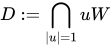
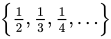
Suppose that W is a convex and absorbing subset of X. Then D:=\bigcap _{|u|=1}uW will be convex balanced absorbing subset of X, which guarantees that the Minkowski functional p_{D}:X\to \mathbb {R} of D will be a seminorm on X, thereby making \left(X,p_{D}\right) into a seminormed space that carries its canonical pseduometrizable topology. The set of scalar multiples rD as r ranges over \left\{{\tfrac {1}{2}},{\tfrac {1}{3}},{\tfrac {1}{4}},\ldots \right\} (or over any other set of non-zero scalars having 0 as a limit point) forms a neighborhood basis of absorbing disks at the origin for this locally convex topology. If X is a topological vector space and if this convex absorbing subset W is also a bounded subset of X, then the same will be true of the absorbing disk D:={\textstyle \bigcap \limits _{|u|=1}}uW; if in addition D does not contain any non-trivial vector subspace then p_{D} will be a norm and \left(X,p_{D}\right) will form what is known as an auxiliary normed space. If this normed space is a Banach space then D is called a Banach disk.

03Properties

Properties of balanced sets

A balanced set is not empty if and only if it contains the origin. By definition, a set is absolutely convex if and only if it is convex and balanced. Every balanced set is star-shaped (at 0) and a symmetric set. If B is a balanced subset of X then:

  • for any scalars c and d, if |c|\leq |d| then cB\subseteq dB and cB=|c|B. Thus if c and d are any scalars then (cB)\cap (dB)=\min _{}\{|c|,|d|\}B.
  • B is absorbing in X if and only if for all x\in X, there exists r>0 such that x\in rB.
  • for any 1-dimensional vector subspace Y of X, the set B\cap Y is convex and balanced. If B is not empty and if Y is a 1-dimensional vector subspace of \operatorname {span} B then B\cap Y is either \{0\} or else it is absorbing in Y.
  • for any x\in X, if B\cap \operatorname {span} x contains more than one point then it is a convex and balanced neighborhood of 0 in the 1-dimensional vector space \operatorname {span} x when this space is endowed with the Hausdorff Euclidean topology; and the set B\cap \mathbb {R} x is a convex balanced subset of the real vector space \mathbb {R} x that contains the origin.

Properties of balanced hulls and balanced cores

For any collection {\mathcal {S}} of subsets of X, \operatorname {bal} \left(\bigcup _{S\in {\mathcal {S}}}S\right)=\bigcup _{S\in {\mathcal {S}}}\operatorname {bal} S\quad {\text{ and }}\quad \operatorname {balcore} \left(\bigcap _{S\in {\mathcal {S}}}S\right)=\bigcap _{S\in {\mathcal {S}}}\operatorname {balcore} S.

In any topological vector space, the balanced hull of any open neighborhood of the origin is again open. If X is a Hausdorff topological vector space and if K is a compact subset of X then the balanced hull of K is compact.

If a set is closed (respectively, convex, absorbing, a neighborhood of the origin) then the same is true of its balanced core.

For any subset S\subseteq X and any scalar c, \operatorname {bal} (c\,S)=c\operatorname {bal} S=|c|\operatorname {bal} S.

For any scalar c\neq 0, \operatorname {balcore} (c\,S)=c\operatorname {balcore} S=|c|\operatorname {balcore} S. This equality holds for c=0 if and only if S\subseteq \{0\}. Thus if 0\in S or S=\varnothing then \operatorname {balcore} (c\,S)=c\operatorname {balcore} S=|c|\operatorname {balcore} S for every scalar c.

Watch videos about Balanced setExplainers and documentaries on YouTube (opens in a new tab)

Sources and credits

This article is adapted from the Wikipedia article Balanced set, written by its contributors and licensed under CC BY-SA 4.0. Fathomly has changed the layout, removed citation markers, navigation and maintenance notices, and adjusted punctuation. This adapted version is shared under the same license. For references, see the original article.

Fathomly is not affiliated with or endorsed by the Wikimedia Foundation. Spotted a problem? Tell us.