Bounded operator
Kind of linear transformation
In functional analysis and operator theory, a bounded linear operator is a special kind of linear transformation that is particularly important in infinite dimensions. In finite dimensions, a linear transformation takes a bounded set to another bounded set (for example, a rectangle in the plane goes either to a parallelogram or bounded line segment when a linear transformation is applied). However, in infinite dimensions, linearity is not enough to ensure that bounded sets remain bounded: a bounded linear operator is thus a linear transformation that sends bounded sets to bounded sets.
Formally, it is a linear transformation 





The concept of a bounded linear operator has been extended from normed spaces to all topological vector spaces.
Outside of functional analysis, when a function 


01In normed vector spaces
Every bounded operator is Lipschitz continuous at
Equivalence of boundedness and continuity
A linear operator between normed spaces is bounded if and only if it is continuous.
ProofSuppose that 




Conversely, it follows from the continuity at the zero vector that there exists a 



Relative boundedness
Given two partially defined linear operators 


02In Hilbert spaces
Since Hilbert spaces are complete normed spaces with the norm induced by the inner product, the previous applies here as well. Notably, the space of bounded linear operators 
For example, T is called power bounded if 
Another boundedness condition is that of polynomial boundedness: an operator T on L(H) is polynomially bounded if there exists a positive constant 


Furthermore, an operator 


Positive examples of completely polynomially bounded operators are contractive operators T, namely those for which
03In topological vector spaces
A linear operator 


Continuity and boundedness
Every sequentially continuous linear operator between TVS is a bounded operator. This implies that every continuous linear operator between metrizable TVS is bounded. However, in general, a bounded linear operator between two TVSs need not be continuous.
This formulation allows one to define bounded operators between general topological vector spaces as an operator which takes bounded sets to bounded sets. In this context, it is still true that every continuous map is bounded, however the converse fails; a bounded operator need not be continuous. This also means that boundedness is no longer equivalent to Lipschitz continuity in this context.
If the domain is a bornological space (for example, a pseudometrizable TVS, a Fréchet space, a normed space) then a linear operators into any other locally convex spaces is bounded if and only if it is continuous. For LF spaces, a weaker converse holds; any bounded linear map from an LF space is sequentially continuous.
If 


Bornological spaces
Bornological spaces are exactly those locally convex spaces for which every bounded linear operator into another locally convex space is necessarily continuous.
That is, a locally convex TVS
Every normed space is bornological.
Characterizations of bounded linear operators
Let
- (Definition):
;
- A null sequence is by definition a sequence that converges to the origin.
- Thus any linear map that is sequentially continuous at the origin is necessarily a bounded linear map.
- A sequence
is said to be Mackey convergent to the origin in
of positive real number such that
is a bounded subset of
- A sequence

if
maps bornivorous disks in
if
- A sequentially continuous linear map between two TVSs is always bounded, but the converse requires additional assumptions to hold (such as the domain being bornological and the codomain being locally convex).
- If the domain
04Examples
- Any linear operator between two finite-dimensional normed spaces is bounded, and such an operator may be viewed as multiplication by some fixed matrix.
- Any linear operator defined on a finite-dimensional normed space is bounded.
- On the sequence space
of eventually zero sequences of real numbers, considered with the
norm, the linear operator to the real numbers which returns the sum of a sequence is bounded, with operator norm 1. If the same space is considered with the
norm, the same operator is not bounded.
- Many integral transforms are bounded linear operators. For instance, if
is a continuous function, then the operator
of continuous functions on
endowed with the uniform norm and with values in the space
with
is bounded. This operator is in fact a compact operator. The compact operators form an important class of bounded operators.
- The Laplace operator
(its domain is a Sobolev space and it takes values in a space of square-integrable functions) is bounded.
- The unilateral shift operator on the Lp space
of all sequences
of real numbers with
is bounded. Its operator norm is easily seen to be


Unbounded linear operators
Let ![[-\pi ,\pi ],](https://wikimedia.org/api/rest_v1/media/math/render/svg/7d9f0d54c7944ecc029624a4317a7aee63b3ee14)
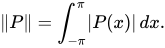
The operator 





Properties of the space of bounded linear operators
The space of all bounded linear operators from 
- If
- For any
the kernel of
- If
Sources and credits
This article is adapted from the Wikipedia article “Bounded operator”, written by its contributors and licensed under CC BY-SA 4.0. Fathomly has changed the layout, removed citation markers, navigation and maintenance notices, and adjusted punctuation. This adapted version is shared under the same license. For references, see the original article.
Fathomly is not affiliated with or endorsed by the Wikimedia Foundation. Spotted a problem? Tell us.