Compact operator
Type of continuous linear operator
In functional analysis, a branch of mathematics, a compact operator is a linear operator that behaves, in several important respects, like a finite-dimensional operator such as a matrix. In infinite-dimensional spaces, bounded sets are usually not compact, and bounded sequences need not have convergent subsequences. Compact operators partly restore this finite-dimensional behavior by sending bounded sets to sets whose closures are compact, or equivalently, in normed spaces, by sending bounded sequences to sequences with convergent subsequences.
Compact operators first arose in the theory of integral equations, where many integral operators have compactness properties. They play a central role in the Fredholm alternative, in the spectral theory of linear operators, and in applications to differential equations and Sobolev spaces. For example, compactness often implies that the nonzero spectrum of an operator consists of isolated eigenvalues of finite multiplicity, with possible accumulation only at zero.
01Motivation: integral equations
Compact operators were first studied in connection with integral equations. A typical example is an operator of the form

where the function 

![C([a,b])](https://wikimedia.org/api/rest_v1/media/math/render/svg/d8e4f44fa2823fcdffc5fc26981c0d4fa57cade9)
This compactness is useful because it makes some infinite-dimensional linear equations resemble finite-dimensional systems of linear equations. For example, the Fredholm equation

can often be studied by finite-dimensional approximation and by the Fredholm alternative. In this way, compact operators provide a bridge between concrete integral equations and the abstract spectral theory of operators on function spaces.
The same idea appears in other parts of analysis. Compact embeddings of function spaces, such as certain embeddings of Sobolev spaces into Lp spaces, allow differential and boundary value problems to be treated by methods similar to those used for compact integral operators.
02Definitions
Normed spaces
Let 


Equivalently, 


Every compact linear operator between normed spaces is bounded, and hence continuous.
Many standard results on compact operators are stated for Banach spaces. If
TVS case
Let 
The following statements are equivalent, and different authors may pick any one of these as the principal definition for "
- there exists a neighborhood
of the origin in
is a relatively compact subset of
- there exists a neighborhood
such that
;
- there exists a nonempty open set
03Basic properties
Throughout this section, 


Relation with finite-dimensional operators
Every finite-rank operator is compact. Indeed, if the range of
Compactness is therefore automatic in finite-dimensional linear algebra. Conversely, the identity operator on an infinite-dimensional Banach space is not compact: the closed unit ball of an infinite-dimensional Banach space is not compact. Thus a Banach space 
More generally, if a Banach space 
Continuity and boundedness
Every compact linear operator between normed spaces is bounded, and hence continuous.
Algebraic properties
If 
Compact operators are stable under composition with bounded operators. If 


is compact. In particular, 

In a Hilbert space 


Approximation by finite-rank operators
Since every finite-rank operator is compact, every operator-norm limit of finite-rank operators is compact. On Hilbert spaces the converse also holds: every compact operator between Hilbert spaces is the operator-norm limit of finite-rank operators.
For general Banach spaces this converse need not hold. The question of whether compact operators can always be approximated by finite-rank operators is related to the approximation property, which fails for some Banach spaces. Whether this was true in general for Banach spaces (the approximation property) was an unsolved question for many years; in 1973 Per Enflo gave a counter-example, building on work by Alexander Grothendieck and Stefan Banach.
Adjoints and ranges
A bounded linear operator between Banach spaces is compact if and only if its adjoint is compact; this result is known as Schauder's theorem.
If
Relation to other operator classes
Every compact operator between Banach spaces is strictly singular, but the converse is false: there are strictly singular operators that are not compact.
04Fredholm theory
Compact operators are closely connected with Fredholm operators and the Fredholm alternative. This connection is one reason compact operators behave, in many respects, like finite-dimensional linear maps.
Let 
is a Fredholm operator of index zero. Equivalently, the kernel of 

More generally, for every scalar 

is Fredholm of index zero.
Fredholm alternative
A standard consequence is the Fredholm alternative. For a compact operator
has a unique solution 


has only the zero solution. If the homogeneous equation has a nonzero solution, then its solution space is finite-dimensional, and the inhomogeneous equation is solvable only for those 
In terms of the adjoint operator 

Thus the obstruction to solving 
For the parameter-dependent equation

with 

05Spectral theory
The spectral theory of compact operators is closer to finite-dimensional linear algebra than the spectral theory of general bounded operators.
Let 


is finite-dimensional, the range of 

The nonzero spectrum is therefore either finite or countably infinite. If it is infinite, its only possible accumulation point is 

is finite. Thus compact operators cannot have a continuous band of nonzero spectral values.
The finite-dimensional character of the nonzero spectrum can also be expressed in Fredholm-theoretic terms. For
has finite-dimensional kernel and cokernel, and these dimensions are equal:

In particular,
The adjoint has the same nonzero spectral values. If 

when algebraic multiplicities are taken into account.
These results are often called the Riesz-Schauder theory of compact operators. They generalize the elementary fact that a finite-dimensional linear map has a spectrum consisting only of eigenvalues, while allowing for the infinite-dimensional phenomenon that eigenvalues may accumulate at
A notion related to the compactness of an operator is an operator with compact resolvent. An unbounded operator 

06Compact operators on Hilbert spaces
Compact operators on Hilbert spaces have a particularly close relationship with finite-dimensional linear algebra. In addition to the general Banach-space spectral properties of compact operators, Hilbert-space compact operators admit orthogonal decompositions, singular-value expansions, and, in the self-adjoint case, a spectral theorem resembling the spectral theorem for finite-dimensional Hermitian matrices.
Compact self-adjoint operators
If 

Equivalently,

where 


The same description applies, with complex eigenvalues, to compact normal operators on a complex Hilbert space.
Singular-value expansion
A general compact operator on a Hilbert space need not be self-adjoint or normal. Nevertheless, it has a singular-value decomposition. If 
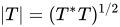
There are orthonormal families 


The series converges in norm for each 
This singular-value expansion is often the most useful description of a compact Hilbert-space operator that is not self-adjoint. It generalizes the singular-value decomposition of finite-dimensional matrices.
Hilbert-Schmidt and trace-class operators
Important subclasses of compact Hilbert-space operators are the Hilbert-Schmidt operators and trace-class operators. If 

and trace class when

Every trace-class operator is Hilbert-Schmidt, and every Hilbert-Schmidt operator is compact. The converses are false in general. For example, an operator with singular values 

07Completely continuous operators
Let 
Compact operators between Banach spaces are always completely continuous, but the converse is false, because there exists a completely continuous operator that is not compact. However, the converse is true if
Somewhat confusingly, compact operators are sometimes referred to as "completely continuous" in older literature, even though the latter is a weaker condition in modern terminology.
08Examples and non-examples
Finite-rank operators are the simplest examples of compact operators. If
One class of examples is given by diagonal or multiplication operators on sequence spaces. For example, on 


is compact when the scalar sequence 
Integral operators also provide compact operators in many important cases. If

has a sufficiently regular kernel

where ![g\in C([0,1])](https://wikimedia.org/api/rest_v1/media/math/render/svg/a94ba8e633ca820b193b3ec674f2acab3081969d)
![C([0,1])](https://wikimedia.org/api/rest_v1/media/math/render/svg/44211c4c325ea7edb9462e7ccecda09841a41216)
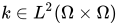
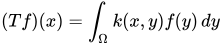
is compact on 
The identity operator on an infinite-dimensional Banach space is a basic non-example. It is bounded, but not compact, because the closed unit ball of an infinite-dimensional Banach space is not compact. Equivalently, the identity operator would be compact only if every bounded sequence had a convergent subsequence, which fails in infinite-dimensional Banach spaces. The same argument shows that any nonzero scalar multiple of the identity is not compact on an infinite-dimensional Banach space.
The unilateral shift operators on sequence spaces are also not compact. For example, on 


Every bounded linear operator from a normed space into a complete nuclear space is compact, because bounded sets in complete nuclear spaces are precompact. A complex-analytic example is given by the Cauchy integral operator. For the unit disk 

As an operator from 

09Compact embeddings
Compact operators often arise as inclusion maps between function spaces. If 

is called an embedding when it is continuous. The embedding is called compact if this inclusion map is a compact operator; that is, if every bounded sequence in

Compactness of an embedding is stronger than continuity. A continuous embedding gives an estimate of the form

whereas a compact embedding also asserts a precompactness property: bounded sets in the stronger space
The Arzelà-Ascoli theorem provides one example. The inclusion of a uniformly bounded and equicontinuous family of functions into
The Rellich-Kondrachov theorem yields other compact embeddings. If 


then the natural inclusion

is compact. Thus every bounded sequence in 

A non-example is the inclusion of Lebesgue spaces. If 


![[0,1]](https://wikimedia.org/api/rest_v1/media/math/render/svg/738f7d23bb2d9642bab520020873cccbef49768d)


Compact embeddings are central in the study of partial differential equations and calculus of variations. They allow weak or bounded sequences of approximate solutions to be replaced, after passing to subsequences, by strongly convergent sequences in a weaker norm. This compactness is used in existence proofs, in the study of elliptic boundary value problems, and in showing that many differential operators have discrete spectral behavior analogous to that of compact operators.
Holomorphic function spaces provide another class of compact embeddings. Let 


from the Hardy space 
The same principle applies to Bergman spaces. If 


Thus bounded sets in

is compact. Similar compactness statements hold for restrictions to smaller subdomains 

In several complex variables, analogous compact embeddings occur for Hardy and Bergman spaces on bounded domains, and for Hardy spaces on tube domains. For example, Hardy spaces on tube domains over cones consist of holomorphic functions satisfying uniform
Sources and credits
This article is adapted from the Wikipedia article “Compact operator”, written by its contributors and licensed under CC BY-SA 4.0. Fathomly has changed the layout, removed citation markers, navigation and maintenance notices, and adjusted punctuation. This adapted version is shared under the same license. For references, see the original article.
Fathomly is not affiliated with or endorsed by the Wikimedia Foundation. Spotted a problem? Tell us.