Normal operator
(on a complex Hilbert space) continuous linear operator
In mathematics, especially functional analysis, a normal operator on a complex Hilbert space 


Normal operators are important because the spectral theorem holds for them. The class of normal operators is well understood. Examples of normal operators are
- unitary operators:
- Hermitian operators (i.e., self-adjoint operators):
- skew-Hermitian operators:
- positive operators:
for some
(so N is self-adjoint).


A normal matrix is the matrix expression of a normal operator on the Hilbert space 
01Properties
Normal operators are characterized by the spectral theorem. A compact normal operator (in particular, a normal operator on a finite-dimensional inner product space) is unitarily diagonalizable.
Let 
is normal.
for all
(use
).
- The self-adjoint and anti-self adjoint parts of
with
and
then

If 


The product of normal operators that commute is again normal; this is nontrivial, but follows directly from Fuglede's theorem, which states (in a form generalized by Putnam):
- If
and
are normal operators and if
is a bounded linear operator such that
then
.
The operator norm of a normal operator equals its numerical radius and spectral radius.
A normal operator coincides with its Aluthge transform.
02Properties in finite-dimensional case
If a normal operator T on a finite-dimensional real or complex Hilbert space (inner product space) H stabilizes a subspace V, then it also stabilizes its orthogonal complement V⊥. (This statement is trivial in the case where T is self-adjoint.)
Proof. Let PV be the orthogonal projection onto V. Then the orthogonal projection onto V⊥ is 1H−PV. The fact that T stabilizes V can be expressed as (1H−PV)TPV = 0, or TPV = PVTPV. The goal is to show that PVT(1H−PV) = 0.
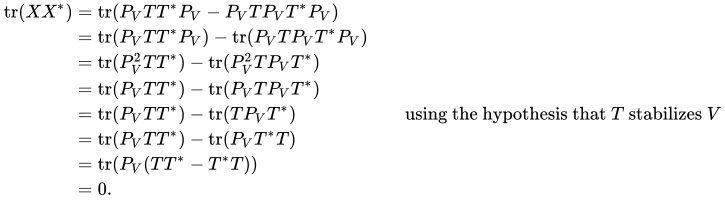
Let X = PVT(1H−PV). Since (A, B) ↦ tr(AB*) is an inner product on the space of endomorphisms of H, it is enough to show that tr(XX*) = 0. First it is noted that
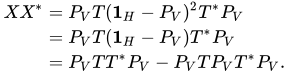
Now using properties of the trace and of orthogonal projections we have:
The same argument goes through for compact normal operators in infinite dimensional Hilbert spaces, where one make use of the Hilbert-Schmidt inner product, defined by tr(AB*) suitably interpreted. However, for bounded normal operators, the orthogonal complement to a stable subspace may not be stable. It follows that the Hilbert space cannot in general be spanned by eigenvectors of a normal operator. Consider, for example, the bilateral shift (or two-sided shift) acting on 
The invariant subspaces of a shift acting on Hardy space are characterized by Beurling's theorem.
03Normal elements of algebras
The notion of normal operators generalizes to an involutive algebra:
An element 
Self-adjoint and unitary elements are normal.
The most important case is when such an algebra is a C*-algebra.
04Unbounded normal operators
The definition of normal operators naturally generalizes to some class of unbounded operators. Explicitly, a closed operator N is said to be normal if

Here, the existence of the adjoint N* requires that the domain of N be dense, and the equality includes the assertion that the domain of N*N equals that of NN*, which is not necessarily the case in general.
Equivalently normal operators are precisely those for which

with

The spectral theorem still holds for unbounded (normal) operators. The proofs work by reduction to bounded (normal) operators.
05Generalization
The success of the theory of normal operators led to several attempts for generalization by weakening the commutativity requirement. Classes of operators that include normal operators are (in order of inclusion)
Sources and credits
This article is adapted from the Wikipedia article “Normal operator”, written by its contributors and licensed under CC BY-SA 4.0. Fathomly has changed the layout, removed citation markers, navigation and maintenance notices, and adjusted punctuation. This adapted version is shared under the same license. For references, see the original article.
Fathomly is not affiliated with or endorsed by the Wikimedia Foundation. Spotted a problem? Tell us.