Positive operator
In mathematics, a linear operator acting on inner product space
In mathematics (specifically linear algebra, operator theory, and functional analysis) as well as physics, a linear operator 



Many authors define a positive operator
In physics (specifically quantum mechanics), such operators represent quantum states, via the density matrix formalism.
01Cauchy-Schwarz inequality
Take the inner product 

![{\begin{aligned}\langle A(\lambda x+\mu y),\lambda x+\mu y\rangle =|\lambda |^{2}\langle Ax,x\rangle +\lambda ^{*}\mu \langle Ax,y\rangle +\lambda \mu ^{*}\langle Ay,x\rangle +|\mu |^{2}\langle Ay,y\rangle \\[1mm]=|\lambda |^{2}\langle Ax,x\rangle +\lambda ^{*}\mu \langle Ax,y\rangle +\lambda \mu ^{*}(\langle Ax,y\rangle )^{*}+|\mu |^{2}\langle Ay,y\rangle \end{aligned}}](https://wikimedia.org/api/rest_v1/media/math/render/svg/dfa6fe16545b068eb9ae69e1de9b19ffd2883b04)
for all complex 


It follows that 


02On a complex Hilbert space, if an operator is non-negative then it is symmetric
For 
![{\begin{aligned}\langle Ax,y\rangle ={\frac {1}{4}}({}&\langle A(x+y),x+y\rangle -\langle A(x-y),x-y\rangle \\[1mm]&{}-i\langle A(x+iy),x+iy\rangle +i\langle A(x-iy),x-iy\rangle )\end{aligned}}](https://wikimedia.org/api/rest_v1/media/math/render/svg/8723ccc4576e55f1744625b2c81b2f99f465f3c6)
and the fact that 

In contrast with the complex case, a positive-semidefinite operator on a real Hilbert space 
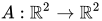


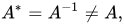
03If an operator is non-negative and defined on the whole complex Hilbert space, then it is self-adjoint and bounded
The symmetry of 


This property does not hold on

04Partial order of self-adjoint operators
A natural partial ordering of self-adjoint operators arises from the definition of positive operators. Define 
are self-adjoint

It can be seen that a similar result as the Monotone convergence theorem holds for monotone increasing, bounded, self-adjoint operators on Hilbert spaces.
05Application to physics: quantum states
The definition of a quantum system includes a complex separable Hilbert space 


Sources and credits
This article is adapted from the Wikipedia article “Positive operator”, written by its contributors and licensed under CC BY-SA 4.0. Fathomly has changed the layout, removed citation markers, navigation and maintenance notices, and adjusted punctuation. This adapted version is shared under the same license. For references, see the original article.
Fathomly is not affiliated with or endorsed by the Wikimedia Foundation. Spotted a problem? Tell us.