Nuclear operator
Linear operator related to topological vector spaces
In mathematics, nuclear operators are an important class of linear operators introduced by Alexander Grothendieck in his doctoral dissertation. Nuclear operators are intimately tied to the projective tensor product of two topological vector spaces (TVSs).
01Preliminaries and notation
Throughout let X,Y, and Z be topological vector spaces (TVSs) and L : X → Y be a linear operator (no assumption of continuity is made unless otherwise stated).
- The projective tensor product of two locally convex TVSs X and Y is denoted by
and the completion of this space will be denoted by
.
- L : X → Y is a topological homomorphism or homomorphism, if it is linear, continuous, and
is an open map, where
, the image of L, has the subspace topology induced by Y.
- If S is a subspace of X then both the quotient map X → X/S and the canonical injection S → X are homomorphisms.
- The set of continuous linear maps X → Z (resp. continuous bilinear maps
) will be denoted by L(X, Z) (resp. B(X, Y; Z)) where if Z is the underlying scalar field then we may instead write L(X) (resp. B(X, Y)).
- Any linear map
can be canonically decomposed as follows:
where
defines a bijection called the canonical bijection associated with L.
- X* or
will denote the continuous dual space of X.
- To increase the clarity of the exposition, we use the common convention of writing elements of
denotes an element of
- To increase the clarity of the exposition, we use the common convention of writing elements of
will denote the algebraic dual space of X (which is the vector space of all linear functionals on X, whether continuous or not).
- A linear map L : H → H from a Hilbert space into itself is called positive if
for every
. In this case, there is a unique positive map r : H → H, called the square-root of L, such that
.
- If
is any continuous linear map between Hilbert spaces, then
is always positive. Now let R : H → H denote its positive square-root, which is called the absolute value of L. Define
first on
by setting
for
and extending
continuously to
, and then define U on
by setting
for
and extend this map linearly to all of
. The map
is a surjective isometry and
.
- If
- A linear map
is called compact or completely continuous if there is a neighborhood U of the origin in X such that
is precompact in Y.
In a Hilbert space, positive compact linear operators, say L : H → H have a simple spectral decomposition discovered at the beginning of the 20th century by Fredholm and F. Riesz:
There is a sequence of positive numbers, decreasing and either finite or else converging to 0, 


Notation for topologies
- σ(X, X′) denotes the coarsest topology on X making every map in X′ continuous and
or
denotes X endowed with this topology.
- σ(X′, X) denotes weak-* topology on X* and
or
denotes X′ endowed with this topology.
- Note that every
induces a map
defined by
. σ(X′, X) is the coarsest topology on X′ making all such maps continuous.
- Note that every
- b(X, X′) denotes the topology of bounded convergence on X and
or
denotes X endowed with this topology.
- b(X′, X) denotes the topology of bounded convergence on X′ or the strong dual topology on X′ and
or
denotes X′ endowed with this topology.
- As usual, if X* is considered as a topological vector space but it has not been made clear what topology it is endowed with, then the topology will be assumed to be b(X′, X).
A canonical tensor product as a subspace of the dual of Bi(X, Y)
Let X and Y be vector spaces (no topology is needed yet) and let Bi(X, Y) be the space of all bilinear maps defined on 
For every 





If Z is any other vector space then the mapping Li(X ⊗ Y; Z) → Bi(X, Y; Z) given by u ↦ u ∘ 𝜒 is an isomorphism of vector spaces.
In particular, this allows us to identify the algebraic dual of X ⊗ Y with the space of bilinear forms on X × Y.
Moreover, if X and Y are locally convex topological vector spaces (TVSs) and if X ⊗ Y is given the π-topology then for every locally convex TVS Z, this map restricts to a vector space isomorphism 

02Nuclear operators between Banach spaces
There is a canonical vector space embedding 

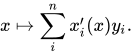
Assuming that X and Y are Banach spaces, then the map 



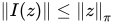


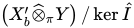




Characterization
Suppose that X and Y are Banach spaces and that 
- The following are equivalent:
- There exists a sequence
in the closed unit ball of
in the closed unit ball of
, and a complex sequence
such that
and
is equal to the mapping:
for all
. Furthermore, the trace-norm
is equal to the infimum of the numbers
over the set of all representations of
- If Y is reflexive then
is nuclear, in which case
.
Properties
Let X and Y be Banach spaces and let
- If
.
03Nuclear operators between Hilbert spaces
Nuclear automorphisms of a Hilbert space are called trace class operators.
Let X and Y be Hilbert spaces and let N : X → Y be a continuous linear map. Suppose that 


Characterizations
Let X and Y be Hilbert spaces and let N : X → Y be a continuous linear map whose absolute value is R : X → X. The following are equivalent:
- N : X → Y is nuclear.
- R : X → X is nuclear.
- R : X → X is compact and
is finite, in which case
.
- Here,
of positive numbers with corresponding non-trivial finite-dimensional and mutually orthogonal vector spaces
such that the orthogonal (in H) of
is equal to
) and for all k,
for all
; the trace is defined as
.
- Here,
.
- There are two orthogonal sequences
in X and
in Y, and a sequence
in
such that for all
.
- N : X → Y is an integral map.
04Nuclear operators between locally convex spaces
Suppose that U is a convex balanced closed neighborhood of the origin in X and B is a convex balanced bounded Banach disk in Y with both X and Y locally convex spaces. Let 


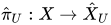




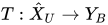

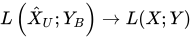


Definition: Let X and Y be Hausdorff locally convex spaces. The union of all 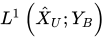
When X and Y are Banach spaces, then this new definition of nuclear mapping is consistent with the original one given for the special case where X and Y are Banach spaces.
Sufficient conditions for nuclearity
- Let W, X, Y, and Z be Hausdorff locally convex spaces,
and
be continuous linear maps. Then
,
, and
are nuclear and if in addition W, X, Y, and Z are all Banach spaces then
.
- If
- If in addition X and Y are Banach spaces, then
- If in addition X and Y are Banach spaces, then
- If
is a completion of X, then the unique continuous extension
of N is nuclear.
Characterizations
Let X and Y be Hausdorff locally convex spaces and let
- The following are equivalent:
- (Definition) There exists a convex balanced neighborhood U of the origin in X and a bounded Banach disk B in Y such that
and the induced map
is nuclear, where
is the unique continuous extension of
, which is the unique map satisfying
where
is the natural inclusion and
is the canonical projection.
- There exist Banach spaces
and
and continuous linear maps
,
, and
such that
.
- There exists an equicontinuous sequence
, a sequence
- If X is barreled and Y is quasi-complete, then N is nuclear if and only if N has a representation of the form
Properties
The following is a type of Hahn-Banach theorem for extending nuclear maps:
- If
is a TVS-embedding and
such that
. Furthermore, when X and Y are Banach spaces and E is an isometry then for any
,
can be picked so that
.
- Suppose that
be the canonical projection. Suppose all that every compact disk in
is the image under
of a bounded Banach disk in Z (this is true, for instance, if X and Z are both Fréchet spaces, or if Z is the strong dual of a Fréchet space and
is weakly closed in Z). Then for every nuclear map
there exists a nuclear map
such that
.
- Furthermore, when X and Z are Banach spaces and E is an isometry then for any
.
- Furthermore, when X and Z are Banach spaces and E is an isometry then for any
Let X and Y be Hausdorff locally convex spaces and let
- Any nuclear map is compact.
- For every topology of uniform convergence on
(when
Sources and credits
This article is adapted from the Wikipedia article “Nuclear operator”, written by its contributors and licensed under CC BY-SA 4.0. Fathomly has changed the layout, removed citation markers, navigation and maintenance notices, and adjusted punctuation. This adapted version is shared under the same license. For references, see the original article.
Fathomly is not affiliated with or endorsed by the Wikimedia Foundation. Spotted a problem? Tell us.