Reference articles on history, science, culture and more
Encyclopedia

String group

Infinite-dimensional group in topology

In topology, a branch of mathematics, a string group is an infinite-dimensional group \operatorname {String} (n) introduced by Stolz (1996) as a 3-connected cover of a spin group. A string manifold is a manifold with a lifting of its frame bundle to a string group bundle. This means that in addition to being able to define holonomy along paths, one can also define holonomies for surfaces going between strings. There is a short exact sequence of topological groups

0\rightarrow {\displaystyle K(\mathbb {Z} ,2)}\rightarrow \operatorname {String} (n)\rightarrow \operatorname {Spin} (n)\rightarrow 0

where K(\mathbb {Z} ,2) is an Eilenberg-MacLane space and \operatorname {Spin} (n) is a spin group. The string group is an entry in the Whitehead tower (dual to the notion of Postnikov tower) for the orthogonal group:

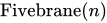
\cdots \rightarrow \operatorname {Fivebrane} (n)\to \operatorname {String} (n)\rightarrow \operatorname {Spin} (n)\rightarrow \operatorname {SO} (n)\rightarrow \operatorname {O} (n)

It is obtained by killing the \pi _{3} homotopy group for \operatorname {Spin} (n), in the same way that \operatorname {Spin} (n) is obtained from \operatorname {SO} (n) by killing \pi _{1}. The resulting manifold cannot be any finite-dimensional Lie group, since all finite-dimensional compact Lie groups have a non-vanishing \pi _{3}. The fivebrane group follows, by killing \pi _{7}.

More generally, the construction of the Postnikov tower via short exact sequences starting with Eilenberg, MacLane spaces can be applied to any Lie group G, giving the string group String(G).

01Intuition for the string group

The relevance of the Eilenberg-MacLane space K(\mathbb {Z} ,2) lies in the fact that there are the homotopy equivalences

K(\mathbb {Z} ,1)\simeq U(1)\simeq B\mathbb {Z}

for the classifying space B\mathbb {Z}, and the fact K(\mathbb {Z} ,2)\simeq BU(1). Notice that because the complex spin group is a group extension

0\to K(\mathbb {Z} ,1)\to \operatorname {Spin} ^{\mathbb {C} }(n)\to \operatorname {Spin} (n)\to 0

the String group can be thought of as a "higher" complex spin group extension, in the sense of higher group theory since the space K(\mathbb {Z} ,2) is an example of a higher group. It can be thought of the topological realization of the groupoid \mathbf {B} U(1) whose object is a single point and whose morphisms are the group U(1). Note that the homotopical degree of K(\mathbb {Z} ,2) is 2, meaning its homotopy is concentrated in degree 2, because it comes from the homotopy fiber of the map

\operatorname {String} (n)\to \operatorname {Spin} (n)

from the Whitehead tower whose homotopy cokernel is K(\mathbb {Z} ,3). This is because the homotopy fiber lowers the degree by 1.

Understanding the geometry

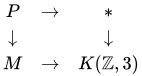
The geometry of String bundles requires the understanding of multiple constructions in homotopy theory, but they essentially boil down to understanding what K(\mathbb {Z} ,2)-bundles are, and how these higher group extensions behave. Namely, K(\mathbb {Z} ,2)-bundles on a space M are represented geometrically as bundle gerbes since any K(\mathbb {Z} ,2)-bundle can be realized as the homotopy fiber of a map giving a homotopy square

{\begin{matrix}P&\to &*\\\downarrow &&\downarrow \\M&\xrightarrow {} &K(\mathbb {Z} ,3)\end{matrix}}

where K(\mathbb {Z} ,3)=B(K(\mathbb {Z} ,2)). Then, a string bundle S\to M must map to a spin bundle \mathbb {S} \to M which is K(\mathbb {Z} ,2)-equivariant, analogously to how spin bundles map equivariantly to the frame bundle.

02Fivebrane group and higher groups

The fivebrane group can similarly be understood by killing the \pi _{7}(\operatorname {Spin} (n))\cong \pi _{7}(\operatorname {O} (n)) group of the string group \operatorname {String} (n) using the Whitehead tower. It can then be understood again using an exact sequence of higher groups

0\to K(\mathbb {Z} ,6)\to \operatorname {Fivebrane} (n)\to \operatorname {String} (n)\to 0

giving a presentation of \operatorname {Fivebrane} (n) it terms of an iterated extension, i.e. an extension by K(\mathbb {Z} ,6) by \operatorname {String} (n). Note map on the right is from the Whitehead tower, and the map on the left is the homotopy fiber.

Watch videos about String groupExplainers and documentaries on YouTube (opens in a new tab)

Sources and credits

This article is adapted from the Wikipedia article String group, written by its contributors and licensed under CC BY-SA 4.0. Fathomly has changed the layout, removed citation markers, navigation and maintenance notices, and adjusted punctuation. This adapted version is shared under the same license. For references, see the original article.

Fathomly is not affiliated with or endorsed by the Wikimedia Foundation. Spotted a problem? Tell us.