Gerbe
Construct in mathematics
In mathematics, a gerbe (/dʒɜːrb/; French: [ʒɛʁb]) is a construct in homological algebra and topology. Gerbes were introduced by Jean Giraud (Giraud 1971) following ideas of Alexandre Grothendieck as a tool for non-commutative cohomology in degree 2. They can be seen as an analogue of fibre bundles where the fibre is the classifying stack of a group. Gerbes provide a convenient, if highly abstract, language for dealing with many types of deformation questions especially in modern algebraic geometry. In addition, special cases of gerbes have been used more recently in differential topology and differential geometry to give alternative descriptions to certain cohomology classes and additional structures attached to them.
"Gerbe" is a French (and archaic English) word that literally means "wheat sheaf."
01Definitions
Gerbes on a topological space
A gerbe on a topological space 


A canonical example is the gerbe 


Gerbes on a site
The most general definition of gerbes are defined over a site. Given a site 


- There exists a refinement
of
the associated fibered category
is non-empty
- For every
any two objects in the fibered category
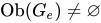
Note that for a site 
Motivation for gerbes on a site
One of the main motivations for considering gerbes on a site is to consider the following naive question: if the Čech cohomology group 




02Cohomological classification
One of the main theorems concerning gerbes is their cohomological classification whenever they have automorphism groups given by a fixed sheaf of abelian groups 


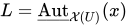

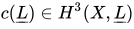
representing the isomorphism class of the gerbe 


,
which is exactly the third singular homology group 


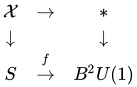
analogous to how a line bundle comes from the homotopy fiber square
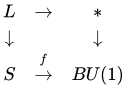
where 

03Examples
C*-algebras
There are natural examples of Gerbes that arise from studying the algebra of compactly supported complex valued functions on a paracompact space 
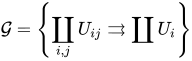
with source and target maps given by the inclusions
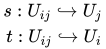
and the space of composable arrows is just

Then a degree 2 cohomology class 
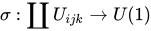
We can then form a non-commutative C*-algebra 

It has a non-commutative product given by

where the cohomology class 

Algebraic geometry
Let 







![[*/G]](https://wikimedia.org/api/rest_v1/media/math/render/svg/b6f116559fd1b315152c5d95ccca949b2bd4ae5b)
From two-term complexes of coherent sheaves
Every two-term complex of coherent sheaves
![{\mathcal {E}}^{\bullet }=[{\mathcal {E}}^{-1}\xrightarrow {d} {\mathcal {E}}^{0}]](https://wikimedia.org/api/rest_v1/media/math/render/svg/b94de3128519365b3b659f5a1ccb9d52af3dd57d)
on a scheme 


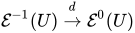
giving a groupoid. It has objects given by elements 


In order for this stack to be a gerbe, the cohomology sheaf 


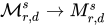
Moduli stack of stable bundles on a curve
Consider a smooth projective curve 


Root stacks
Another class of gerbes can be found using the construction of root stacks. Informally, the 
pg 52
The
![\bigotimes ^{r}{\sqrt[{r}]{L/S}}\cong L](https://wikimedia.org/api/rest_v1/media/math/render/svg/c41939268266a40d6849365c4401ee59839c00ff)
as gerbes. It is constructed as the stack
![{\sqrt[{r}]{L/S}}:(\operatorname {Sch} /S)^{op}\to \operatorname {Grpd}](https://wikimedia.org/api/rest_v1/media/math/render/svg/f5fd21adadb083eec0d49dca39c3deaaeffc0d08)
sending an 

and morphisms are commutative diagrams compatible with the isomorphisms 

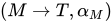


where the vertical map of 

This is because 

Root stacks with sections
There is another related construction of root stacks with sections. Given the data above, let 

![{\sqrt[{r}]{(L,s)/S}}:(\operatorname {Sch} /S)^{op}\to \operatorname {Grpd}](https://wikimedia.org/api/rest_v1/media/math/render/svg/d25c3c0b668d894106161426182c67de1e4c60df)
sending an
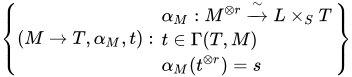
and morphisms are given similarly. These stacks can be constructed very explicitly, and are well understood for affine schemes. In fact, these form the affine models for root stacks with sections. Locally, we may assume 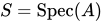


![{\sqrt[{r}]{(L,s)/S}}=[{\text{Spec}}(B)/\mu _{r}]](https://wikimedia.org/api/rest_v1/media/math/render/svg/1eaa603fe6d665079a38e307de6e648a83a155eb)
with
![B={\frac {A[x]}{x^{r}-s}}](https://wikimedia.org/api/rest_v1/media/math/render/svg/fe4b2e03f60525d4c2ad1205a8331c155c0616f6)
If 
![[{\text{Spec}}(A)/\mu _{r}]](https://wikimedia.org/api/rest_v1/media/math/render/svg/ab0811ea6443b95779cc79f67d04a187562d9bd9)
Examples throughout algebraic geometry
These and more general kinds of gerbes arise in several contexts as both geometric spaces and as formal bookkeeping tools:
- Azumaya algebras
- Deformations of infinitesimal thickenings
- Twisted forms of projective varieties
- Fiber functors for motives
Differential geometry
-gerbes: Jean-Luc Brylinski's approach
04History
Gerbes first appeared in the context of algebraic geometry. They were subsequently developed in a more traditional geometric framework by Brylinski (Brylinski 1993). One can think of gerbes as being a natural step in a hierarchy of mathematical objects providing geometric realizations of integral cohomology classes.
A more specialised notion of gerbe was introduced by Murray and called bundle gerbes. Essentially they are a smooth version of abelian gerbes belonging more to the hierarchy starting with principal bundles than sheaves. Bundle gerbes have been used in gauge theory and also string theory. Current work by others is developing a theory of non-abelian bundle gerbes.
Sources and credits
This article is adapted from the Wikipedia article “Gerbe”, written by its contributors and licensed under CC BY-SA 4.0. Fathomly has changed the layout, removed citation markers, navigation and maintenance notices, and adjusted punctuation. This adapted version is shared under the same license. For references, see the original article.
Fathomly is not affiliated with or endorsed by the Wikimedia Foundation. Spotted a problem? Tell us.