Reference articles on history, science, culture and more
Encyclopedia

Fiber functor

Fiber functors in category theory, topology and algebraic geometry refer to several loosely related functors that generalise the functors taking a covering space \pi \colon X\rightarrow S to the fiber \pi ^{-1}(s) over a point s\in S.

01Definition

A fiber functor (or fibre functor) is a loose concept which has multiple definitions depending on the formalism considered. One of the main initial motivations for fiber functors comes from Topos theory. Recall a topos is the category of sheaves over a site. If a site is just a single object, as with a point, then the topos of the point is equivalent to the category of sets, {\mathfrak {Set}}. If we have the topos of sheaves on a topological space X, denoted {\mathfrak {T}}(X), then to give a point a in X is equivalent to defining adjoint functors

a^{*}:{\mathfrak {T}}(X)\leftrightarrows {\mathfrak {Set}}:a_{*}

The functor a^{*} sends a sheaf {\mathfrak {F}} on X to its fiber over the point a; that is, its stalk.

From covering spaces

Consider the category of covering spaces over a topological space X, denoted {\mathfrak {Cov}}(X). Then, from a point x\in X there is a fiber functor

{\text{Fib}}_{x}:{\mathfrak {Cov}}(X)\to {\mathfrak {Set}}

sending a covering space \pi :Y\to X to the fiber \pi ^{-1}(x). This functor has automorphisms coming from \pi _{1}(X,x) since the fundamental group acts on covering spaces on a topological space X. In particular, it acts on the set \pi ^{-1}(x)\subset Y. In fact, the only automorphisms of {\text{Fib}}_{x} come from \pi _{1}(X,x).

With étale topologies

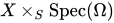
There is an algebraic analogue of covering spaces coming from the étale topology on a connected scheme S. The underlying site consists of finite étale covers, which are finite flat surjective morphisms X\to S such that the fiber over every geometric point s\in S is the spectrum of a finite étale \kappa (s)-algebra. For a fixed geometric point {\overline {s}}:{\text{Spec}}(\Omega )\to S, consider the geometric fiber X\times _{S}{\text{Spec}}(\Omega ) and let {\text{Fib}}_{\overline {s}}(X) be the underlying set of \Omega-points. Then,

{\text{Fib}}_{\overline {s}}:{\mathfrak {Fet}}_{S}\to {\mathfrak {Sets}}

is a fiber functor where {\mathfrak {Fet}}_{S} is the topos from the finite étale topology on S. In fact, it is a theorem of Grothendieck that the automorphisms of {\text{Fib}}_{\overline {s}} form a profinite group, denoted \pi _{1}(S,{\overline {s}}), and induce a continuous group action on these finite fiber sets, giving an equivalence between covers and the finite sets with such actions.

From Tannakian categories

Another class of fiber functors come from cohomological realizations of motives in algebraic geometry. For example, the De Rham cohomology functor H_{dR} sends a motive M(X) to its underlying de-Rham cohomology groups H_{dR}^{*}(X).

Watch videos about Fiber functorExplainers and documentaries on YouTube (opens in a new tab)

Sources and credits

This article is adapted from the Wikipedia article Fiber functor, written by its contributors and licensed under CC BY-SA 4.0. Fathomly has changed the layout, removed citation markers, navigation and maintenance notices, and adjusted punctuation. This adapted version is shared under the same license. For references, see the original article.

Fathomly is not affiliated with or endorsed by the Wikimedia Foundation. Spotted a problem? Tell us.