Postnikov system
In mathematics, a topological construction
In homotopy theory, a branch of algebraic topology, a Postnikov system (or Postnikov tower) is a way of decomposing a topological space by filtering its homotopy type. For a space 


and a series of maps 
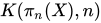

There is a similar construction called the Whitehead tower (defined below) where instead of having spaces 


01Definition
A Postnikov system of a path-connected space

with a sequence of maps 
- The map
for every
.
for
.
- Each map
is a fibration, and so the fiber
is an Eilenberg-MacLane space,
The first two conditions imply that 


Existence
Postnikov systems exist on connected CW complexes, and there is a weak homotopy-equivalence between
,
showing that 
![[f]\in \pi _{n}(X)](https://wikimedia.org/api/rest_v1/media/math/render/svg/449b604d87a11ea7505c0ad08560baef7b8c65fe)


Main property
One of the main properties of the Postnikov tower, which makes it so powerful to study while computing cohomology, is the fact the spaces 

Homotopy classification of fibrations
The sequence of fibrations 
![[X]\in \operatorname {Ob} (hTop)](https://wikimedia.org/api/rest_v1/media/math/render/svg/7c073d5a269d7671b71c1a2ef83a39b237c4acd8)
,
hence the homotopy class ![[p_{n}]](https://wikimedia.org/api/rest_v1/media/math/render/svg/f2674fc7b02dd7a732c82d460e0c0a4aedbfe6f4)
![[p_{n}]\in [X_{n-1},K(\pi _{n}(X),n+1)]\cong H^{n+1}(X_{n-1},\pi _{n}(X))](https://wikimedia.org/api/rest_v1/media/math/render/svg/6493d54b61ed7811e79ff7a3364fea7ee75a140d)
called the nth Postnikov invariant of
Fiber sequence for spaces with two nontrivial homotopy groups
One of the special cases of the homotopy classification is the homotopy class of spaces

giving a homotopy type with two non-trivial homotopy groups, 


,
which can also be interpreted as a group cohomology class. This space
02Examples of Postnikov towers
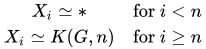
Postnikov tower of a K(G, n)
One of the conceptually simplest cases of a Postnikov tower is that of the Eilenberg-Maclane space 
Postnikov tower of S2
The Postnikov tower for the sphere 


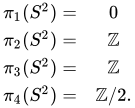
Then, 

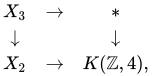
which is an element in
.
If this was trivial it would imply 


03Homotopy groups of spheres
One application of the Postnikov tower is the computation of homotopy groups of spheres. For an 


.
We can then form a homological spectral sequence with 
.
And the first non-trivial map to 
,
equivalently written as
.
If it's easy to compute 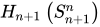
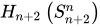




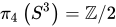


Note that similar techniques can be applied using the Whitehead tower (below) for computing 

04Postnikov towers of spectra
In addition to the classical Postnikov tower, there is a notion of Postnikov towers in stable homotopy theory constructed on spectra pg 85-86.
Definition
For a spectrum 
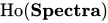
,
with maps

commuting with the
for
is an isomorphism for
where 
05Whitehead tower
Given a CW complex
,
where
- The lower homotopy groups are zero, so
- The induced map
is an isomorphism for
- The maps
.
Implications
Notice 

Construction
The spaces 


for some fixed basepoint 

,
and so we have a Serre fibration
.
Using the long exact sequence in homotopy theory, we have that 



,
where if the middle morphism is an isomorphism, the other two groups are zero. This can be checked by looking at the inclusion
; thus,
,
giving the desired result.
As a homotopy fiber
Another way to view the components in the Whitehead tower is as a homotopy fiber. If we take

from the Postnikov tower, we get a space 
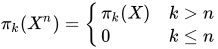
06Whitehead tower of spectra
The dual notion of the Whitehead tower can be defined in a similar manner using homotopy fibers in the category of spectra. If we let

then this can be organized in a tower giving connected covers of a spectrum. This is a widely used construction in bordism theory because the coverings of the unoriented cobordism spectrum 
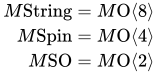
such as string bordism.
07Whitehead tower and string theory
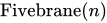
In Spin geometry the 



where 


Sources and credits
This article is adapted from the Wikipedia article “Postnikov system”, written by its contributors and licensed under CC BY-SA 4.0. Fathomly has changed the layout, removed citation markers, navigation and maintenance notices, and adjusted punctuation. This adapted version is shared under the same license. For references, see the original article.
Fathomly is not affiliated with or endorsed by the Wikimedia Foundation. Spotted a problem? Tell us.