Eilenberg-MacLane spaces
One of the principal examples of higher groups come from the homotopy types of Eilenberg-MacLane spaces  since they are the fundamental building blocks for constructing higher groups, and homotopy types in general. For instance, every group
  can be turned into an Eilenberg-MacLane space
  through a simplicial construction, and it behaves functorially. This construction gives an equivalence between groups and 1-groups. Note that some authors write as
  , and for an abelian group
  , is written as
  .
.
2-groups
The definition and many properties of 2-groups are already known. 2-groups can be described using crossed modules and their classifying spaces. Essentially, these are given by a quadruple  where
where  are groups with
  abelian,

a group homomorphism, and  a cohomology class. These groups can be encoded as homotopy
  -types
  with
with  and
and  , with the action coming from the action of
  on higher homotopy groups, and
  coming from the Postnikov tower since there is a fibration

coming from a map 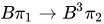 . Note that this idea can be used to construct other higher groups with group data having trivial middle groups
  , where the fibration sequence is now

coming from a map  whose homotopy class is an element of
 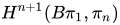 .
.
3-groups
Another interesting and accessible class of examples which requires homotopy theoretic methods, not accessible to strict groupoids, comes from looking at homotopy 3-types of groups. Essentially, these are given by a triple of groups  with only the first group being non-abelian, and some additional homotopy theoretic data from the Postnikov tower. If we take this 3-group as a homotopy 3-type , the existence of universal covers gives us a homotopy type
  which fits into a fibration sequence
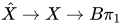
giving a homotopy  type with
  trivial on which acts on. These can be understood explicitly using the previous model of 2-groups, shifted up by degree (called delooping). Explicitly, fits into a Postnikov tower with associated Serre fibration

giving where the  -bundle
  comes from a map
 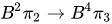 , giving a cohomology class in
 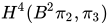 . Then, can be reconstructed using a homotopy quotient
  .
.
n-groups
The previous construction gives the general idea of how to consider higher groups in general. For an n-group with groups  with the latter bunch being abelian, we can consider the associated homotopy type and first consider the universal cover . Then, this is a space with trivial
  , making it easier to construct the rest of the homotopy type using the Postnikov tower. Then, the homotopy quotient
  gives a reconstruction of , showing the data of an
  -group is a higher group, or simple space, with trivial such that a group acts on it homotopy theoretically. This observation is reflected in the fact that homotopy types are not realized by simplicial groups, but simplicial groupoids pg 295 since the groupoid structure models the homotopy quotient
  .
.
Going through the construction of a 4-group is instructive because it gives the general idea for how to construct the groups in general. For simplicity, let's assume  is trivial, so the non-trivial groups are
  . This gives a Postnikov tower

where the first non-trivial map  is a fibration with fiber . Again, this is classified by a cohomology class in . Now, to construct from
  , there is an associated fibration

given by a homotopy class ![[X_{3},B^{5}\pi _{4}]\cong H^{5}(X_{3},\pi _{4})](https://wikimedia.org/api/rest_v1/media/math/render/svg/8bae437511721fb1aedfb70c8a1ab06b022e5879) . In principle this cohomology group should be computable using the previous fibration
. In principle this cohomology group should be computable using the previous fibration  with the Serre spectral sequence with the correct coefficients, namely
  . Doing this recursively, say for a
  -group, would require several spectral sequence computations, at worst
  many spectral sequence computations for an -group.
n-groups from sheaf cohomology
For a complex manifold with universal cover  , and a sheaf of abelian groups
  on , for every
  there exists canonical homomorphisms

giving a technique for relating n-groups constructed from a complex manifold and sheaf cohomology on . This is particularly applicable for complex tori.

