Divisor function
Arithmetic function related to the divisors of an integer

In mathematics, and specifically in number theory, a divisor function is an arithmetic function related to the divisors of an integer. When referred to as the divisor function, it counts the number of divisors of an integer (including 1 and the number itself). It appears in a number of remarkable identities, including relationships on the Riemann zeta function and the Eisenstein series of modular forms. Divisor functions were studied by Ramanujan, who gave a number of important congruences and identities; these are treated separately in the article Ramanujan's sum.
A related function is the divisor summatory function, which, as the name implies, is a sum over the divisor function.
01Definition
The sum of positive divisors function σz(n), for a real or complex number z, is defined as the sum of the zth powers of the positive divisors of n. It can be expressed in sigma notation as
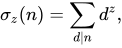
where 
The aliquot sum s(n) of n is the sum of the proper divisors (that is, the divisors excluding n itself, OEIS: A001065), and equals σ1(n) − n; the aliquot sequence of n is formed by repeatedly applying the aliquot sum function.

02Example
For example, σ0(12) is the number of the divisors of 12:

while σ1(12) is the sum of all the divisors:

and the aliquot sum s(12) of proper divisors is:

σ−1(n) is sometimes called the abundancy index of n, and we have:
![{\begin{aligned}\sigma _{-1}(12)&=1^{-1}+2^{-1}+3^{-1}+4^{-1}+6^{-1}+12^{-1}\\[6pt]&={\tfrac {1}{1}}+{\tfrac {1}{2}}+{\tfrac {1}{3}}+{\tfrac {1}{4}}+{\tfrac {1}{6}}+{\tfrac {1}{12}}\\[6pt]&={\tfrac {12}{12}}+{\tfrac {6}{12}}+{\tfrac {4}{12}}+{\tfrac {3}{12}}+{\tfrac {2}{12}}+{\tfrac {1}{12}}\\[6pt]&={\tfrac {12+6+4+3+2+1}{12}}={\tfrac {28}{12}}={\tfrac {7}{3}}={\tfrac {\sigma _{1}(12)}{12}}\end{aligned}}](https://wikimedia.org/api/rest_v1/media/math/render/svg/88918bd7732280a37e9aa6924d06cc1b901dd3c9)
03Table of values
The cases x = 2 to 5 are listed in OEIS: A001157 through OEIS: A001160, x = 6 to 24 are listed in OEIS: A013954 through OEIS: A013972.
| n | prime factorization | 𝜎0(n) | 𝜎1(n) | 𝜎2(n) | 𝜎3(n) | 𝜎4(n) |
|---|---|---|---|---|---|---|
| 1 | 1 | 1 | 1 | 1 | 1 | 1 |
| 2 | 2 | 2 | 3 | 5 | 9 | 17 |
| 3 | 3 | 2 | 4 | 10 | 28 | 82 |
| 4 | 22 | 3 | 7 | 21 | 73 | 273 |
| 5 | 5 | 2 | 6 | 26 | 126 | 626 |
| 6 | 2×3 | 4 | 12 | 50 | 252 | 1394 |
| 7 | 7 | 2 | 8 | 50 | 344 | 2402 |
| 8 | 23 | 4 | 15 | 85 | 585 | 4369 |
| 9 | 32 | 3 | 13 | 91 | 757 | 6643 |
| 10 | 2×5 | 4 | 18 | 130 | 1134 | 10642 |
| 11 | 11 | 2 | 12 | 122 | 1332 | 14642 |
| 12 | 22×3 | 6 | 28 | 210 | 2044 | 22386 |
| 13 | 13 | 2 | 14 | 170 | 2198 | 28562 |
| 14 | 2×7 | 4 | 24 | 250 | 3096 | 40834 |
| 15 | 3×5 | 4 | 24 | 260 | 3528 | 51332 |
| 16 | 24 | 5 | 31 | 341 | 4681 | 69905 |
| 17 | 17 | 2 | 18 | 290 | 4914 | 83522 |
| 18 | 2×32 | 6 | 39 | 455 | 6813 | 112931 |
| 19 | 19 | 2 | 20 | 362 | 6860 | 130322 |
| 20 | 22×5 | 6 | 42 | 546 | 9198 | 170898 |
| 21 | 3×7 | 4 | 32 | 500 | 9632 | 196964 |
| 22 | 2×11 | 4 | 36 | 610 | 11988 | 248914 |
| 23 | 23 | 2 | 24 | 530 | 12168 | 279842 |
| 24 | 23×3 | 8 | 60 | 850 | 16380 | 358258 |
| 25 | 52 | 3 | 31 | 651 | 15751 | 391251 |
| 26 | 2×13 | 4 | 42 | 850 | 19782 | 485554 |
| 27 | 33 | 4 | 40 | 820 | 20440 | 538084 |
| 28 | 22×7 | 6 | 56 | 1050 | 25112 | 655746 |
| 29 | 29 | 2 | 30 | 842 | 24390 | 707282 |
| 30 | 2×3×5 | 8 | 72 | 1300 | 31752 | 872644 |
| 31 | 31 | 2 | 32 | 962 | 29792 | 923522 |
| 32 | 25 | 6 | 63 | 1365 | 37449 | 1118481 |
| 33 | 3×11 | 4 | 48 | 1220 | 37296 | 1200644 |
| 34 | 2×17 | 4 | 54 | 1450 | 44226 | 1419874 |
| 35 | 5×7 | 4 | 48 | 1300 | 43344 | 1503652 |
| 36 | 22×32 | 9 | 91 | 1911 | 55261 | 1813539 |
| 37 | 37 | 2 | 38 | 1370 | 50654 | 1874162 |
| 38 | 2×19 | 4 | 60 | 1810 | 61740 | 2215474 |
| 39 | 3×13 | 4 | 56 | 1700 | 61544 | 2342084 |
| 40 | 23×5 | 8 | 90 | 2210 | 73710 | 2734994 |
| 41 | 41 | 2 | 42 | 1682 | 68922 | 2825762 |
| 42 | 2×3×7 | 8 | 96 | 2500 | 86688 | 3348388 |
| 43 | 43 | 2 | 44 | 1850 | 79508 | 3418802 |
| 44 | 22×11 | 6 | 84 | 2562 | 97236 | 3997266 |
| 45 | 32×5 | 6 | 78 | 2366 | 95382 | 4158518 |
| 46 | 2×23 | 4 | 72 | 2650 | 109512 | 4757314 |
| 47 | 47 | 2 | 48 | 2210 | 103824 | 4879682 |
| 48 | 24×3 | 10 | 124 | 3410 | 131068 | 5732210 |
| 49 | 72 | 3 | 57 | 2451 | 117993 | 5767203 |
| 50 | 2×52 | 6 | 93 | 3255 | 141759 | 6651267 |

04Properties
Formulas at prime powers
For a prime number p,
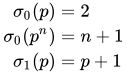
because by definition, the factors of a prime number are 1 and itself.
Clearly, 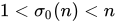


In general, since the divisors of a prime power 


General formula
If 

which, when x ≠ 0, is equivalent to:
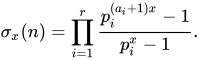
When x = 0, 
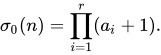
Proof: The proof is combinatorial in nature. Distributing (expanding) the product

gives a sum in which each summand is a product. In the products there is one factor per parentheses, and each is one of the summands in the parentheses. Each such selection gives a different summand. Each such selection is equivalent to select, for each 


For example, the divisors of 


A direct consequence of the formula is that the function 


Other properties and identities
Euler proved the remarkable recurrence:
![{\begin{aligned}\sigma _{1}(n)&=\sigma _{1}(n-1)+\sigma _{1}(n-2)-\sigma _{1}(n-5)-\sigma _{1}(n-7)+\sigma _{1}(n-12)+\sigma _{1}(n-15)+\cdots \\[12mu]&=\sum _{i\in \mathbb {N} }(-1)^{i+1}\left(\sigma _{1}\left(n-{\frac {1}{2}}\left(3i^{2}-i\right)\right)+\sigma _{1}\left(n-{\frac {1}{2}}\left(3i^{2}+i\right)\right)\right),\end{aligned}}](https://wikimedia.org/api/rest_v1/media/math/render/svg/57edf7ce8b5ba7cd703d6696d6272fc4bce20ffc)
where 


For a non-square integer, n, every divisor, d, of n is paired with divisor n/d of n and 

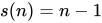
We also note s(n) = σ(n) − n. Here s(n) denotes the sum of the proper divisors of n, that is, the divisors of n excluding n itself. This function is used to recognize perfect numbers, which are the n such that s(n) = n. If s(n) > n, then n is an abundant number, and if s(n) < n, then n is a deficient number.
If n is a power of 2, 

As an example, for two primes 
.
Then


and


where 
Then, the roots of
![(x-p)(x-q)=x^{2}-(p+q)x+n=x^{2}-[(\sigma (n)-\varphi (n))/2]x+[(\sigma (n)+\varphi (n))/2-1]=0](https://wikimedia.org/api/rest_v1/media/math/render/svg/0ad1713c0c16dad5582f05ac235d6f6a116b598a)
express p and q in terms of σ(n) and φ(n) only, requiring no knowledge of n or 
![p=(\sigma (n)-\varphi (n))/4-{\sqrt {[(\sigma (n)-\varphi (n))/4]^{2}-[(\sigma (n)+\varphi (n))/2-1]}},](https://wikimedia.org/api/rest_v1/media/math/render/svg/4451d4e5cba4e47140fd055650c0cc07739186a2)
![q=(\sigma (n)-\varphi (n))/4+{\sqrt {[(\sigma (n)-\varphi (n))/4]^{2}-[(\sigma (n)+\varphi (n))/2-1]}}.](https://wikimedia.org/api/rest_v1/media/math/render/svg/ec0c03afb9b83137b596f0c857be23fa65b66806)
Also, knowing n and either 
In 1984, Roger Heath-Brown proved that the equality

is true for infinitely many values of n, see OEIS: A005237.
Dirichlet convolutions
By definition:

05Series relations
Two Dirichlet series involving the divisor function are:

where 

and a Ramanujan identity

which is a special case of the Rankin-Selberg convolution.
A Lambert series involving the divisor function is:

for arbitrary complex |q| ≤ 1 and a (
For 

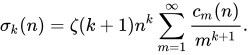
The computation of the first terms of 
![\sigma _{k}(n)=\zeta (k+1)n^{k}\left[1+{\frac {(-1)^{n}}{2^{k+1}}}+{\frac {2\cos {\frac {2\pi n}{3}}}{3^{k+1}}}+{\frac {2\cos {\frac {\pi n}{2}}}{4^{k+1}}}+\cdots \right]](https://wikimedia.org/api/rest_v1/media/math/render/svg/cf656d9d28eb4e6b5948ea58d577e6f17bf3fbdd)

06Growth rate
In little-o notation, the divisor function satisfies the inequality:

More precisely, Severin Wigert showed that:

approached by

On the other hand, since there are infinitely many prime numbers,
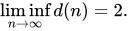
In Big-O notation, Peter Gustav Lejeune Dirichlet showed that the average order of the divisor function satisfies the following inequality:

where 

The behaviour of the sigma function is irregular. The asymptotic growth rate of the sigma function can be expressed by:
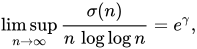
where lim sup is the limit superior. This result is Grönwall's theorem, published in 1913 (Grönwall 1913). His proof uses Mertens' third theorem, which says that:
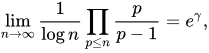
where p denotes a prime. Grönwall also showed that

where
In 1915, Ramanujan proved that under the assumption of the Riemann hypothesis, Robin's inequality
(where γ is the Euler-Mascheroni constant)
holds for all sufficiently large n (Ramanujan 1997). The largest known value that violates the inequality is n=5040. In 1984, Guy Robin proved that the inequality is true for all n > 5040 if and only if the Riemann hypothesis is true (Robin 1984). This is Robin's theorem and the inequality became known after him. Robin furthermore showed that if the Riemann hypothesis is false then there are an infinite number of values of n that violate the inequality, and it is known that the smallest such n > 5040 must be superabundant (Akbary & Friggstad 2009). It has been shown that the inequality holds for large odd and square-free integers, and that the Riemann hypothesis is equivalent to the inequality just for n divisible by the fifth power of a prime (Choie et al. 2007).
Robin also proved, unconditionally, that the inequality:

holds for all n ≥ 3.
A related bound was given by Jeffrey Lagarias in 2002, who proved that the Riemann hypothesis is equivalent to the statement that:

for every natural number n > 1, where 
Sources and credits
This article is adapted from the Wikipedia article “Divisor function”, written by its contributors and licensed under CC BY-SA 4.0. Fathomly has changed the layout, removed citation markers, navigation and maintenance notices, and adjusted punctuation. This adapted version is shared under the same license. For references, see the original article.
Images, from Wikimedia Commons:
- Divisor.svg by Linas, CC BY-SA 3.0
- Sigma function.svg by Linas, CC BY-SA 3.0
- Divisor square.svg by Linas, GFDL
- Divisor cube.svg by The original uploader was Linas at English Wikipedia., CC BY-SA 3.0
Fathomly is not affiliated with or endorsed by the Wikimedia Foundation. Spotted a problem? Tell us.

