Divisor
Integer that divides another integer

In mathematics, a divisor of an integer 


The concept of a divisor is extended, with the same definition, to elements of any ring; see Divisibility (ring theory).
01Definition
An integer 


This may be read as that

There are two conventions, distinguished by whether
- With the convention without an additional constraint on
for every integer
- With the convention that


02General
Divisors can be negative as well as positive, although often the term is restricted to positive divisors. For example, there are six divisors of 4; they are 1, 2, 4, −1, −2, and −4, but only the positive ones (1, 2, and 4) would usually be mentioned.
1 and −1 divide (are divisors of) every integer. Every integer (and its negation) is a divisor of itself. Integers divisible by 2 are called even, and integers not divisible by 2 are called odd.
1, −1, 
There are divisibility rules that allow one to recognize certain divisors of a number from the number's digits.
03Examples
- 7 is a divisor of 42 because
so we can say
It can also be said that 42 is divisible by 7, 42 is a multiple of 7, 7 divides 42, or 7 is a factor of 42.
- The non-trivial divisors of 6 are 2, −2, 3, −3.
- The positive divisors of 42 are 1, 2, 3, 6, 7, 14, 21, 42.
- The set of all positive divisors of 60,
partially ordered by divisibility, has the Hasse diagram:

04Further notions and facts
There are some elementary rules:
- If
and
then
that is, divisibility is a transitive relation.
- If
then
or
(That is,
and
are associates.)
- If
then
holds, as does
However, if
then
does not always hold (for example,
and
but 5 does not divide 6).
for nonzero
. This follows immediately from writing
.
If 
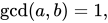

If 


A positive divisor of
An integer 
Any positive divisor of
A number
The total number of positive divisors of 




If the prime factorization of

then the number of positive divisors of

and each of the divisors has the form
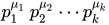
where 

For every natural
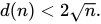
Also,

where 

05Division lattice
In definitions that allow the divisor to be 0, the relation of divisibility turns the set 
Sources and credits
This article is adapted from the Wikipedia article “Divisor”, written by its contributors and licensed under CC BY-SA 4.0. Fathomly has changed the layout, removed citation markers, navigation and maintenance notices, and adjusted punctuation. This adapted version is shared under the same license. For references, see the original article.
Images, from Wikimedia Commons:
- Cuisenaire ten.JPG by Annielogue, CC BY-SA 3.0
- Highly composite numbers.svg by Cmglee, CC BY-SA 3.0
- Lattice of the divisibility of 60; factors.svg by Watchduck You can name the author as "T. Piesk", "Tilman Piesk" or "Watchduck"., CC BY 3.0
Fathomly is not affiliated with or endorsed by the Wikimedia Foundation. Spotted a problem? Tell us.

