Reference articles on history, science, culture and more
Encyclopedia

Prime omega function

Number of prime factors of a natural number

In number theory, the prime omega functions \omega (n) and \Omega (n) count the number of prime factors of a natural number n. The number of distinct prime factors is assigned to \omega (n) (little omega), while \Omega (n) (big omega) counts the total number of prime factors with multiplicity (see arithmetic function). That is, if we have a prime factorization of n of the form n=p_{1}^{\alpha _{1}}p_{2}^{\alpha _{2}}\cdots p_{k}^{\alpha _{k}} for distinct primes p_{i} (1\leq i\leq k), then the prime omega functions are given by \omega (n)=k and \Omega (n)=\alpha _{1}+\alpha _{2}+\cdots +\alpha _{k}. These prime-factor-counting functions have many important number theoretic relations.

01Properties and relations

The function \omega (n) is additive and \Omega (n) is completely additive. Little omega has the formula

\omega (n)=\sum _{p\mid n}1,

where notation p|n indicates that the sum is taken over all primes p that divide n, without multiplicity. For example, \omega (12)=\omega (2^{2}3)=2.

Big omega has the formulas

\Omega (n)=\sum _{p^{\alpha }\mid n}1=\sum _{p^{\alpha }\parallel n}\alpha .

The notation pα|n indicates that the sum is taken over all prime powers pα that divide n, while pα||n indicates that the sum is taken over all prime powers pα that divide n and such that n / pα is coprime to pα. For example, \Omega (12)=\Omega (2^{2}3^{1})=3.

The omegas are related by the inequalities ω(n) Ω(n) and 2ω(n) d(n) 2Ω(n), where d(n) is the divisor-counting function. If Ω(n) = ω(n), then n is squarefree and related to the Möbius function by

\mu (n)=(-1)^{\omega (n)}=(-1)^{\Omega (n)}.

If \omega (n)=1 then n is a prime power, and if \Omega (n)=1 then n is prime.

An asymptotic series for the average order of \omega (n) is

{\frac {1}{n}}\sum \limits _{k=1}^{n}\omega (k)\sim \log \log n+B_{1}+\sum _{k\geq 1}\left(\sum _{j=0}^{k-1}{\frac {\gamma _{j}}{j!}}-1\right){\frac {(k-1)!}{(\log n)^{k}}},

where B_{1}\approx 0.26149721 is the Mertens constant and \gamma _{j} are the Stieltjes constants.

The function \omega (n) is related to divisor sums over the Möbius function and the divisor function, including:

\sum _{d\mid n}|\mu (d)|=2^{\omega (n)} is the number of unitary divisors. (sequence A034444 in the OEIS)
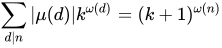
\sum _{d\mid n}|\mu (d)|k^{\omega (d)}=(k+1)^{\omega (n)}
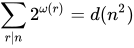
\sum _{r\mid n}2^{\omega (r)}=d(n^{2})
\sum _{r\mid n}2^{\omega (r)}d\left({\frac {n}{r}}\right)=d^{2}(n)
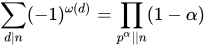
\sum _{d\mid n}(-1)^{\omega (d)}=\prod \limits _{p^{\alpha }||n}(1-\alpha )
\sum _{\stackrel {1\leq k\leq m}{(k,m)=1}}\gcd(k^{2}-1,m_{1})\gcd(k^{2}-1,m_{2})=\varphi (n)\sum _{\stackrel {d_{1}\mid m_{1}}{d_{2}\mid m_{2}}}\varphi (\gcd(d_{1},d_{2}))2^{\omega (\operatorname {lcm} (d_{1},d_{2}))},\ m_{1},m_{2}{\text{ odd}},m=\operatorname {lcm} (m_{1},m_{2})
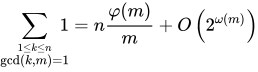
\sum _{\stackrel {1\leq k\leq n}{\operatorname {gcd} (k,m)=1}}\!\!\!\!1=n{\frac {\varphi (m)}{m}}+O\left(2^{\omega (m)}\right)

The characteristic function of the primes can be expressed by a convolution with the Möbius function:

\chi _{\mathbb {P} }(n)=(\mu \ast \omega )(n)=\sum _{d|n}\omega (d)\mu (n/d).

A partition-related exact identity for \omega (n) is given by

\omega (n)=\log _{2}\left[\sum _{k=1}^{n}\sum _{j=1}^{k}\left(\sum _{d\mid k}\sum _{i=1}^{d}p(d-ji)\right)s_{n,k}\cdot |\mu (j)|\right],

where p(n) is the partition function, \mu (n) is the Möbius function, and the triangular sequence s_{n,k} is expanded by

s_{n,k}=[q^{n}](q;q)_{\infty }{\frac {q^{k}}{1-q^{k}}}=s_{o}(n,k)-s_{e}(n,k),

in terms of the infinite q-Pochhammer symbol and the restricted partition functions s_{o/e}(n,k) which respectively denote the number of k's in all partitions of n into an odd (even) number of distinct parts.

02Continuation to the complex plane

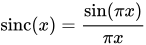
A continuation of \omega (n) has been found, though it is not analytic everywhere. Note that the normalized \operatorname {sinc} function \operatorname {sinc} (x)={\frac {\sin(\pi x)}{\pi x}} is used.

\omega (z)=\log _{2}\left(\sum _{n=1}^{\lceil Re(z)\rceil }\operatorname {sinc} \left(\prod _{m=1}^{\lceil Re(z)\rceil +1}\left(n^{2}+n-mz\right)\right)\right)

This is closely related to the following partition identity. Consider partitions of the form

a={\frac {2}{c}}+{\frac {4}{c}}+\ldots +{\frac {2(b-1)}{c}}+{\frac {2b}{c}}

where a, b, and c are positive integers, and a>b>c. The number of partitions is then given by 2^{\omega (a)}-2.

03Average order and summatory functions

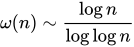
An average order of both \omega (n) and \Omega (n) is \log \log n. When n is prime a lower bound on the value of the function is \omega (n)=1. Similarly, if n is primorial then the function is as large as

\omega (n)\sim {\frac {\log n}{\log \log n}}

on average order. When n is a power of 2, then \Omega (n)=\log _{2}(n).

Asymptotics for the summatory functions over \omega (n), \Omega (n), and powers of \omega (n) are respectively
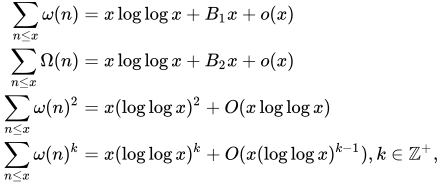
{\begin{aligned}\sum _{n\leq x}\omega (n)&=x\log \log x+B_{1}x+o(x)\\\sum _{n\leq x}\Omega (n)&=x\log \log x+B_{2}x+o(x)\\\sum _{n\leq x}\omega (n)^{2}&=x(\log \log x)^{2}+O(x\log \log x)\\\sum _{n\leq x}\omega (n)^{k}&=x(\log \log x)^{k}+O(x(\log \log x)^{k-1}),k\in \mathbb {Z} ^{+},\end{aligned}}

where B_{1}\approx 0.2614972128 is the Mertens constant and the constant B_{2} is defined by

B_{2}=B_{1}+\sum _{p{\text{ prime}}}{\frac {1}{p(p-1)}}\approx 1.0345061758.

The sum of number of unitary divisors is

\sum _{n\leq x}2^{\omega (n)}=(x\log x)/\zeta (2)+O(x) (sequence A064608 in the OEIS)

Other sums relating the two variants of the prime omega functions include

\sum _{n\leq x}\left\{\Omega (n)-\omega (n)\right\}=O(x),

and

\#\left\{n\leq x:\Omega (n)-\omega (n)>{\sqrt {\log \log x}}\right\}=O\left({\frac {x}{(\log \log x)^{1/2}}}\right).

Example I: A modified summatory function

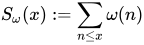
In this example we suggest a variant of the summatory functions S_{\omega }(x):=\sum _{n\leq x}\omega (n) estimated in the above results for sufficiently large x. We then prove an asymptotic formula for the growth of this modified summatory function derived from the asymptotic estimate of S_{\omega }(x) provided in the formulas in the main subsection of this article above.
To be completely precise, let the odd-indexed summatory function be defined as

S_{\operatorname {odd} }(x):=\sum _{n\leq x}\omega (n)[n{\text{ odd}}],

where [\cdot ] denotes Iverson bracket. Then we have that

S_{\operatorname {odd} }(x)={\frac {x}{2}}\log \log x+{\frac {(2B_{1}-1)x}{4}}+\left\{{\frac {x}{4}}\right\}-\left[x\equiv 2,3{\bmod {4}}\right]+O\left({\frac {x}{\log x}}\right).

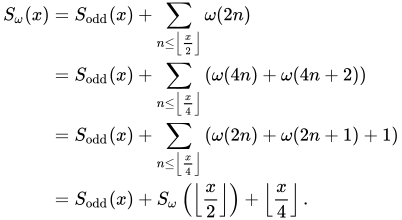
The proof of this result follows by first observing that

\omega (2n)={\begin{cases}\omega (n)+1,&{\text{if }}n{\text{ is odd; }}\\\omega (n),&{\text{if }}n{\text{ is even,}}\end{cases}}

and then applying the asymptotic result from Hardy and Wright for the summatory function over \omega (n), denoted by S_{\omega }(x):=\sum _{n\leq x}\omega (n), in the following form:
{\begin{aligned}S_{\omega }(x)&=S_{\operatorname {odd} }(x)+\sum _{n\leq \left\lfloor {\frac {x}{2}}\right\rfloor }\omega (2n)\\&=S_{\operatorname {odd} }(x)+\sum _{n\leq \left\lfloor {\frac {x}{4}}\right\rfloor }\left(\omega (4n)+\omega (4n+2)\right)\\&=S_{\operatorname {odd} }(x)+\sum _{n\leq \left\lfloor {\frac {x}{4}}\right\rfloor }\left(\omega (2n)+\omega (2n+1)+1\right)\\&=S_{\operatorname {odd} }(x)+S_{\omega }\left(\left\lfloor {\frac {x}{2}}\right\rfloor \right)+\left\lfloor {\frac {x}{4}}\right\rfloor .\end{aligned}}

Example II: Summatory functions for so-termed factorial moments of ω(n)

The computations expanded in Chapter 22.11 of Hardy and Wright provide asymptotic estimates for the summatory function

\omega (n)\left\{\omega (n)-1\right\},

by estimating the product of these two component omega functions as

\omega (n)\left\{\omega (n)-1\right\}=\sum _{\stackrel {pq\mid n}{\stackrel {p\neq q}{p,q{\text{ prime}}}}}1=\sum _{\stackrel {pq\mid n}{p,q{\text{ prime}}}}1-\sum _{\stackrel {p^{2}\mid n}{p{\text{ prime}}}}1.

We can similarly calculate asymptotic formulas more generally for the related summatory functions over so-termed factorial moments of the function \omega (n).

04Dirichlet series

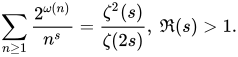
A known Dirichlet series involving \omega (n) and the Riemann zeta function is given by
\sum _{n\geq 1}{\frac {2^{\omega (n)}}{n^{s}}}={\frac {\zeta ^{2}(s)}{\zeta (2s)}},\ \Re (s)>1.

We can also see that

\sum _{n\geq 1}{\frac {z^{\omega (n)}}{n^{s}}}=\prod _{p}\left(1+{\frac {z}{p^{s}-1}}\right),|z|<2,\Re (s)>1,
\sum _{n\geq 1}{\frac {z^{\Omega (n)}}{n^{s}}}=\prod _{p}\left(1-{\frac {z}{p^{s}}}\right)^{-1},|z|<2,\Re (s)>1,

The function \Omega (n) is completely additive, where \omega (n) is strongly additive (additive). Now we can prove a short lemma in the following form which implies exact formulas for the expansions of the Dirichlet series over both \omega (n) and \Omega (n):

Lemma. Suppose that f is a strongly additive arithmetic function defined such that its values at prime powers is given by f(p^{\alpha }):=f_{0}(p,\alpha ), i.e., f(p_{1}^{\alpha _{1}}\cdots p_{k}^{\alpha _{k}})=f_{0}(p_{1},\alpha _{1})+\cdots +f_{0}(p_{k},\alpha _{k}) for distinct primes p_{i} and exponents \alpha _{i}\geq 1. The Dirichlet series of f is expanded by

\sum _{n\geq 1}{\frac {f(n)}{n^{s}}}=\zeta (s)\times \sum _{p\mathrm {\ prime} }(1-p^{-s})\cdot \sum _{n\geq 1}f_{0}(p,n)p^{-ns},\Re (s)>\min(1,\sigma _{f}).

Proof. We can see that

\sum _{n\geq 1}{\frac {u^{f(n)}}{n^{s}}}=\prod _{p\mathrm {\ prime} }\left(1+\sum _{n\geq 1}u^{f_{0}(p,n)}p^{-ns}\right).

This implies that

{\begin{aligned}\sum _{n\geq 1}{\frac {f(n)}{n^{s}}}&={\frac {d}{du}}\left[\prod _{p\mathrm {\ prime} }\left(1+\sum _{n\geq 1}u^{f_{0}(p,n)}p^{-ns}\right)\right]{\Biggr |}_{u=1}=\prod _{p}\left(1+\sum _{n\geq 1}p^{-ns}\right)\times \sum _{p}{\frac {\sum _{n\geq 1}f_{0}(p,n)p^{-ns}}{1+\sum _{n\geq 1}p^{-ns}}}\\&=\zeta (s)\times \sum _{p\mathrm {\ prime} }(1-p^{-s})\cdot \sum _{n\geq 1}f_{0}(p,n)p^{-ns},\end{aligned}}

wherever the corresponding series and products are convergent. In the last equation, we have used the Euler product representation of the Riemann zeta function.

The lemma implies that for \Re (s)>1,

{\begin{aligned}D_{\omega }(s)&:=\sum _{n\geq 1}{\frac {\omega (n)}{n^{s}}}=\zeta (s)P(s)\\&\ =\zeta (s)\times \sum _{n\geq 1}{\frac {\mu (n)}{n}}\log \zeta (ns)\\D_{\Omega }(s)&:=\sum _{n\geq 1}{\frac {\Omega (n)}{n^{s}}}=\zeta (s)\times \sum _{n\geq 1}P(ns)\\&\ =\zeta (s)\times \sum _{n\geq 1}{\frac {\phi (n)}{n}}\log \zeta (ns)\\D_{h}(s)&:=\sum _{n\geq 1}{\frac {h(n)}{n^{s}}}=\zeta (s)\log \zeta (s)\\&\ =\zeta (s)\times \sum _{n\geq 1}{\frac {\varepsilon (n)}{n}}\log \zeta (ns),\end{aligned}}

where P(s) is the prime zeta function, h(n)=\sum _{p^{k}|n}{\frac {1}{k}}=\sum _{p^{k}||n}{H_{k}} where H_{k} is the k-th harmonic number and \varepsilon is the identity for the Dirichlet convolution, \varepsilon (n)=\lfloor {\frac {1}{n}}\rfloor.

05The distribution of the difference of prime omega functions

The distribution of the distinct integer values of the differences \Omega (n)-\omega (n) is regular in comparison with the semi-random properties of the component functions. For k\geq 0, define

N_{k}(x):=\#(\{n\in \mathbb {Z} ^{+}:\Omega (n)-\omega (n)=k\}\cap [1,x]).

These cardinalities have a corresponding sequence of limiting densities d_{k} such that for x\geq 2

N_{k}(x)=d_{k}\cdot x+O\left(\left({\frac {3}{4}}\right)^{k}{\sqrt {x}}(\log x)^{\frac {4}{3}}\right).

These densities are generated by the prime products

\sum _{k\geq 0}d_{k}\cdot z^{k}=\prod _{p}\left(1-{\frac {1}{p}}\right)\left(1+{\frac {1}{p-z}}\right).

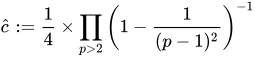
With the absolute constant {\hat {c}}:={\frac {1}{4}}\times \prod _{p>2}\left(1-{\frac {1}{(p-1)^{2}}}\right)^{-1}, the densities d_{k} satisfy

d_{k}={\hat {c}}\cdot 2^{-k}+O(5^{-k}).

Compare to the definition of the prime products defined in the last section of in relation to the Erdős-Kac theorem.

Watch videos about Prime omega functionExplainers and documentaries on YouTube (opens in a new tab)

Sources and credits

This article is adapted from the Wikipedia article Prime omega function, written by its contributors and licensed under CC BY-SA 4.0. Fathomly has changed the layout, removed citation markers, navigation and maintenance notices, and adjusted punctuation. This adapted version is shared under the same license. For references, see the original article.

Fathomly is not affiliated with or endorsed by the Wikimedia Foundation. Spotted a problem? Tell us.

Continue exploring

Related topics