Primorial
Product of the first "n" prime numbers
In mathematics, and more particularly in number theory, primorial, denoted by "
The name "primorial", coined by Harvey Dubner, draws an analogy to primes similar to the way the name "factorial" relates to factors.
01Definition for prime numbers
The primorial 
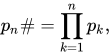
where 



The first few primorials
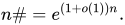
Asymptotically, primorials grow according to

![''n''</sub>#"}},"i":0}}]}' id="mwGA">pn# as a function of n, plotted logarithmically.](https://thumb.wikimedia.org/wikipedia/commons/thumb/e/e3/Primorial_pn_plot.png/960px-Primorial_pn_plot.png)
02Definition for natural numbers
In general, for a positive integer 

where 
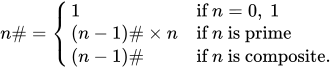
For example, 


Since 

Consider the first 12 values of the sequence

We see that for composite 

Primorials are related to the first Chebyshev function 

Since
03Properties
- For any
,
iff
is the largest prime such that
.
- Let
has exactly
divisors.
- The sum of the reciprocal values of the primorial converges towards a constant

- The Engel expansion of this number results in the sequence of the prime numbers. Griffiths (2015) proved that it is irrational.
- Euclid's proof of his theorem on the infinitude of primes can be paraphrased by saying that, for any prime
has a prime divisor not contained in the set of primes less than or equal to
-
. For
, the values are smaller than
, but for larger
- Since the binomial coefficient
is divisible by every prime between
and
, and since
, we have the following upper bound:
.
- Using elementary methods, Denis Hanson showed that
.
- Using more advanced methods, Rosser and Schoenfeld showed that
. Furthermore, they showed that for
,
.
- Using elementary methods, Denis Hanson showed that
04Applications
Primorials play a role in the search for prime numbers in additive arithmetic progressions. For instance,


Every highly composite number is a product of primorials.
Primorials are all square-free integers, and each one has more distinct prime factors than any number smaller than it. For each primorial 

Any completely multiplicative function is defined by its values at primorials, since it is defined by its values at primes, which can be recovered by division of adjacent values.
Base systems corresponding to primorials (such as base 30, not to be confused with the primorial number system) have a lower proportion of repeating fractions than any smaller base.
Every primorial is a sparsely totient number.

05Compositorial
06Riemann zeta function
The Riemann zeta function at positive integers greater than one can be expressed by using the primorial function and Jordan's totient function 
.
07Table of primorials
| n | n# | pn | pn# | Primorial prime? | |
|---|---|---|---|---|---|
| pn# + 1 | pn# − 1 | ||||
| 0 | 1 | , N/a | 1 | Yes | No |
| 1 | 1 | 2 | 2 | Yes | No |
| 2 | 2 | 3 | 6 | Yes | Yes |
| 3 | 6 | 5 | 30 | Yes | Yes |
| 4 | 6 | 7 | 210 | Yes | No |
| 5 | 30 | 11 | 2310 | Yes | Yes |
| 6 | 30 | 13 | 30030 | No | Yes |
| 7 | 210 | 17 | 510510 | No | No |
| 8 | 210 | 19 | 9699690 | No | No |
| 9 | 210 | 23 | 223092870 | No | No |
| 10 | 210 | 29 | 6469693230 | No | No |
| 11 | 2310 | 31 | 200560490130 | Yes | No |
| 12 | 2310 | 37 | 7420738134810 | No | No |
| 13 | 30030 | 41 | 304250263527210 | No | Yes |
| 14 | 30030 | 43 | 13082761331670030 | No | No |
| 15 | 30030 | 47 | 614889782588491410 | No | No |
| 16 | 30030 | 53 | 32589158477190044730 | No | No |
| 17 | 510510 | 59 | 1922760350154212639070 | No | No |
| 18 | 510510 | 61 | 117288381359406970983270 | No | No |
| 19 | 9699690 | 67 | 7858321551080267055879090 | No | No |
| 20 | 9699690 | 71 | 557940830126698960967415390 | No | No |
| 21 | 9699690 | 73 | 40729680599249024150621323470 | No | No |
| 22 | 9699690 | 79 | 3217644767340672907899084554130 | No | No |
| 23 | 223092870 | 83 | 267064515689275851355624017992790 | No | No |
| 24 | 223092870 | 89 | 23768741896345550770650537601358310 | No | Yes |
| 25 | 223092870 | 97 | 2305567963945518424753102147331756070 | No | No |
| 26 | 223092870 | 101 | 232862364358497360900063316880507363070 | No | No |
| 27 | 223092870 | 103 | 23984823528925228172706521638692258396210 | No | No |
| 28 | 223092870 | 107 | 2566376117594999414479597815340071648394470 | No | No |
| 29 | 6469693230 | 109 | 279734996817854936178276161872067809674997230 | No | No |
| 30 | 6469693230 | 113 | 31610054640417607788145206291543662493274686990 | No | No |
| 31 | 200560490130 | 127 | 4014476939333036189094441199026045136645885247730 | No | No |
| 32 | 200560490130 | 131 | 525896479052627740771371797072411912900610967452630 | No | No |
| 33 | 200560490130 | 137 | 72047817630210000485677936198920432067383702541010310 | No | No |
| 34 | 200560490130 | 139 | 10014646650599190067509233131649940057366334653200433090 | No | No |
| 35 | 200560490130 | 149 | 1492182350939279320058875736615841068547583863326864530410 | No | No |
| 36 | 200560490130 | 151 | 225319534991831177328890236228992001350685163362356544091910 | No | No |
| 37 | 7420738134810 | 157 | 35375166993717494840635767087951744212057570647889977422429870 | No | No |
| 38 | 7420738134810 | 163 | 5766152219975951659023630035336134306565384015606066319856068810 | No | No |
| 39 | 7420738134810 | 167 | 962947420735983927056946215901134429196419130606213075415963491270 | No | No |
| 40 | 7420738134810 | 173 | 166589903787325219380851695350896256250980509594874862046961683989710 | No | No |
Sources and credits
This article is adapted from the Wikipedia article “Primorial”, written by its contributors and licensed under CC BY-SA 4.0. Fathomly has changed the layout, removed citation markers, navigation and maintenance notices, and adjusted punctuation. This adapted version is shared under the same license. For references, see the original article.
Images, from Wikimedia Commons:
- Primorial pn plot.png by Unknown author, Public domain
- Primorial n plot.png by Unknown author, Public domain
Fathomly is not affiliated with or endorsed by the Wikimedia Foundation. Spotted a problem? Tell us.
