Chebyshev function
Mathematical function

In mathematics, the Chebyshev function is either a scalarising function (Tchebycheff function) or one of two related functions. The first Chebyshev function ϑ(x) or θ(x) is given by
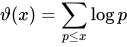
where 
The second Chebyshev function ψ(x) is defined similarly, with the sum extending over all prime powers not exceeding x

where Λ is the von Mangoldt function. The Chebyshev functions, especially the second one ψ(x), are often used in proofs related to prime numbers, because it is typically simpler to work with them than with the prime-counting function, π(x) (see the exact formula below.) Both Chebyshev functions are asymptotic to x, a statement equivalent to the prime number theorem.
Tchebycheff function, Chebyshev utility function, or weighted Tchebycheff scalarizing function is used when one has several functions to be minimized and one wants to "scalarize" them to a single function:

By minimizing this function for different values of 



All three functions are named in honour of Pafnuty Chebyshev.
01Relationships
The second Chebyshev function can be seen to be related to the first by writing it as
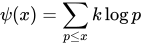
where k is the unique integer such that pk ≤ x and x < pk+1. The values of k are given in OEIS: A206722. A more direct relationship is given by
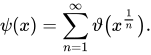
This last sum has only a finite number of non-vanishing terms, as

The second Chebyshev function is the logarithm of the least common multiple of the integers from 1 to n.

Values of lcm(1, 2, ..., n) for the integer variable n are given at OEIS: A003418.
![The function , for 4</sup>"}},"i":0}}]}' id="mwEA">x < 104](https://upload.wikimedia.org/wikipedia/en/thumb/7/7b/Chebyshev.svg/500px-Chebyshev.svg.png)
02Relationships between ψ(x)/x and ϑ(x)/x
The following theorem relates the two quotients 

Theorem: For 
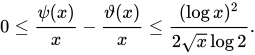
This inequality implies that
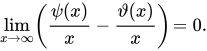
In other words, if one of the 

Proof: Since 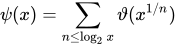

But from the definition of 
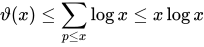
so
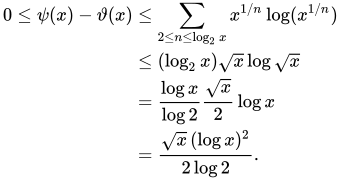
Lastly, divide by 
03Asymptotics and bounds
The following bounds are known for the Chebyshev functions: (in these formulas pk is the kth prime number; p1 = 2, p2 = 3, etc.)
![{\begin{aligned}\vartheta (p_{k})&\geq k\left(\log k+\log \log k-1+{\frac {\log \log k-2.050735}{\log k}}\right)&&{\text{for }}k\geq 10^{11},\\[8px]\vartheta (p_{k})&\leq k\left(\log k+\log \log k-1+{\frac {\log \log k-2}{\log k}}\right)&&{\text{for }}k\geq 198,\\[8px]|\vartheta (x)-x|&\leq 0.006788\,{\frac {x}{\log x}}&&{\text{for }}x\geq 10\,544\,111,\\[8px]|\psi (x)-x|&\leq 0.006409\,{\frac {x}{\log x}}&&{\text{for }}x\geq e^{22},\\[8px]0.9999{\sqrt {x}}&<\psi (x)-\vartheta (x)<1.00007{\sqrt {x}}+1.78{\sqrt[{3}]{x}}&&{\text{for }}x\geq 121.\end{aligned}}](https://wikimedia.org/api/rest_v1/media/math/render/svg/f7301be23d04a6fb8d72a32bdccccb1cc2f9596f)
Furthermore, under the Riemann hypothesis,
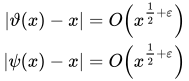
for any ε > 0.
Upper bounds exist for both ϑ(x) and ψ(x) such that
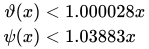
for any x > 0.
An explanation of the constant 1.03883 is given at OEIS: A206431.
04The exact formula
In 1895, Hans Carl Friedrich von Mangoldt proved an explicit expression for ψ(x) as a sum over the nontrivial zeros of the Riemann zeta function:

(The numerical value of ζ′(0)/ζ(0) is log(2π).) Here ρ runs over the nontrivial zeros of the zeta function, and ψ0 is the same as ψ, except that at its jump discontinuities (the prime powers) it takes the value halfway between the values to the left and the right:

From the Taylor series for the logarithm, the last term in the explicit formula can be understood as a summation of xω/ω over the trivial zeros of the zeta function, ω = −2, −4, −6, ..., i.e.
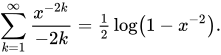
Similarly, the first term, x = x1/1, corresponds to the simple pole of the zeta function at 1. It being a pole rather than a zero accounts for the opposite sign of the term.
![The function , for 7</sup>"}},"i":0}}]}' id="mwFg">x < 107](https://upload.wikimedia.org/wikipedia/en/thumb/7/77/Chebyshev-big.svg/500px-Chebyshev-big.svg.png)
05Properties
A theorem due to Erhard Schmidt states that, for some explicit positive constant K, there are infinitely many natural numbers x such that

and infinitely many natural numbers x such that

In little-o notation, one may write the above as

Hardy and Littlewood prove the stronger result, that

06Relation to primorials
The first Chebyshev function is the logarithm of the primorial of x, denoted x#, as we have

The prime number theorem is equivalent to 


07Relation to the prime-counting function
The Chebyshev function can be related to the prime-counting function as follows. Define
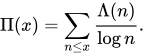
Then

The transition from Π to the prime-counting function, π, is made through the equation
![\Pi (x)=\pi (x)+{\tfrac {1}{2}}\pi \left({\sqrt {x}}\,\right)+{\tfrac {1}{3}}\pi \left({\sqrt[{3}]{x}}\,\right)+\cdots](https://wikimedia.org/api/rest_v1/media/math/render/svg/366ea3365a925e84a1dd8555ba2d8d27aac1207e)
Certainly π(x) ≤ x, so for the sake of approximation, this last relation can be recast in the form

![The difference of the smoothed Chebyshev function and 2</sup>|2}}"}},"i":0}}]}' id="mwAT0">x2/2 for 6</sup>"}},"i":0}}]}' id="mwAT4">x < 106](https://upload.wikimedia.org/wikipedia/en/thumb/9/9d/Chebyshev-smooth.svg/500px-Chebyshev-smooth.svg.png)
08The Riemann hypothesis
The Riemann hypothesis states that all nontrivial zeros of the zeta function have real part 1/2. In this case, |xρ| = √x, and it can be shown that
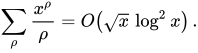
By the above, this implies

09Smoothing function
The smoothing function is defined as
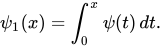
It can trivially be shown that

Sources and credits
This article is adapted from the Wikipedia article “Chebyshev function”, written by its contributors and licensed under CC BY-SA 4.0. Fathomly has changed the layout, removed citation markers, navigation and maintenance notices, and adjusted punctuation. This adapted version is shared under the same license. For references, see the original article.
Images, from Wikimedia Commons:
- Chebyshev.svg by Unknown author, Cc-by-sa-3.0
- Chebyshev-big.svg by Unknown author, Cc-by-sa-3.0
- Chebyshev-smooth.svg by Unknown author, Cc-by-sa-3.0
- ChebyshevPsi.png by Dantheox (talk) (Uploads), Public domain
Fathomly is not affiliated with or endorsed by the Wikimedia Foundation. Spotted a problem? Tell us.