Riesz potential
Potential in mathematics
In mathematics, the Riesz potential is a potential named after its discoverer, the Hungarian mathematician Marcel Riesz. In a sense, the Riesz potential defines a fractional inverse power 
01Definition
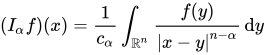
If 0 < α < n, then the Riesz potential Iαf of a locally integrable function f on Rn is the function defined by
 | 1 |
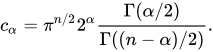
where the constant is given by
This singular integral is well-defined provided f decays sufficiently rapidly at infinity, specifically if f ∈ Lp(Rn) with 1 ≤ p < n/α. The classical result due to Sobolev states that the rate of decay of f and that of Iαf are related in the form of an inequality (the Hardy-Littlewood-Sobolev inequality)

For p=1 the result was extended by (Schikorra, Spector & Van Schaftingen 2014),

where 
The Riesz potential can be defined more generally in a weak sense as the convolution

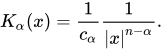
where Kα is the locally integrable function:
The Riesz potential can therefore be defined whenever f is a compactly supported distribution. In this connection, the Riesz potential of a positive Borel measure μ with compact support is chiefly of interest in potential theory because Iαμ is then a (continuous) subharmonic function off the support of μ, and is lower semicontinuous on all of Rn.
Consideration of the Fourier transform reveals that the Riesz potential is a Fourier multiplier. In fact, one has

and so, by the convolution theorem,

The Riesz potentials satisfy the following semigroup property on, for instance, rapidly decreasing continuous functions

provided

Furthermore, if 0 < Re α < n, 2, then

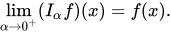
One also has, for this class of functions,
Sources and credits
This article is adapted from the Wikipedia article “Riesz potential”, written by its contributors and licensed under CC BY-SA 4.0. Fathomly has changed the layout, removed citation markers, navigation and maintenance notices, and adjusted punctuation. This adapted version is shared under the same license. For references, see the original article.
Fathomly is not affiliated with or endorsed by the Wikimedia Foundation. Spotted a problem? Tell us.