Differintegral
Operator in fractional calculus
In fractional calculus, an area of mathematical analysis, the differintegral is a combined differentiation/integration operator. Applied to a function ƒ, the q-differintegral of f, here denoted by

is the fractional derivative (if q > 0) or fractional integral (if q < 0). If q = 0, then the q-th differintegral of a function is the function itself. In the context of fractional integration and differentiation, there are several definitions of the differintegral.
01Standard definitions
The four most common forms are:
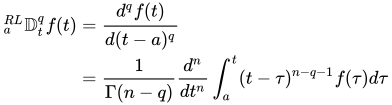
- The Riemann-Liouville differintegral
This is the simplest and easiest to use, and consequently it is the most often used. It is a generalization of the Cauchy formula for repeated integration to arbitrary order. Here,.
- The Grunwald-Letnikov differintegral
The Grunwald-Letnikov differintegral is a direct generalization of the definition of a derivative. It is more difficult to use than the Riemann-Liouville differintegral, but can sometimes be used to solve problems that the Riemann-Liouville cannot. - The Weyl differintegral
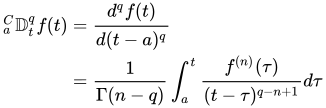
This is formally similar to the Riemann-Liouville differintegral, but applies to periodic functions, with integral zero over a period. - The Caputo differintegral
In opposite to the Riemann-Liouville differintegral, Caputo derivative of a constantis equal to zero. Moreover, a form of the Laplace transform allows to simply evaluate the initial conditions by computing finite, integer-order derivatives at point
.
![{\begin{aligned}{}_{a}^{GL}\mathbb {D} _{t}^{q}f(t)&={\frac {d^{q}f(t)}{d(t-a)^{q}}}\\&=\lim _{N\to \infty }\left[{\frac {t-a}{N}}\right]^{-q}\sum _{j=0}^{N-1}(-1)^{j}{q \choose j}f\left(t-j\left[{\frac {t-a}{N}}\right]\right)\end{aligned}}](https://wikimedia.org/api/rest_v1/media/math/render/svg/4a9425ed6583f9404f96a0805e86307fbb405d17)
02Definitions via transforms
The definitions of fractional derivatives given by Liouville, Fourier, and Grunwald and Letnikov coincide. They can be represented via Laplace, Fourier transforms or via Newton series expansion.
Recall the continuous Fourier transform, here denoted 

Using the continuous Fourier transform, in Fourier space, differentiation transforms into a multiplication:
![{\mathcal {F}}\left[{\frac {df(t)}{dt}}\right]=i\omega {\mathcal {F}}[f(t)]](https://wikimedia.org/api/rest_v1/media/math/render/svg/9c00eacccf6a3a8f1dbdd59b950fc67a994d075a)
So,
![{\frac {d^{n}f(t)}{dt^{n}}}={\mathcal {F}}^{-1}\left\{(i\omega )^{n}{\mathcal {F}}[f(t)]\right\}](https://wikimedia.org/api/rest_v1/media/math/render/svg/0d92d8b17feb7237c53a32ad44a415baef07d1e4)
![\mathbb {D} ^{q}f(t)={\mathcal {F}}^{-1}\left\{(i\omega )^{q}{\mathcal {F}}[f(t)]\right\}.](https://wikimedia.org/api/rest_v1/media/math/render/svg/432db8176dacdf77a6efc57b64d98b7129c9b71f)
Under the bilateral Laplace transform, here denoted by 
![{\textstyle {\mathcal {L}}[f(t)]=\int _{-\infty }^{\infty }e^{-st}f(t)\,dt](https://wikimedia.org/api/rest_v1/media/math/render/svg/eec27a03bd008307d998207e5c17230ff5bfc897)
![{\mathcal {L}}\left[{\frac {df(t)}{dt}}\right]=s{\mathcal {L}}[f(t)].](https://wikimedia.org/api/rest_v1/media/math/render/svg/ab746e6713f090c3f638a07107dfe3d0fed052f3)
Generalizing to arbitrary order and solving for 
![\mathbb {D} ^{q}f(t)={\mathcal {L}}^{-1}\left\{s^{q}{\mathcal {L}}[f(t)]\right\}.](https://wikimedia.org/api/rest_v1/media/math/render/svg/1209039e313d0d0a3f34994f613bcddf28dd5430)
Representation via Newton series is the Newton interpolation over consecutive integer orders:

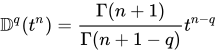
For fractional derivative definitions described in this section, the following identities hold:


03Basic formal properties
- Linearity rules


- Zero rule
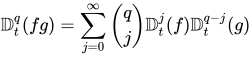
- Product rule

In general, composition (or semigroup) rule is a desirable property, but is hard to achieve mathematically and hence is not always completely satisfied by each proposed operator; this forms part of the decision making process on which one to choose:
(ideally)
(in practice)
Sources and credits
This article is adapted from the Wikipedia article “Differintegral”, written by its contributors and licensed under CC BY-SA 4.0. Fathomly has changed the layout, removed citation markers, navigation and maintenance notices, and adjusted punctuation. This adapted version is shared under the same license. For references, see the original article.
Fathomly is not affiliated with or endorsed by the Wikimedia Foundation. Spotted a problem? Tell us.