Reference articles on history, science, culture and more
Encyclopedia

Bessel potential

Mathematical potential

In mathematics, the Bessel potential is a potential (named after Friedrich Wilhelm Bessel) similar to the Riesz potential but with better decay properties at infinity.

If s is a complex number with positive real part then the Bessel potential of order s is the operator

(I-\Delta )^{-s/2}

where Δ is the Laplace operator and the fractional power is defined using Fourier transforms.

Yukawa potentials are particular cases of Bessel potentials for s=2 in the 3-dimensional space.

01Representation in Fourier space

The Bessel potential acts by multiplication on the Fourier transforms: for each \xi \in \mathbb {R} ^{d}

{\mathcal {F}}((I-\Delta )^{-s/2}u)(\xi )={\frac {{\mathcal {F}}u(\xi )}{(1+4\pi ^{2}\vert \xi \vert ^{2})^{s/2}}}.

02Integral representations

When s>0, the Bessel potential on \mathbb {R} ^{d} can be represented by

(I-\Delta )^{-s/2}u=G_{s}\ast u,

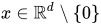
where the Bessel kernel G_{s} is defined for x\in \mathbb {R} ^{d}\setminus \{0\} by the integral formula

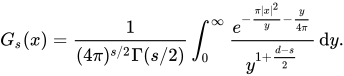
G_{s}(x)={\frac {1}{(4\pi )^{s/2}\Gamma (s/2)}}\int _{0}^{\infty }{\frac {e^{-{\frac {\pi \vert x\vert ^{2}}{y}}-{\frac {y}{4\pi }}}}{y^{1+{\frac {d-s}{2}}}}}\,\mathrm {d} y.

Here \Gamma denotes the Gamma function. The Bessel kernel can also be represented for x\in \mathbb {R} ^{d}\setminus \{0\} by

G_{s}(x)={\frac {e^{-\vert x\vert }}{(2\pi )^{\frac {d-1}{2}}2^{\frac {s}{2}}\Gamma ({\frac {s}{2}})\Gamma ({\frac {d-s+1}{2}})}}\int _{0}^{\infty }e^{-\vert x\vert t}{\Big (}t+{\frac {t^{2}}{2}}{\Big )}^{\frac {d-s-1}{2}}\,\mathrm {d} t.

This last expression can be more succinctly written in terms of a modified Bessel function, for which the potential gets its name:

G_{s}(x)={\frac {1}{2^{(s-2)/2}(2\pi )^{d/2}\Gamma ({\frac {s}{2}})}}K_{(d-s)/2}(\vert x\vert )\vert x\vert ^{(s-d)/2}.

03Asymptotics

At the origin, one has as \vert x\vert \to 0,

G_{s}(x)={\frac {\Gamma ({\frac {d-s}{2}})}{2^{s}\pi ^{s/2}\vert x\vert ^{d-s}}}(1+o(1))\quad {\text{ if }}0<s<d,
G_{d}(x)={\frac {1}{2^{d-1}\pi ^{d/2}}}\ln {\frac {1}{\vert x\vert }}(1+o(1)),
G_{s}(x)={\frac {\Gamma ({\frac {s-d}{2}})}{2^{s}\pi ^{s/2}}}(1+o(1))\quad {\text{ if }}s>d.

In particular, when 0<s<d the Bessel potential behaves asymptotically as the Riesz potential.

At infinity, one has, as \vert x\vert \to \infty,

G_{s}(x)={\frac {e^{-\vert x\vert }}{2^{\frac {d+s-1}{2}}\pi ^{\frac {d-1}{2}}\Gamma ({\frac {s}{2}})\vert x\vert ^{\frac {d+1-s}{2}}}}(1+o(1)).
Watch videos about Bessel potentialExplainers and documentaries on YouTube (opens in a new tab)

Sources and credits

This article is adapted from the Wikipedia article Bessel potential, written by its contributors and licensed under CC BY-SA 4.0. Fathomly has changed the layout, removed citation markers, navigation and maintenance notices, and adjusted punctuation. This adapted version is shared under the same license. For references, see the original article.

Fathomly is not affiliated with or endorsed by the Wikimedia Foundation. Spotted a problem? Tell us.