Mertens function
Summatory function of the Möbius function

In number theory, the Mertens function is defined for all positive integers n as
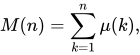
where 

Less formally, 
The first 143 M(n) values are (sequence A002321 in the OEIS)
| M(n) | +0 | +1 | +2 | +3 | +4 | +5 | +6 | +7 | +8 | +9 | +10 | +11 |
|---|---|---|---|---|---|---|---|---|---|---|---|---|
| 0+ | 1 | 0 | −1 | −1 | −2 | −1 | −2 | −2 | −2 | −1 | −2 | |
| 12+ | −2 | −3 | −2 | −1 | −1 | −2 | −2 | −3 | −3 | −2 | −1 | −2 |
| 24+ | −2 | −2 | −1 | −1 | −1 | −2 | −3 | −4 | −4 | −3 | −2 | −1 |
| 36+ | −1 | −2 | −1 | 0 | 0 | −1 | −2 | −3 | −3 | −3 | −2 | −3 |
| 48+ | −3 | −3 | −3 | −2 | −2 | −3 | −3 | −2 | −2 | −1 | 0 | −1 |
| 60+ | −1 | −2 | −1 | −1 | −1 | 0 | −1 | −2 | −2 | −1 | −2 | −3 |
| 72+ | −3 | −4 | −3 | −3 | −3 | −2 | −3 | −4 | −4 | −4 | −3 | −4 |
| 84+ | −4 | −3 | −2 | −1 | −1 | −2 | −2 | −1 | −1 | 0 | 1 | 2 |
| 96+ | 2 | 1 | 1 | 1 | 1 | 0 | −1 | −2 | −2 | −3 | −2 | −3 |
| 108+ | −3 | −4 | −5 | −4 | −4 | −5 | −6 | −5 | −5 | −5 | −4 | −3 |
| 120+ | −3 | −3 | −2 | −1 | −1 | −1 | −1 | −2 | −2 | −1 | −2 | −3 |
| 132+ | −3 | −2 | −1 | −1 | −1 | −2 | −3 | −4 | −4 | −3 | −2 | −1 |
The Mertens function slowly grows in positive and negative directions both on average and in peak value, oscillating in an apparently chaotic manner passing through zero when n has the values
- 2, 39, 40, 58, 65, 93, 101, 145, 149, 150, 159, 160, 163, 164, 166, 214, 231, 232, 235, 236, 238, 254, 329, 331, 332, 333, 353, 355, 356, 358, 362, 363, 364, 366, 393, 401, 403, 404, 405, 407, 408, 413, 414, 419, 420, 422, 423, 424, 425, 427, 428, ... (sequence A028442 in the OEIS).
Because the Möbius function only takes the values −1, 0, and +1, the Mertens function moves slowly, and there is no x such that |M(x)| > x. H. Davenport demonstrated that, for any fixed h,
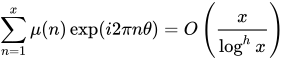
uniformly in 

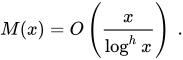
The Mertens conjecture went further, stating that there would be no x where the absolute value of the Mertens function exceeds the square root of x. The Mertens conjecture was proven false in 1985 by Andrew Odlyzko and Herman te Riele. However, the Riemann hypothesis is equivalent to a weaker conjecture on the growth of M(x), namely M(x) = O(x1/2 + ε). Since high values for M(x) grow at least as fast as 
The true rate of growth of M(x) is not known. An unpublished conjecture of Steve Gonek states that

Probabilistic evidence towards this conjecture is given by Nathan Ng. In particular, Ng gives a conditional proof that the function 



if one assumes various conjectures about the Riemann zeta function.
01Representations
As an integral
Using the Euler product, one finds that
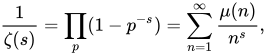
where 
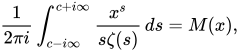
where c > 1.
Conversely, one has the Mellin transform
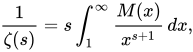
which holds for 
A curious relation given by Mertens himself involving the second Chebyshev function is

Assuming that the Riemann zeta function has no multiple non-trivial zeros, one has the "exact formula" by the residue theorem:

Hermann Weyl conjectured that the Mertens function satisfied the approximate functional-differential equation

where H(x) is the Heaviside step function, B are Bernoulli numbers, and all derivatives with respect to t are evaluated at t = 0.
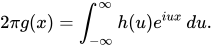
There is also a trace formula involving a sum over the Möbius function and zeros of the Riemann zeta function in the form

where the first sum on the right-hand side is taken over the non-trivial zeros of the Riemann zeta function, and (g, h) are related by the Fourier transform, such that
As a sum over Farey sequences
Another formula for the Mertens function is
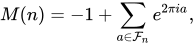
where 
This formula is used in the proof of the Franel-Landau theorem.
As a determinant
M(n) is the determinant of the n × n Redheffer matrix, a (0, 1) matrix in which aij is 1 if either j is 1 or i divides j.
As a sum of the number of points under n-dimensional hyperboloids

This formulation expanding the Mertens function suggests asymptotic bounds obtained by considering the Piltz divisor problem, which generalizes the Dirichlet divisor problem of computing asymptotic estimates for the summatory function of the divisor function.

02Other properties


 is the
 03Calculation
Neither of the methods mentioned previously leads to practical algorithms to calculate the Mertens function. Using sieve methods similar to those used in prime counting, the Mertens function has been computed for all integers up to an increasing range of x.
| Person | Year | Limit |
|---|---|---|
| Mertens | 1897 | 104 |
| von Sterneck | 1897 | 1.5×10⁵ |
| von Sterneck | 1901 | 5×10⁵ |
| von Sterneck | 1912 | 5×10⁶ |
| Neubauer | 1963 | 108 |
| Cohen and Dress | 1979 | 7.8×10⁹ |
| Dress | 1993 | 1012 |
| Lioen and van de Lune | 1994 | 1013 |
| Kotnik and van de Lune | 2003 | 1014 |
| Boncompagni | 2011 | 1017 |
| Kuznetsov | 2012 | 1022 |
| Helfgott and Thompson | 2021 | 1023 |
The Mertens function for all integer values up to x may be computed in O(x log log x) time. A combinatorial algorithm has been developed incrementally starting in 1870 by Ernst Meissel, Lehmer, Lagarias-Miller-Odlyzko, and Deléglise-Rivat that computes isolated values of M(x) in O(x2/3(log log x)1/3) time; a further improvement by Harald Helfgott and Lola Thompson in 2021 improves this to O(x3/5(log x)3/5+ε), and an algorithm by Lagarias and Odlyzko based on integrals of the Riemann zeta function achieves a running time of O(x1/2+ε).
04Known upper bounds
Ng notes that the Riemann hypothesis (RH) is equivalent to

for some positive constant 
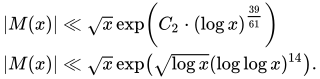
Known explicit upper bounds without assuming the RH are given by:
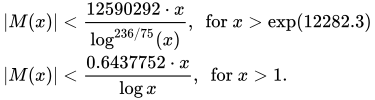
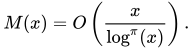
It is possible to simplify the above expression into a less restrictive but illustrative form as:
Sources and credits
This article is adapted from the Wikipedia article “Mertens function”, written by its contributors and licensed under CC BY-SA 4.0. Fathomly has changed the layout, removed citation markers, navigation and maintenance notices, and adjusted punctuation. This adapted version is shared under the same license. For references, see the original article.
Images, from Wikimedia Commons:
- Mertens.svg by Unknown author, Cc-by-sa-3.0
- Mertens-big.svg by Unknown author, Cc-by-sa-3.0
Fathomly is not affiliated with or endorsed by the Wikimedia Foundation. Spotted a problem? Tell us.