Linear complex structure
Mathematics concept
In mathematics, a complex structure on a real vector space 

Every complex vector space can be equipped with a compatible complex structure in a canonical way; however, there is in general no canonical complex structure. Complex structures have applications in representation theory as well as in complex geometry where they play an essential role in the definition of almost complex manifolds, by contrast to complex manifolds. The term "complex structure" often refers to this structure on manifolds; when it refers instead to a structure on vector spaces, it may be called a linear complex structure.
01Definition and properties
A complex structure on a real vector space 


Going in the other direction, if one starts with a complex vector space 

More formally, a linear complex structure on a real vector space is an algebra representation of the complex numbers 
![\mathbb {C} =\mathbb {R} [x]/(x^{2}+1),](https://wikimedia.org/api/rest_v1/media/math/render/svg/1eea0bc4d153e53f51a2c1bedb5f885d7da23a9a)


If 


A real linear transformation 


02Examples
Elementary example
The collection of 


has square equal to the negative of the identity matrix. A complex structure may be formed in 

Complex n-dimensional space Cn
The fundamental example of a linear complex structure is the structure on R2n coming from the complex structure on Cn. That is, the complex n-dimensional space Cn is also a real 2n-dimensional space, using the same vector addition and real scalar multiplication, while multiplication by the complex number i is not only a complex linear transform of the space, thought of as a complex vector space, but also a real linear transform of the space, thought of as a real vector space. Concretely, this is because scalar multiplication by i commutes with scalar multiplication by real numbers 
Given a basis 



If one orders the basis as 
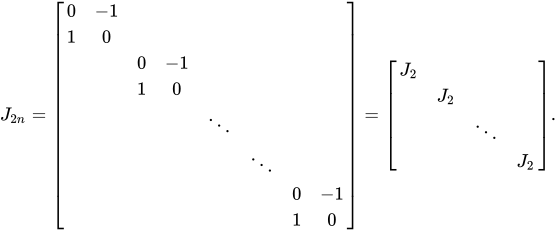


On the other hand, if one orders the basis as 
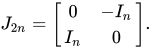
The data of the real vector space and the J matrix is exactly the same as the data of the complex vector space, as the J matrix allows one to define complex multiplication. At the level of Lie algebras and Lie groups, this corresponds to the inclusion of gl(n,C) in gl(2n,R) (Lie algebras, matrices, not necessarily invertible) and GL(n,C) in GL(2n,R):
gl(n,C) < gl(2n,R) and GL(n,C) < GL(2n,R).The inclusion corresponds to forgetting the complex structure (and keeping only the real), while the subgroup GL(n,C) can be characterized (given in equations) as the matrices that commute with J:

![[J,A]=0;](https://wikimedia.org/api/rest_v1/media/math/render/svg/a79a26a2f81aa03c5683a68a026b0c4d881c6cda)
![[J,-].](https://wikimedia.org/api/rest_v1/media/math/render/svg/3a03a9700a09d778a0388ca81254aa778c1f09c0)
Note that the defining equations for these statements are the same, as 

![[A,J]=0,](https://wikimedia.org/api/rest_v1/media/math/render/svg/108d2923a2580f45f753ddc2b7d1fe7c0d0f2ba9)
Direct sum
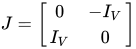
If V is any real vector space there is a canonical complex structure on the direct sum V ⊕ V given by



03Compatibility with other structures
If B is a bilinear form on V then we say that J preserves B if


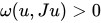
If g is an inner product on V then J preserves g if and only if J is an orthogonal transformation. Likewise, J preserves a nondegenerate, skew-symmetric form ω if and only if J is a symplectic transformation (that is, if 

Given a symplectic form ω and a linear complex structure J on V, one may define an associated bilinear form gJ on V by

If the symplectic form ω is preserved (but not necessarily tamed) by J, then gJ is the real part of the Hermitian form (by convention antilinear in the first argument) 

04Relation to complexifications
Given any real vector space V we may define its complexification by extension of scalars:
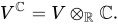
This is a complex vector space whose complex dimension is equal to the real dimension of V. It has a canonical complex conjugation defined by
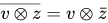
If J is a complex structure on V, we may extend J by linearity to VC:

Since C is algebraically closed, J is guaranteed to have eigenvalues which satisfy λ2 = −1, namely λ = ±i. Thus we may write

where V+ and V− are the eigenspaces of +i and −i, respectively. Complex conjugation interchanges V+ and V−. The projection maps onto the V± eigenspaces are given by
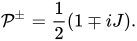
So that

There is a natural complex linear isomorphism between VJ and V+, so these vector spaces can be considered the same, while V− may be regarded as the complex conjugate of VJ.
Note that if VJ has complex dimension n then both V+ and V− have complex dimension n while VC has complex dimension 2n.
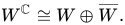
Abstractly, if one starts with a complex vector space W and takes the complexification of the underlying real space, one obtains a space isomorphic to the direct sum of W and its conjugate:
05Extension to related vector spaces
Let V be a real vector space with a complex structure J. The dual space V* has a natural complex structure J* given by the dual (or transpose) of J. The complexification of the dual space (V*)C therefore has a natural decomposition

into the ±i eigenspaces of J*. Under the natural identification of (V*)C with (VC)* one can characterize (V*)+ as those complex linear functionals which vanish on V−. Likewise (V*)− consists of those complex linear functionals which vanish on V+.
The (complex) tensor, symmetric, and exterior algebras over VC also admit decompositions. The exterior algebra is perhaps the most important application of this decomposition. In general, if a vector space U admits a decomposition U = S ⊕ T, then the exterior powers of U can be decomposed as follows:

A complex structure J on V therefore induces a decomposition
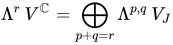
where

All exterior powers are taken over the complex numbers. So if VJ has complex dimension n (real dimension 2n) then

The dimensions add up correctly as a consequence of Vandermonde's identity.
The space of (p,q)-forms Λp,q VJ* is the space of (complex) multilinear forms on VC which vanish on homogeneous elements unless p are from V+ and q are from V−. It is also possible to regard Λp,q VJ* as the space of real multilinear maps from VJ to C which are complex linear in p terms and conjugate-linear in q terms.
See complex differential form and almost complex manifold for applications of these ideas.
Sources and credits
This article is adapted from the Wikipedia article “Linear complex structure”, written by its contributors and licensed under CC BY-SA 4.0. Fathomly has changed the layout, removed citation markers, navigation and maintenance notices, and adjusted punctuation. This adapted version is shared under the same license. For references, see the original article.
Fathomly is not affiliated with or endorsed by the Wikimedia Foundation. Spotted a problem? Tell us.
