Block matrix
Matrix defined using smaller matrices called blocks

In mathematics, a block matrix or a partitioned matrix is a matrix that is interpreted as having been broken into sections called blocks or submatrices.
Intuitively, a matrix interpreted as a block matrix can be visualized as the original matrix with a collection of horizontal and vertical lines, which break it up, or partition it, into a collection of smaller matrices. For example, the 3×4 matrix presented below is divided by horizontal and vertical lines into four blocks: the top-left 2×3 block, the top-right 2×1 block, the bottom-left 1×3 block, and the bottom-right 1×1 block.
![\left[{\begin{array}{ccc|c}a_{11}&a_{12}&a_{13}&b_{1}\\a_{21}&a_{22}&a_{23}&b_{2}\\\hline c_{1}&c_{2}&c_{3}&d\end{array}}\right]](https://wikimedia.org/api/rest_v1/media/math/render/svg/baf9177be256a1e10129aaf8ab43c0bb505edcf4)
Any matrix may be interpreted as a block matrix in one or more ways, with each interpretation defined by how its rows and columns are partitioned.
This notion can be made more precise for an 




Block matrix algebra arises in general from biproducts in categories of matrices.
01Example
The matrix
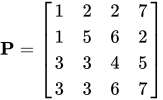
can be visualized as divided into four blocks, as
![\mathbf {P} =\left[{\begin{array}{cc|cc}1&2&2&7\\1&5&6&2\\\hline 3&3&4&5\\3&3&6&7\end{array}}\right].](https://wikimedia.org/api/rest_v1/media/math/render/svg/2e1eb6b3f7794b26543da63b488d648509eef9f5)
The horizontal and vertical lines have no special mathematical meaning, but are a common way to visualize a partition. By this partition, 
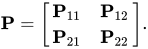
![{\begin{aligned}\mathbf {P} _{11}&={\begin{bmatrix}1&2\\1&5\end{bmatrix}},&\mathbf {P} _{12}&={\begin{bmatrix}2&7\\6&2\end{bmatrix}},\\[1ex]\mathbf {P} _{21}&={\begin{bmatrix}3&3\\3&3\end{bmatrix}},&\mathbf {P} _{22}&={\begin{bmatrix}4&5\\6&7\end{bmatrix}}.\end{aligned}}](https://wikimedia.org/api/rest_v1/media/math/render/svg/579c50846543ba0f4aa02d9da49361582f4402d1)
The partitioned matrix can then be written as
02Formal definition
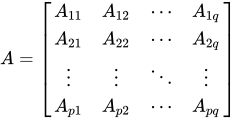
Let 


where 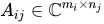


By this definition, the blocks in any one column must all have the same number of columns. Similarly, the blocks in any one row must have the same number of rows.
Partitioning methods
A matrix can be partitioned in many ways. For example, a matrix

where 


where 

Common partitions
Often, we encounter the 2×2 partition

particularly in the form where 

03Block matrix operations
Transpose
Let
where 

and the same equation holds with the transpose replaced by the conjugate transpose.
Block transpose
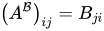
A special form of matrix transpose can also be defined for block matrices, where individual blocks are reordered but not transposed. Let 





Addition
Let

where 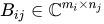


Multiplication
It is possible to use a block partitioned matrix product that involves only algebra on submatrices of the factors. The partitioning of the factors is not arbitrary, however, and requires "conformable partitions" between two matrices
Two matrices
, when
, Arak M. Mathai and Hans J. Haubold, Linear Algebra: A Course for Physicists and Engineers
Let

can be performed blockwise, yielding 
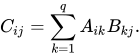
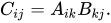
Or, using the Einstein notation that implicitly sums over repeated indices:
Depicting

Inversion
If a matrix is partitioned into four blocks, it can be inverted blockwise as follows:
![{\begin{aligned}P&={\begin{bmatrix}A&B\\C&D\end{bmatrix}}^{-1}\\[1ex]&={\begin{bmatrix}A^{-1}+A^{-1}B\left(D-CA^{-1}B\right)^{-1}CA^{-1}&-A^{-1}B\left(D-CA^{-1}B\right)^{-1}\\-\left(D-CA^{-1}B\right)^{-1}CA^{-1}&\left(D-CA^{-1}B\right)^{-1}\end{bmatrix}},\end{aligned}}](https://wikimedia.org/api/rest_v1/media/math/render/svg/150c90ee97b06239a673eb8379ef8c2ea1cc6e85)
where A and D are square blocks of arbitrary size, and B and C are conformable with them for partitioning. Furthermore, A and the Schur complement of A in P: P/A = D − CA−1B must be invertible.
Equivalently, by permuting the blocks:
![{\begin{aligned}P&={\begin{bmatrix}A&B\\C&D\end{bmatrix}}^{-1}\\[1ex]&={\begin{bmatrix}\left(A-BD^{-1}C\right)^{-1}&-\left(A-BD^{-1}C\right)^{-1}BD^{-1}\\-D^{-1}C\left(A-BD^{-1}C\right)^{-1}&D^{-1}+D^{-1}C\left(A-BD^{-1}C\right)^{-1}BD^{-1}\end{bmatrix}}.\end{aligned}}](https://wikimedia.org/api/rest_v1/media/math/render/svg/f86f6841c0645147f164a1e82d02fe56be470b8b)
Here, D and the Schur complement of D in P: P/D = A − BD−1C must be invertible.
If A and D are both invertible, then:

By the Weinstein-Aronszajn identity, one of the two matrices in the block-diagonal matrix is invertible exactly when the other is. Block matrix inversion also enables to yield from the efficiency of the fast matrix multiplication algorithms, which allows to perform the inversion in time 

Computing submatrix inverses from the full inverse
By the symmetry between a matrix and its inverse in the block inversion formula, if a matrix P and its inverse P−1 are partitioned conformally:

then the inverse of any principal submatrix can be computed from the corresponding blocks of P−1:


This relationship follows from recognizing that E−1 = A − BD−1C (the Schur complement), and applying the same block inversion formula with the roles of P and P−1 reversed.
Determinant
The formula for the determinant of a 



Using this formula, we can derive that characteristic polynomials of 


If

and if

If the blocks are square matrices of the same size further formulas hold. For example, if 



This formula has been generalized to matrices composed of more than
For 


04Special types of block matrices
Direct sums and block diagonal matrices
Direct sum
For any arbitrary matrices A (of size m × n) and B (of size p × q), we have the direct sum of A and B, denoted by A ⊕ B and defined as
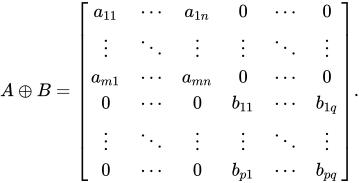
For instance,
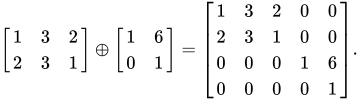
This operation generalizes naturally to arbitrary dimensioned arrays (provided that A and B have the same number of dimensions).
Note that any element in the direct sum of two vector spaces of matrices could be represented as a direct sum of two matrices.
Block diagonal matrices
A block diagonal matrix is a block matrix that is a square matrix such that the main-diagonal blocks are square matrices and all off-diagonal blocks are zero matrices. That is, a block diagonal matrix A has the form

where Ak is a square matrix for all k = 1, ..., n. In other words, matrix A is the direct sum of A1, ..., An. It can also be indicated as A1 ⊕ A2 ⊕ ... ⊕ An or diag(A1, A2, ..., An) (the latter being the same formalism used for a diagonal matrix). Any square matrix can trivially be considered a block diagonal matrix with only one block.
For the determinant and trace, the following properties hold:
and

A block diagonal matrix is invertible if and only if each of its main-diagonal blocks are invertible, and in this case its inverse is another block diagonal matrix given by
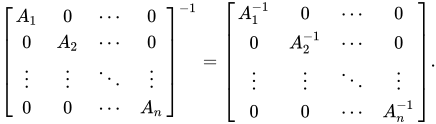
The eigenvalues and eigenvectors of 

Block tridiagonal matrices
A block tridiagonal matrix is another special block matrix, which is just like the block diagonal matrix a square matrix, having square matrices (blocks) in the lower diagonal, main diagonal and upper diagonal, with all other blocks being zero matrices. It is essentially a tridiagonal matrix but has submatrices in places of scalars. A block tridiagonal matrix

where 

Block tridiagonal matrices are often encountered in numerical solutions of engineering problems (e.g., computational fluid dynamics). Optimized numerical methods for LU factorization are available and hence efficient solution algorithms for equation systems with a block tridiagonal matrix as coefficient matrix. The Thomas algorithm, used for efficient solution of equation systems involving a tridiagonal matrix can also be applied using matrix operations to block tridiagonal matrices (see also Block LU decomposition).
Block triangular matrices
An 




Block Toeplitz matrices
A block Toeplitz matrix is another special block matrix, which contains blocks that are repeated down the diagonals of the matrix, as a Toeplitz matrix has elements repeated down the diagonal.
A matrix 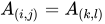
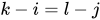

where 
Block Hankel matrices
A matrix 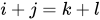

where
Sources and credits
This article is adapted from the Wikipedia article “Block matrix”, written by its contributors and licensed under CC BY-SA 4.0. Fathomly has changed the layout, removed citation markers, navigation and maintenance notices, and adjusted punctuation. This adapted version is shared under the same license. For references, see the original article.
Images, from Wikimedia Commons:
- BlockMatrix168square.png by Parasakthi ( பராசக்தி ) / User:Photonique, CC BY-SA 3.0
Fathomly is not affiliated with or endorsed by the Wikimedia Foundation. Spotted a problem? Tell us.