Reference articles on history, science, culture and more
Encyclopedia

Multilinear map

Vector-valued function of multiple vectors, linear in each argument

In linear algebra, a multilinear map is a function of several variables that is linear separately in each variable. More precisely, a multilinear map is a function

f\colon V_{1}\times \cdots \times V_{n}\to W{\text{,}}

where V_{1},\ldots ,V_{n} (n\in \mathbb {Z} _{\geq 0}) and W are vector spaces (or modules over a commutative ring), with the following property: for each i, if all of the variables but v_{i} are held constant, then f(v_{1},\ldots ,v_{i},\ldots ,v_{n}) is a linear function of v_{i}. One way to visualize this is to imagine two orthogonal vectors; if one of these vectors is scaled by a factor of 2 while the other remains unchanged, the cross product likewise scales by a factor of two. If both are scaled by a factor of 2, the cross product scales by a factor of 2^{2}.

A multilinear map of one variable is a linear map, and of two variables is a bilinear map. More generally, for any nonnegative integer k, a multilinear map of k variables is called a k-linear map. If the codomain of a multilinear map is the field of scalars, it is called a multilinear form. Multilinear maps and multilinear forms are fundamental objects of study in multilinear algebra.

If all variables belong to the same space, one can consider symmetric, antisymmetric and alternating k-linear maps. The latter two coincide if the underlying ring (or field) has a characteristic different from two, else the former two coincide.

01Examples

02Coordinate representation

Let

f\colon V_{1}\times \cdots \times V_{n}\to W{\text{,}}

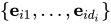
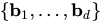
be a multilinear map between finite-dimensional vector spaces, where V_{i}\! has dimension d_{i}\!, and W\! has dimension d\!. If we choose a basis \{{\textbf {e}}_{i1},\ldots ,{\textbf {e}}_{id_{i}}\} for each V_{i}\! and a basis \{{\textbf {b}}_{1},\ldots ,{\textbf {b}}_{d}\} for W\! (using bold for vectors), then we can define a collection of scalars A_{j_{1}\cdots j_{n}}^{k} by

f({\textbf {e}}_{1j_{1}},\ldots ,{\textbf {e}}_{nj_{n}})=A_{j_{1}\cdots j_{n}}^{1}\,{\textbf {b}}_{1}+\cdots +A_{j_{1}\cdots j_{n}}^{d}\,{\textbf {b}}_{d}.

Then the scalars \{A_{j_{1}\cdots j_{n}}^{k}\mid 1\leq j_{i}\leq d_{i},1\leq k\leq d\} completely determine the multilinear function f\!. In particular, if

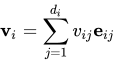
{\textbf {v}}_{i}=\sum _{j=1}^{d_{i}}v_{ij}{\textbf {e}}_{ij}\!

for 1\leq i\leq n\!, then

f({\textbf {v}}_{1},\ldots ,{\textbf {v}}_{n})=\sum _{j_{1}=1}^{d_{1}}\cdots \sum _{j_{n}=1}^{d_{n}}\sum _{k=1}^{d}A_{j_{1}\cdots j_{n}}^{k}v_{1j_{1}}\cdots v_{nj_{n}}{\textbf {b}}_{k}.

03Example

Let's take a trilinear function

g\colon R^{2}\times R^{2}\times R^{2}\to R, where Vi = R2, di = 2, i = 1,2,3, and W = R, d = 1.

A basis for each Vi is \{{\textbf {e}}_{i1},\ldots ,{\textbf {e}}_{id_{i}}\}=\{{\textbf {e}}_{1},{\textbf {e}}_{2}\}=\{(1,0),(0,1)\}. Let

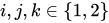
g({\textbf {e}}_{1i},{\textbf {e}}_{2j},{\textbf {e}}_{3k})=f({\textbf {e}}_{i},{\textbf {e}}_{j},{\textbf {e}}_{k})=A_{ijk}, where i,j,k\in \{1,2\}. In other words, the constant A_{ijk} is a function value at one of the eight possible triples of basis vectors (since there are two choices for each of the three V_{i}), namely: \{{\textbf {e}}_{1},{\textbf {e}}_{1},{\textbf {e}}_{1}\},\{{\textbf {e}}_{1},{\textbf {e}}_{1},{\textbf {e}}_{2}\},\{{\textbf {e}}_{1},{\textbf {e}}_{2},{\textbf {e}}_{1}\},\{{\textbf {e}}_{1},{\textbf {e}}_{2},{\textbf {e}}_{2}\},\{{\textbf {e}}_{2},{\textbf {e}}_{1},{\textbf {e}}_{1}\},\{{\textbf {e}}_{2},{\textbf {e}}_{1},{\textbf {e}}_{2}\},\{{\textbf {e}}_{2},{\textbf {e}}_{2},{\textbf {e}}_{1}\},\{{\textbf {e}}_{2},{\textbf {e}}_{2},{\textbf {e}}_{2}\}.

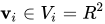
Each vector {\textbf {v}}_{i}\in V_{i}=R^{2} can be expressed as a linear combination of the basis vectors

{\textbf {v}}_{i}=\sum _{j=1}^{2}v_{ij}{\textbf {e}}_{ij}=v_{i1}\times {\textbf {e}}_{1}+v_{i2}\times {\textbf {e}}_{2}=v_{i1}\times (1,0)+v_{i2}\times (0,1).

The function value at an arbitrary collection of three vectors {\textbf {v}}_{i}\in R^{2} can be expressed as g({\textbf {v}}_{1},{\textbf {v}}_{2},{\textbf {v}}_{3})=\sum _{i=1}^{2}\sum _{j=1}^{2}\sum _{k=1}^{2}A_{ijk}v_{1i}v_{2j}v_{3k}, or in expanded form as {\begin{aligned}g((a,b),(c,d)&,(e,f))=ace\times g({\textbf {e}}_{1},{\textbf {e}}_{1},{\textbf {e}}_{1})+acf\times g({\textbf {e}}_{1},{\textbf {e}}_{1},{\textbf {e}}_{2})\\&+ade\times g({\textbf {e}}_{1},{\textbf {e}}_{2},{\textbf {e}}_{1})+adf\times g({\textbf {e}}_{1},{\textbf {e}}_{2},{\textbf {e}}_{2})+bce\times g({\textbf {e}}_{2},{\textbf {e}}_{1},{\textbf {e}}_{1})+bcf\times g({\textbf {e}}_{2},{\textbf {e}}_{1},{\textbf {e}}_{2})\\&+bde\times g({\textbf {e}}_{2},{\textbf {e}}_{2},{\textbf {e}}_{1})+bdf\times g({\textbf {e}}_{2},{\textbf {e}}_{2},{\textbf {e}}_{2}).\end{aligned}}

04Relation to tensor products

There is a natural one-to-one correspondence between multilinear maps

f\colon V_{1}\times \cdots \times V_{n}\to W{\text{,}}

and linear maps

F\colon V_{1}\otimes \cdots \otimes V_{n}\to W{\text{,}}

where V_{1}\otimes \cdots \otimes V_{n}\! denotes the tensor product of V_{1},\ldots ,V_{n}. The relation between the functions f and F is given by the formula

f(v_{1},\ldots ,v_{n})=F(v_{1}\otimes \cdots \otimes v_{n}).

05Multilinear functions on n×n matrices

One can consider multilinear functions, on an n×n matrix over a commutative ring K with identity, as a function of the rows (or equivalently the columns) of the matrix. Let A be such a matrix and ai, 1 ≤ in, be the rows of A. Then the multilinear function D can be written as

D(A)=D(a_{1},\ldots ,a_{n}),

satisfying

D(a_{1},\ldots ,ca_{i}+a_{i}',\ldots ,a_{n})=cD(a_{1},\ldots ,a_{i},\ldots ,a_{n})+D(a_{1},\ldots ,a_{i}',\ldots ,a_{n}).

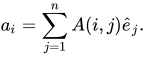
If we let {\hat {e}}_{j} represent the jth row of the identity matrix, we can express each row ai as the sum

a_{i}=\sum _{j=1}^{n}A(i,j){\hat {e}}_{j}.

Using the multilinearity of D we rewrite D(A) as

D(A)=D\left(\sum _{j=1}^{n}A(1,j){\hat {e}}_{j},a_{2},\ldots ,a_{n}\right)=\sum _{j=1}^{n}A(1,j)D({\hat {e}}_{j},a_{2},\ldots ,a_{n}).

Continuing this substitution for each ai we get, for 1 ≤ in,

D(A)=\sum _{1\leq k_{1}\leq n}\ldots \sum _{1\leq k_{i}\leq n}\ldots \sum _{1\leq k_{n}\leq n}A(1,k_{1})A(2,k_{2})\dots A(n,k_{n})D({\hat {e}}_{k_{1}},\dots ,{\hat {e}}_{k_{n}}).

Therefore, D(A) is uniquely determined by how D operates on {\hat {e}}_{k_{1}},\dots ,{\hat {e}}_{k_{n}}.

06Example

In the case of 2×2 matrices, we get

D(A)=A_{1,1}A_{1,2}D({\hat {e}}_{1},{\hat {e}}_{1})+A_{1,1}A_{2,2}D({\hat {e}}_{1},{\hat {e}}_{2})+A_{1,2}A_{2,1}D({\hat {e}}_{2},{\hat {e}}_{1})+A_{1,2}A_{2,2}D({\hat {e}}_{2},{\hat {e}}_{2}),\,

where {\hat {e}}_{1}=[1,0] and {\hat {e}}_{2}=[0,1]. If we restrict D to be an alternating function, then D({\hat {e}}_{1},{\hat {e}}_{1})=D({\hat {e}}_{2},{\hat {e}}_{2})=0 and D({\hat {e}}_{2},{\hat {e}}_{1})=-D({\hat {e}}_{1},{\hat {e}}_{2})=-D(I). Letting D(I)=1, we get the determinant function on 2×2 matrices:

D(A)=A_{1,1}A_{2,2}-A_{1,2}A_{2,1}.

07Properties

  • A multilinear map has a value of zero whenever one of its arguments is zero.
Watch videos about Multilinear mapExplainers and documentaries on YouTube (opens in a new tab)

Sources and credits

This article is adapted from the Wikipedia article Multilinear map, written by its contributors and licensed under CC BY-SA 4.0. Fathomly has changed the layout, removed citation markers, navigation and maintenance notices, and adjusted punctuation. This adapted version is shared under the same license. For references, see the original article.

Fathomly is not affiliated with or endorsed by the Wikimedia Foundation. Spotted a problem? Tell us.