Alternating multilinear map
Multilinear map that is 0 whenever arguments are linearly dependent
In mathematics, more specifically in multilinear algebra, an alternating multilinear map is a multilinear map with all arguments belonging to the same vector space (for example, a bilinear form or a multilinear form) that is zero whenever any pair of its arguments is equal. This generalizes directly to a module over a commutative ring.
The notion of alternatization (or alternatisation) is used to derive an alternating multilinear map from any multilinear map of which all arguments belong to the same space.
01Definition
Let 


- whenever there exists
such that
then
.
- whenever there exists
such that
then
02Vector spaces
Let 
- if
are linearly dependent then
03Example
In a Lie algebra, the Lie bracket is an alternating bilinear map. The determinant of a matrix is a multilinear alternating map of the rows or columns of the matrix.
04Properties
If any component 


Every alternating multilinear map is antisymmetric, meaning that



05Alternatization
Given a multilinear map of the form 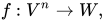



Properties
- The alternatization of an
- The alternatization of a symmetric map is zero.
- The alternatization of a bilinear map is bilinear. Most notably, the alternatization of any cocycle is bilinear. This fact plays a crucial role in identifying the second cohomology group of a lattice with the group of alternating bilinear forms on a lattice.
Sources and credits
This article is adapted from the Wikipedia article “Alternating multilinear map”, written by its contributors and licensed under CC BY-SA 4.0. Fathomly has changed the layout, removed citation markers, navigation and maintenance notices, and adjusted punctuation. This adapted version is shared under the same license. For references, see the original article.
Fathomly is not affiliated with or endorsed by the Wikimedia Foundation. Spotted a problem? Tell us.
