Open and closed maps
Functions that send open (resp. closed) subsets to open (resp. closed) subsets
In mathematics, more specifically in topology, an open map is a function between two topological spaces that maps open sets to open sets.
That is, a function 


Open and closed maps are not necessarily continuous. Further, continuity is independent of openness and closedness in the general case and a continuous function may have one, both, or neither property; this fact remains true even if one restricts oneself to metric spaces.
Although their definitions seem more natural, open and closed maps are much less important than continuous maps.
Recall that, by definition, a function 


Early study of open maps was pioneered by Simion Stoilow and Gordon Thomas Whyburn.
01Definitions and characterizations
If 




Competing definitions
There are two different competing, but closely related, definitions of "open map" that are widely used, where both of these definitions can be summarized as: "it is a map that sends open sets to open sets." The following terminology is sometimes used to distinguish between the two definitions.
A map
- "Strongly open map" if whenever
's codomain
- "Relatively open map" if whenever
where as usual, this set is endowed with the subspace topology induced on it by
Every strongly open map is a relatively open map. However, these definitions are not equivalent in general.
- Warning: Many authors define "open map" to mean "relatively open map" (for example, The Encyclopedia of Mathematics) while others define "open map" to mean "strongly open map". In general, these definitions are not equivalent so it is thus advisable to always check what definition of "open map" an author is using.
A surjective map is relatively open if and only if it is strongly open; so for this important special case the definitions are equivalent.
More generally, a map 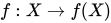
Because 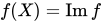
- A map is strongly open if and only if it is relatively open and its image is an open subset of its codomain.
By using this characterization, it is often straightforward to apply results involving one of these two definitions of "open map" to a situation involving the other definition.
The discussion above will also apply to closed maps if each instance of the word "open" is replaced with the word "closed".
Open maps
A map
- Definition:
is an open subset of its codomain
- For every
and every neighborhood
of
(however small),
is a neighborhood of
. We can replace the first or both instances of the word "neighborhood" with "open neighborhood" in this condition and the result will still be an equivalent condition:
- For every
- For every
- For every
for all subsets
of
denotes the topological interior of the set.
- Whenever
is a closed subset of
is a closed subset of
- This is a consequence of the identity
which holds for all subsets
- This is a consequence of the identity

If 
is an open subset of

Closed maps
A map 
A map
- Definition:
for every subset
for every closed subset
- Whenever
is an open subset of
- If
is a net in
is a point such that
in
then
- The convergence
means that every open subset of
will contain
for all sufficiently large indices
- The convergence


A surjective map is strongly closed if and only if it is relatively closed. So for this important special case, the two definitions are equivalent.
By definition, the map 
If in the open set definition of "continuous map" (which is the statement: "every preimage of an open set is open"), both instances of the word "open" are replaced with "closed" then the statement that results ("every preimage of a closed set is closed") is equivalent to continuity.
This does not happen with the definition of "open map" (which is: "every image of an open set is open") since the statement that results ("every image of a closed set is closed") is the definition of "closed map", which is in general not equivalent to openness. There exist open maps that are not closed and there also exist closed maps that are not open. This difference between open/closed maps and continuous maps is ultimately due to the fact that for any set 


02Examples
The function 





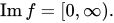

If 
Whenever we have a product of topological spaces 







To every point on the unit circle we can associate the angle of the positive
03Sufficient conditions
Every homeomorphism is open, closed, and continuous. In fact, a continuous bijection is a homeomorphism if and only if it is open, or equivalently, if and only if it is closed.
The composition of two (strongly) open maps is an open map and the composition of two (strongly) closed maps is a closed map. However, the composition of two relatively open maps need not be relatively open and the composition of two relatively closed maps need not be relatively closed.
If 

Let 


The categorical sum of two open maps is open, and of two closed maps is closed. The categorical product of two open maps is also open. However, the categorical product of two closed maps need not be closed.
A bijective map is open if and only if it is closed. The inverse of a continuous bijection is an open and closed bijection (and vice versa). An open surjection is not necessarily closed, and a closed surjection is not necessarily open. All local homeomorphisms, including all coordinate charts on manifolds and all covering maps, are open maps.
Closed map lemma, Every continuous function
A variant of the closed map lemma states that if a continuous function between locally compact Hausdorff spaces is proper, then it is also closed.
In complex analysis, the identically named open mapping theorem states that every non-constant holomorphic function defined on a connected open subset of the complex plane is an open map.
The invariance of domain theorem states that a continuous and locally injective function between two 
Invariance of domain, If 


In functional analysis, the open mapping theorem states that every continuous linear surjection between Banach spaces is an open map. This theorem has been generalized to topological vector spaces beyond just Banach spaces.
A surjective map 



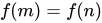


04Properties
Open or closed maps that are continuous
If
- if
- A surjective map
- A surjective map
- if
- if
In the first two cases, being open or closed is merely a sufficient condition for the conclusion that follows. In the third case, it is necessary as well.
Open continuous maps
If 

where
denotes the boundary of a set.
where
- If
where
where this set
is also necessarily a regular closed set (in
- If the continuous open map
and, moreover,
is a regular open (resp. a regular closed) subset of
- If a net
converges in
in
in
is a subnet of
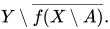
. Moreover, the indexing set
with the product order, where
is any neighbourhood basis of

Sources and credits
This article is adapted from the Wikipedia article “Open and closed maps”, written by its contributors and licensed under CC BY-SA 4.0. Fathomly has changed the layout, removed citation markers, navigation and maintenance notices, and adjusted punctuation. This adapted version is shared under the same license. For references, see the original article.
Fathomly is not affiliated with or endorsed by the Wikimedia Foundation. Spotted a problem? Tell us.
