Clausen function
Transcendental single-variable function

In mathematics, the Clausen function, introduced by Thomas Clausen (1832), is a transcendental, special function of a single variable. It can be expressed in the form of a definite integral, a trigonometric series, and various other forms. It is intimately connected with the polylogarithm, inverse tangent integral, polygamma function, Riemann zeta function, Dirichlet eta function, and Dirichlet beta function.
The Clausen function of order 2, often referred to as the Clausen function, despite being but one of a class of many, is given by the integral:

where log denotes the natural logarithm. In the range 

The Clausen functions, as a class of functions, feature extensively in many areas of modern mathematical research, particularly in relation to the evaluation of many classes of logarithmic and polylogarithmic integrals, both definite and indefinite. They also have numerous applications with regard to the summation of hypergeometric series, summations involving the inverse of the central binomial coefficient, sums of the polygamma function, and Dirichlet L-series.
01Basic properties
The Clausen function (of order 2) has simple zeros at all (integer) multiples of 



It has maxima at
![\theta ={\frac {\pi }{3}}+2m\pi \quad [m\in \mathbb {Z} ]](https://wikimedia.org/api/rest_v1/media/math/render/svg/301caa56535304b0db827b753a2cd412f5665c12)

and minima at
![\theta =-{\frac {\pi }{3}}+2m\pi \quad [m\in \mathbb {Z} ]](https://wikimedia.org/api/rest_v1/media/math/render/svg/2fae98e863733e316c672bdd9098be49e228b375)

The following properties are immediate consequences of the series definition:


See Lu & Perez (1992).
02General definition
More generally, one defines the two generalized Clausen functions:
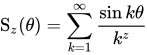
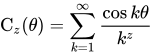
which are valid for complex z with Re z >1. The definition may be extended to all of the complex plane through analytic continuation.
When z is replaced with a non-negative integer, the standard Clausen functions are defined by the following Fourier series:
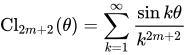
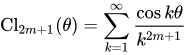
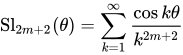
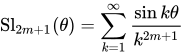
N.B. The SL-type Clausen functions have the alternative notation 
03Relation to the Bernoulli polynomials
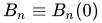
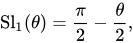
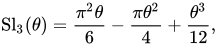
The SL-type Clausen function are polynomials in 


Setting 


where the Bernoulli polynomials 
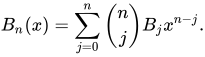
Explicit evaluations derived from the above include:


04Duplication formula
For 

Denoting Catalan's constant by 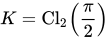
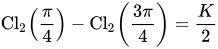
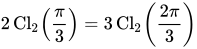
For higher order Clausen functions, duplication formulae can be obtained from the one given above; simply replace 
![\,[0,\theta ].\,](https://wikimedia.org/api/rest_v1/media/math/render/svg/0c44a38c13c401abf6dbb2f057fd64ed963a251d)




And more generally, upon induction on

![\operatorname {Cl} _{m+1}(2\theta )=2^{m}\left[\operatorname {Cl} _{m+1}(\theta )+(-1)^{m}\operatorname {Cl} _{m+1}(\pi -\theta )\right]](https://wikimedia.org/api/rest_v1/media/math/render/svg/2441146c5765f07b3d22ff7d8ff9d94aa675b079)
Use of the generalized duplication formula allows for an extension of the result for the Clausen function of order 2, involving Catalan's constant. For

![\operatorname {Cl} _{2m}\left({\frac {\pi }{2}}\right)=2^{2m-1}\left[\operatorname {Cl} _{2m}\left({\frac {\pi }{4}}\right)-\operatorname {Cl} _{2m}\left({\frac {3\pi }{4}}\right)\right]=\beta (2m)](https://wikimedia.org/api/rest_v1/media/math/render/svg/9ddd71810db9ae56ce6285cb7936562583ce2fba)
Where 
Proof of the duplication formula
From the integral definition,
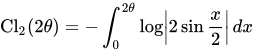
Apply the duplication formula for the sine function, 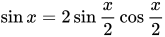
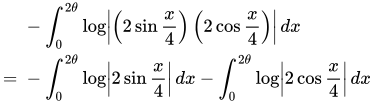
Apply the substitution 
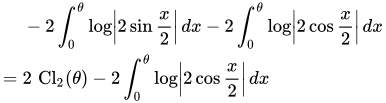
On that last integral, set 

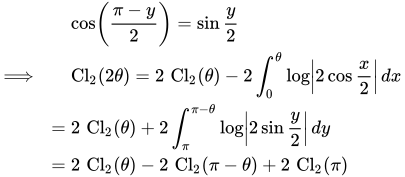

Therefore,

05Derivatives of general-order Clausen functions
Direct differentiation of the Fourier series expansions for the Clausen functions give:




By appealing to the First Fundamental Theorem Of Calculus, we also have:
![{\frac {d}{d\theta }}\operatorname {Cl} _{2}(\theta )={\frac {d}{d\theta }}\left[-\int _{0}^{\theta }\log \left|2\sin {\frac {x}{2}}\right|\,dx\,\right]=-\log \left|2\sin {\frac {\theta }{2}}\right|=\operatorname {Cl} _{1}(\theta )](https://wikimedia.org/api/rest_v1/media/math/render/svg/4d9fa3c1d1d4975c26733d0592edcd47e0804bf8)
06Relation to the inverse tangent integral
The inverse tangent integral is defined on the interval 

It has the following closed form in terms of the Clausen function:

Proof of the inverse tangent integral relation
From the integral definition of the inverse tangent integral, we have

Performing an integration by parts

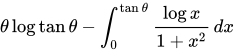
Apply the substitution 
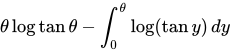
For that last integral, apply the transform 
![{\begin{aligned}&\theta \log \tan \theta -{\frac {1}{2}}\int _{0}^{2\theta }\log \left(\tan {\frac {x}{2}}\right)\,dx\\[6pt]={}&\theta \log \tan \theta -{\frac {1}{2}}\int _{0}^{2\theta }\log \left({\frac {\sin(x/2)}{\cos(x/2)}}\right)\,dx\\[6pt]={}&\theta \log \tan \theta -{\frac {1}{2}}\int _{0}^{2\theta }\log \left({\frac {2\sin(x/2)}{2\cos(x/2)}}\right)\,dx\\[6pt]={}&\theta \log \tan \theta -{\frac {1}{2}}\int _{0}^{2\theta }\log \left(2\sin {\frac {x}{2}}\right)\,dx+{\frac {1}{2}}\int _{0}^{2\theta }\log \left(2\cos {\frac {x}{2}}\right)\,dx\\[6pt]={}&\theta \log \tan \theta +{\frac {1}{2}}\operatorname {Cl} _{2}(2\theta )+{\frac {1}{2}}\int _{0}^{2\theta }\log \left(2\cos {\frac {x}{2}}\right)\,dx.\end{aligned}}](https://wikimedia.org/api/rest_v1/media/math/render/svg/ac1e40c055b307b1f1196786837809a1285052fb)
Finally, as with the proof of the Duplication formula, the substitution 

Thus

07Relation to the Barnes' G-function
For real

Or equivalently

See Adamchik (2003).
08Relation to the polylogarithm
The Clausen functions represent the real and imaginary parts of the polylogarithm, on the unit circle:


This is easily seen by appealing to the series definition of the polylogarithm.

By Euler's theorem,

and by de Moivre's Theorem (De Moivre's formula)

Hence


09Relation to the polygamma function
The Clausen functions are intimately connected to the polygamma function. Indeed, it is possible to express Clausen functions as linear combinations of sine functions and polygamma functions. One such relation is shown here, and proven below:
![\operatorname {Cl} _{2m}\left({\frac {q\pi }{p}}\right)={\frac {1}{(2p)^{2m}(2m-1)!}}\,\sum _{j=1}^{p}\sin \left({\tfrac {qj\pi }{p}}\right)\,\left[\psi _{2m-1}\left({\tfrac {j}{2p}}\right)+(-1)^{q}\psi _{2m-1}\left({\tfrac {j+p}{2p}}\right)\right].](https://wikimedia.org/api/rest_v1/media/math/render/svg/d0df3f90937e191358fb288f9f467cc4ac557350)
An immediate corollary is this equivalent formula in terms of the Hurwitz zeta function:
![\operatorname {Cl} _{2m}\left({\frac {q\pi }{p}}\right)={\frac {1}{(2p)^{2m}}}\,\sum _{j=1}^{p}\sin \left({\tfrac {qj\pi }{p}}\right)\,\left[\zeta \left(2m,{\tfrac {j}{2p}}\right)+(-1)^{q}\zeta \left(2m,{\tfrac {j+p}{2p}}\right)\right].](https://wikimedia.org/api/rest_v1/media/math/render/svg/60025ebbc6e7a7d1676a7fdf206d7a31a4348af4)
| Proof of the formula |
|---|
|
Let We split this sum into exactly p-parts, so that the first series contains all, and only, those terms congruent to We can index these sums to form a double sum: Applying the addition formula for the sine function,
Consequently, To convert the inner sum in the double sum into a non-alternating sum, split in two in parts in exactly the same way as the earlier sum was split into p-parts: For So, in terms of the polygamma function, the previous inner sum becomes: Plugging this back into the double sum gives the desired result: |
 and
and  be positive integers, such that
  is a rational number
 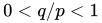 , then, by the series definition for the higher order Clausen function (of even index):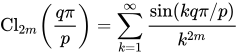
 the second series contains all terms congruent to
  etc., up to the final p-th part, that contain all terms congruent to
![{\begin{aligned}&\operatorname {Cl} _{2m}\left({\frac {q\pi }{p}}\right)\\={}&\sum _{k=0}^{\infty }{\frac {\sin \left[(kp+1){\frac {q\pi }{p}}\right]}{(kp+1)^{2m}}}+\sum _{k=0}^{\infty }{\frac {\sin \left[(kp+2){\frac {q\pi }{p}}\right]}{(kp+2)^{2m}}}+\sum _{k=0}^{\infty }{\frac {\sin \left[(kp+3){\frac {q\pi }{p}}\right]}{(kp+3)^{2m}}}+\cdots \\&\cdots +\sum _{k=0}^{\infty }{\frac {\sin \left[(kp+p-2){\frac {q\pi }{p}}\right]}{(kp+p-2)^{2m}}}+\sum _{k=0}^{\infty }{\frac {\sin \left[(kp+p-1){\frac {q\pi }{p}}\right]}{(kp+p-1)^{2m}}}+\sum _{k=0}^{\infty }{\frac {\sin \left[(kp+p){\frac {q\pi }{p}}\right]}{(kp+p)^{2m}}}\end{aligned}}](https://wikimedia.org/api/rest_v1/media/math/render/svg/0abb29e3b9265e66eb7018f652f04098a17d91d4)
![{\begin{aligned}&\operatorname {Cl} _{2m}\left({\frac {q\pi }{p}}\right)=\sum _{j=1}^{p}\left\{\sum _{k=0}^{\infty }{\frac {\sin \left[(kp+j){\frac {q\pi }{p}}\right]}{(kp+j)^{2m}}}\right\}\\={}&\sum _{j=1}^{p}{\frac {1}{p^{2m}}}\left\{\sum _{k=0}^{\infty }{\frac {\sin \left[(kp+j){\frac {q\pi }{p}}\right]}{(k+(j/p))^{2m}}}\right\}\end{aligned}}](https://wikimedia.org/api/rest_v1/media/math/render/svg/93d3a4f119b0cbb92e6147b61bd28451604b8ee8)
 the sine term in the numerator becomes:
![\sin \left[(kp+j){\frac {q\pi }{p}}\right]=\sin \left(kq\pi +{\frac {qj\pi }{p}}\right)=\sin kq\pi \cos {\frac {qj\pi }{p}}+\cos kq\pi \sin {\frac {qj\pi }{p}}](https://wikimedia.org/api/rest_v1/media/math/render/svg/d008f83fd90d3fdc35c7093aedbabe52cd9276a0)

![\sin \left[(kp+j){\frac {q\pi }{p}}\right]=(-1)^{kq}\sin {\frac {qj\pi }{p}}](https://wikimedia.org/api/rest_v1/media/math/render/svg/1506219055a797a00176b8c46dd48bfafd65ff31)

![{\begin{aligned}&\sum _{k=0}^{\infty }{\frac {(-1)^{kq}}{(k+(j/p))^{2m}}}=\sum _{k=0}^{\infty }{\frac {(-1)^{(2k)q}}{((2k)+(j/p))^{2m}}}+\sum _{k=0}^{\infty }{\frac {(-1)^{(2k+1)q}}{((2k+1)+(j/p))^{2m}}}\\={}&\sum _{k=0}^{\infty }{\frac {1}{(2k+(j/p))^{2m}}}+(-1)^{q}\,\sum _{k=0}^{\infty }{\frac {1}{(2k+1+(j/p))^{2m}}}\\={}&{\frac {1}{2^{p}}}\left[\sum _{k=0}^{\infty }{\frac {1}{(k+(j/2p))^{2m}}}+(-1)^{q}\,\sum _{k=0}^{\infty }{\frac {1}{(k+\left({\frac {j+p}{2p}}\right))^{2m}}}\right]\end{aligned}}](https://wikimedia.org/api/rest_v1/media/math/render/svg/01ce051d7cfe0c8342394d252d02154385293cda)

![{\frac {1}{2^{2m}(2m-1)!}}\left[\psi _{2m-1}\left({\tfrac {j}{2p}}\right)+(-1)^{q}\psi _{2m-1}\left({\tfrac {j+p}{2p}}\right)\right]](https://wikimedia.org/api/rest_v1/media/math/render/svg/26128b06fdb94c2a6db03c6dadef51a6ba4f2418)
![\operatorname {Cl} _{2m}\left({\frac {q\pi }{p}}\right)={\frac {1}{(2p)^{2m}(2m-1)!}}\,\sum _{j=1}^{p}\sin \left({\tfrac {qj\pi }{p}}\right)\,\left[\psi _{2m-1}\left({\tfrac {j}{2p}}\right)+(-1)^{q}\psi _{2m-1}\left({\tfrac {j+p}{2p}}\right)\right]](https://wikimedia.org/api/rest_v1/media/math/render/svg/db9811ae712344b8f051869b880fd4c33014a83d)
10Relation to the generalized logsine integral
The generalized logsine integral is defined by:

In this generalized notation, the Clausen function can be expressed in the form:

11Kummer's relation

 .
.12Relation to the Lobachevsky function
The Lobachevsky function Λ or Л is essentially the same function with a change of variable:

though the name "Lobachevsky function" is not quite historically accurate, as Lobachevsky's formulas for hyperbolic volume used the slightly different function

13Relation to Dirichlet L-functions
For rational values of 


14Series acceleration
A series acceleration for the Clausen function is given by

which holds for 

![{\frac {\operatorname {Cl} _{2}(\theta )}{\theta }}=3-\log \left[|\theta |\left(1-{\frac {\theta ^{2}}{4\pi ^{2}}}\right)\right]-{\frac {2\pi }{\theta }}\log \left({\frac {2\pi +\theta }{2\pi -\theta }}\right)+\sum _{n=1}^{\infty }{\frac {\zeta (2n)-1}{n(2n+1)}}\left({\frac {\theta }{2\pi }}\right)^{2n}.](https://wikimedia.org/api/rest_v1/media/math/render/svg/3a1d4a1a5b2d04b3fd5d444f6f4ba039b7177983)
Convergence is aided by the fact that 
15Special values
Recall the Barnes G-function, the Catalan's constant K and the Gieseking constant V. Some special values include
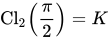
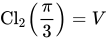






In general, from the Barnes G-function reflection formula,
Equivalently, using Euler's reflection formula for the gamma function, then,

16Generalized special values
Some special values for higher order Clausen functions include

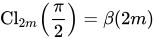



where 


17Integrals of the direct function
The following integrals are easily proven from the series representations of the Clausen function:

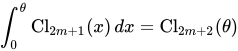
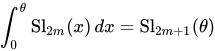

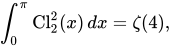
Fourier-analytic methods can be used to find the first moments of the square of the function 
![[0,\pi ]](https://wikimedia.org/api/rest_v1/media/math/render/svg/3e2a912eda6ef1afe46a81b518fe9da64a832751)

![\int _{0}^{\pi }t^{2}\operatorname {Cl} _{2}^{2}(x)\,dx=-{\frac {2}{3}}\pi \left[12\zeta ({\overline {5}},1)+6\zeta ({\overline {4}},2)-{\frac {23}{10080}}\pi ^{6}\right].](https://wikimedia.org/api/rest_v1/media/math/render/svg/d13a18ca3ea120e1cd61af71afab0eb1d9f6f29f)
Here 
18Integral evaluations involving the direct function
A large number of trigonometric and logarithmo-trigonometric integrals can be evaluated in terms of the Clausen function, and various common mathematical constants like 


The examples listed below follow directly from the integral representation of the Clausen function, and the proofs require little more than basic trigonometry, integration by parts, and occasional term-by-term integration of the Fourier series definitions of the Clausen functions.







Sources and credits
This article is adapted from the Wikipedia article “Clausen function”, written by its contributors and licensed under CC BY-SA 4.0. Fathomly has changed the layout, removed citation markers, navigation and maintenance notices, and adjusted punctuation. This adapted version is shared under the same license. For references, see the original article.
Images, from Wikimedia Commons:
- Mplwp Clausen.svg by Geek3, CC BY 3.0
Fathomly is not affiliated with or endorsed by the Wikimedia Foundation. Spotted a problem? Tell us.