Barnes G-function
Extension of superfactorials to the complex numbers

In mathematics, the Barnes G-function 
Formally, the Barnes G-function is defined in the following Weierstrass product form:

where 

The integral representation, which may be deduced from the relation to the double gamma function, is
![\log G(1+z)={\frac {z}{2}}\log(2\pi )+\int _{0}^{\infty }{\frac {dt}{t}}\left[{\frac {1-e^{-zt}}{4\sinh ^{2}{\frac {t}{2}}}}+{\frac {z^{2}}{2}}e^{-t}-{\frac {z}{t}}\right]](https://wikimedia.org/api/rest_v1/media/math/render/svg/0685a3f3888e4be51b260779b00e50ed302c0ba1)
As an entire function, 
01Functional equation and integer arguments
The Barnes G-function satisfies the functional equation
with normalization 

The functional equation implies that

In particular, 


and thus
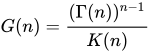
where 


The functional equation 
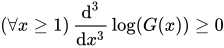
is added. Additionally, the Barnes G-function satisfies the duplication formula,
,
where 

02Characterisation
Similar to the Bohr-Mollerup theorem for the gamma function, for a constant 
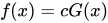

and for


as 
03Reflection formula
The difference equation for the G-function, in conjunction with the functional equation for the gamma function, can be used to obtain the following reflection formula for the Barnes G-function (originally proved by Hermann Kinkelin):

The log-tangent integral on the right-hand side can be evaluated in terms of the Clausen function (of order 2) when 

The proof of this result hinges on the following evaluation of the cotangent integral: introducing the notation 

![{\begin{aligned}\operatorname {Lc} (z)&=\int _{0}^{z}\pi x\cot \pi x\,dx\\&=z\log(\sin \pi z)-\int _{0}^{z}\log(\sin \pi x)\,dx\\&=z\log(\sin \pi z)-\int _{0}^{z}{\Bigg [}\log(2\sin \pi x)-\log 2{\Bigg ]}\,dx\\&=z\log(2\sin \pi z)-\int _{0}^{z}\log(2\sin \pi x)\,dx.\end{aligned}}](https://wikimedia.org/api/rest_v1/media/math/render/svg/f811e80351325fc537e69f045665ca92ec11e907)
Performing the integral substitution 

The Clausen function, of second order, has the integral representation
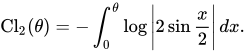
However, within the interval 

Thus, after a slight rearrangement of terms, the proof is complete:
Using the relation 


Adamchik (2003) has given an equivalent form of the reflection formula, but with a different proof.
Replacing 
(involving Bernoulli polynomials):

04Taylor series expansion
By Taylor's theorem, and considering the logarithmic derivatives of the Barnes function, the following series expansion can be obtained:

It is valid for 

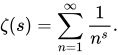
Exponentiating both sides of the Taylor expansion gives:
![{\begin{aligned}G(1+z)&=\exp \left[{\frac {z}{2}}\log 2\pi -\left({\frac {z+(1+\gamma )z^{2}}{2}}\right)+\sum _{k=2}^{\infty }(-1)^{k}{\frac {\zeta (k)}{k+1}}z^{k+1}\right]\\&=(2\pi )^{z/2}\exp \left[-{\frac {z+(1+\gamma )z^{2}}{2}}\right]\exp \left[\sum _{k=2}^{\infty }(-1)^{k}{\frac {\zeta (k)}{k+1}}z^{k+1}\right].\end{aligned}}](https://wikimedia.org/api/rest_v1/media/math/render/svg/8a14a61edb8ebfe3f2191791d862f62578d5cd53)
Comparing this with the Weierstrass product form of the Barnes function gives the following relation:
![\exp \left[\sum _{k=2}^{\infty }(-1)^{k}{\frac {\zeta (k)}{k+1}}z^{k+1}\right]=\prod _{k=1}^{\infty }\left\{\left(1+{\frac {z}{k}}\right)^{k}\exp \left({\frac {z^{2}}{2k}}-z\right)\right\}](https://wikimedia.org/api/rest_v1/media/math/render/svg/eed371b16567eac9b2d3ea3ef14e259bffa29f88)
05Multiplication formula
Like the gamma function, the G-function also has a multiplication formula:

where 

Here 
06Absolute value
It holds true that 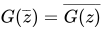


This relation is valid for arbitrary 



for arbitrary real y.
07Asymptotic expansion
The logarithm of G(z + 1) has the following asymptotic expansion, as established by Barnes:

Here the 


08Relation to the log-gamma integral
The parametric log-gamma can be evaluated in terms of the Barnes G-function:

| A proof of the formula |
|---|
|
The proof is somewhat indirect, and involves first considering the logarithmic difference of the gamma function and Barnes G-function: where and Taking the logarithm of the Weierstrass product forms of the Barnes G-function and gamma function gives: A little simplification and re-ordering of terms gives the series expansion: Finally, take the logarithm of the Weierstrass product form of the gamma function, and integrate over the interval Equating the two evaluations completes the proof: And since |

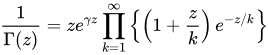
![{\begin{aligned}&z\log \Gamma (z)-\log G(1+z)=-z\log \left({\frac {1}{\Gamma (z)}}\right)-\log G(1+z)\\[5pt]={}&{-z}\left[\log z+\gamma z+\sum _{k=1}^{\infty }{\Bigg \{}\log \left(1+{\frac {z}{k}}\right)-{\frac {z}{k}}{\Bigg \}}\right]\\[5pt]&{}-\left[{\frac {z}{2}}\log 2\pi -{\frac {z}{2}}-{\frac {z^{2}}{2}}-{\frac {z^{2}\gamma }{2}}+\sum _{k=1}^{\infty }{\Bigg \{}k\log \left(1+{\frac {z}{k}}\right)+{\frac {z^{2}}{2k}}-z{\Bigg \}}\right]\end{aligned}}](https://wikimedia.org/api/rest_v1/media/math/render/svg/0db40e3638cafa9167e810ea8314e7767646b528)
![{\begin{aligned}&\sum _{k=1}^{\infty }{\Bigg \{}(k+z)\log \left(1+{\frac {z}{k}}\right)-{\frac {z^{2}}{2k}}-z{\Bigg \}}\\[5pt]={}&{-z}\log z-{\frac {z}{2}}\log 2\pi +{\frac {z}{2}}+{\frac {z^{2}}{2}}-{\frac {z^{2}\gamma }{2}}-z\log \Gamma (z)+\log G(1+z)\end{aligned}}](https://wikimedia.org/api/rest_v1/media/math/render/svg/d3ee871b539266912b7ce288884f2afd788a8a7e)
![\,[0,\,z]](https://wikimedia.org/api/rest_v1/media/math/render/svg/715011514a5e69474f60526d75d440599663c335) to obtain:
to obtain:![{\begin{aligned}&\int _{0}^{z}\log \Gamma (x)\,dx=-\int _{0}^{z}\log \left({\frac {1}{\Gamma (x)}}\right)\,dx\\[5pt]={}&{-(z\log z-z)}-{\frac {z^{2}\gamma }{2}}-\sum _{k=1}^{\infty }{\Bigg \{}(k+z)\log \left(1+{\frac {z}{k}}\right)-{\frac {z^{2}}{2k}}-z{\Bigg \}}\end{aligned}}](https://wikimedia.org/api/rest_v1/media/math/render/svg/aa1ea99a1460568752cd6bc4765d2794924dd100)


Taking the logarithm of both sides introduces the analog of the Digamma function 

where
![\varphi (x)=(x-1)[\psi (x)-1]+\varphi (1),\quad \varphi (1)={\frac {\ln(2\pi )-1}{2}}](https://wikimedia.org/api/rest_v1/media/math/render/svg/704a7a1df408f71a55c4911acd6fc5e02920547d)
with Taylor series

Sources and credits
This article is adapted from the Wikipedia article “Barnes G-function”, written by its contributors and licensed under CC BY-SA 4.0. Fathomly has changed the layout, removed citation markers, navigation and maintenance notices, and adjusted punctuation. This adapted version is shared under the same license. For references, see the original article.
Images, from Wikimedia Commons:
- Plot of the Barnes G aka double gamma function G(z) in the complex plane from -2-2i to 2+2i with colors created with Mathematica 13.1 function ComplexPlot3D.svg by WalkingRadiance, CC BY-SA 4.0
- 2022-08-09 12 43 26-Barnes-G from -6 to 4.png by Doc.Acid, CC BY-SA 4.0
Fathomly is not affiliated with or endorsed by the Wikimedia Foundation. Spotted a problem? Tell us.