K-function
Concept in mathematics
In mathematics, the K-function, typically denoted K(z), is a generalization of the hyperfactorial to complex numbers, similar to the generalization of the factorial to the gamma function.
01Definition
There are multiple equivalent definitions of the K-function.
The direct definition:
![K(z)=(2\pi )^{-{\frac {z-1}{2}}}\exp \left[{\binom {z}{2}}+\int _{0}^{z-1}\ln \Gamma (t+1)\,dt\right].](https://wikimedia.org/api/rest_v1/media/math/render/svg/92baaaf4dc396046aef97cda91dd4f102aa06973)
Definition via
![K(z)=\exp {\bigl [}\zeta '(-1,z)-\zeta '(-1){\bigr ]}](https://wikimedia.org/api/rest_v1/media/math/render/svg/12668025758db5c6b204ac5b1f43c1e8e05785a5)
where ζ′(z) denotes the derivative of the Riemann zeta function, ζ(a,z) denotes the Hurwitz zeta function and

Definition via polygamma function:
![K(z)=\exp \left[\psi ^{(-2)}(z)+{\frac {z^{2}-z}{2}}-{\frac {z}{2}}\ln 2\pi \right]](https://wikimedia.org/api/rest_v1/media/math/render/svg/527eb0c1daf22e5bb0b92ff2ff331e64b68f597e)
Definition via balanced generalization of the polygamma function:
![K(z)=A\exp \left[\psi (-2,z)+{\frac {z^{2}-z}{2}}\right]](https://wikimedia.org/api/rest_v1/media/math/render/svg/e7e5a0771140cd752c427198127287d5cc8b0466)
where A is the Glaisher constant.
It can be defined via unique characterization, similar to how the gamma function can be uniquely characterized by the Bohr-Mollerup Theorem:
Let
be a solution to the functional equation
, such that there exists some
, such that given any distinct
, the divided difference
. Such functions are precisely
, where
is an arbitrary constant.
02Properties
For α > 0:

Let
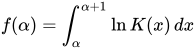
Differentiating this identity now with respect to α yields:

Applying the logarithm rule we get
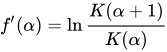
By the definition of the K-function we write
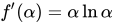
And so

Setting α = 0 we have
![\int _{0}^{1}\ln K(x)\,dx=\lim _{t\rightarrow 0}\left[{\tfrac {1}{2}}t^{2}\left(\ln t-{\tfrac {1}{2}}\right)\right]+C\ =C](https://wikimedia.org/api/rest_v1/media/math/render/svg/b8e8c9ffa5aadcb54c1d1df9e5a769e78d7fa08a)
Functional equations
The K-function is closely related to the gamma function and the Barnes G-function. For all complex 

Multiplication formula
Similar to the multiplication formula for the gamma function:

there exists a multiplication formula for the K-Function involving Glaisher's constant:

Integer values
For all non-negative integers,

The first values are
Sources and credits
This article is adapted from the Wikipedia article “K-function”, written by its contributors and licensed under CC BY-SA 4.0. Fathomly has changed the layout, removed citation markers, navigation and maintenance notices, and adjusted punctuation. This adapted version is shared under the same license. For references, see the original article.
Fathomly is not affiliated with or endorsed by the Wikimedia Foundation. Spotted a problem? Tell us.