Absolute convergence
Mode of convergence of an infinite series
In mathematics, an infinite series of numbers is said to converge absolutely (or to be absolutely convergent) if the sum of the absolute values of the summands is finite. More precisely, a real or complex series 
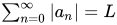



Absolute convergence is important for the study of infinite series, because its definition guarantees that a series will have some "nice" behaviors of finite sums that not all convergent series possess. For instance, rearrangements do not change the value of the sum, which is not necessarily true for conditionally convergent series.
01Background
When adding a finite number of terms, addition is both associative and commutative, meaning that grouping and rearrangement do not alter the final sum. For instance, 


whose terms are fractions that alternate in sign. This series is convergent and can be evaluated using the Maclaurin series for the function 


Substituting 


In this rearrangement, the reciprocal of each odd number is grouped with the reciprocal of twice its value, while the reciprocals of every multiple of 4 are evaluated separately. However, evaluating the terms inside the parentheses yields

or half the original series. The violation of the associativity and commutativity of addition reveals that the alternating harmonic series is conditionally convergent. Indeed, the sum of the absolute values of each term is 
02Definition for real and complex numbers
A sum of real numbers or complex numbers 

03Sums of more general elements
The same definition can be used for series 


- The norm of the identity element of
- For every
implies
- For every
- For every


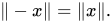


In this case, the function 

Then, a

In particular, these statements apply using the norm 
In topological vector spaces
If 

of the net
converges in
where
is the directed set of all finite subsets of
directed by inclusion
and
), and
- for every continuous seminorm
on
is summable in

If 
Absolutely summable families play an important role in the theory of nuclear spaces.
04Relation to convergence
If 
In particular, for series with values in any Banach space, absolute convergence implies convergence. The converse is also true: if absolute convergence implies convergence in a normed space, then the space is a Banach space.
If a series is convergent but not absolutely convergent, it is called conditionally convergent. An example of a conditionally convergent series is the alternating harmonic series. Many standard tests for divergence and convergence, most notably including the ratio test and the root test, demonstrate absolute convergence. This is because a power series is absolutely convergent on the interior of its disk of convergence.
Proof that any absolutely convergent series of complex numbers is convergent
Suppose that 
![{\textstyle \sum \left[\operatorname {Re} \left(a_{k}\right)^{2}+\operatorname {Im} \left(a_{k}\right)^{2}\right]^{1/2}](https://wikimedia.org/api/rest_v1/media/math/render/svg/6c76b17f25e4c068028016d13e45c50b7c6c41e5)



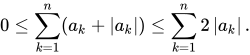
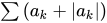
The preceding discussion shows that we need only prove that convergence of 

Let 



Alternative proof using the Cauchy criterion and triangle inequality
By applying the Cauchy criterion for the convergence of a complex series, we can also prove this fact as a simple implication of the triangle inequality. By the Cauchy criterion, 





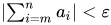


Proof that any absolutely convergent series in a Banach space is convergent
The above result can be easily generalized to every Banach space 



By the triangle inequality for the norm ǁ⋅ǁ, one immediately gets:


05Rearrangements and unconditional convergence
Real and complex numbers
When a series of real or complex numbers is absolutely convergent, any rearrangement or reordering of that series' terms will still converge to the same value. This fact is one reason absolutely convergent series are useful: showing a series is absolutely convergent allows terms to be paired or rearranged in convenient ways without changing the sum's value.
The Riemann rearrangement theorem shows that the converse is also true: every real or complex-valued series whose terms cannot be reordered to give a different value is absolutely convergent.
Series with coefficients in more general space
The term unconditional convergence is used to refer to a series where any rearrangement of its terms still converges to the same value. For any series with values in a normed abelian group
Stated more formally:
Theorem, Let 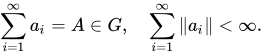

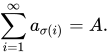
For series with more general coefficients, the converse is more complicated. As stated in the previous section, for real-valued and complex-valued series, unconditional convergence always implies absolute convergence. However, in the more general case of a series with values in any normed abelian group
For example, in the Banach space ℓ∞, one series which is unconditionally convergent but not absolutely convergent is:

where 
Proof of the theorem
For any 
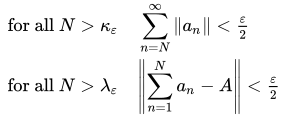
Let





Finally for any integer 
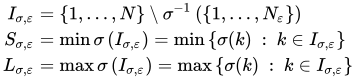

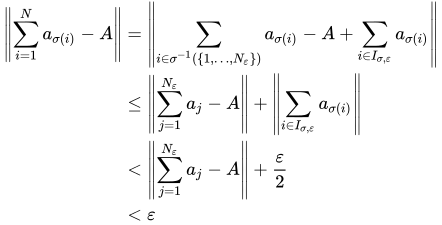
This shows that

06Products of series
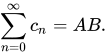
The Cauchy product of two series converges to the product of the sums if at least one of the series converges absolutely. That is, suppose that

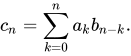
The Cauchy product is defined as the sum of terms 
If either the 
07Absolute convergence over sets
A generalization of the absolute convergence of a series, is the absolute convergence of a sum of a function over a set. We can first consider a countable set 


First note that because no particular enumeration (or "indexing") of 

Therefore we define 
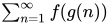
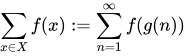
Note that because the series is absolutely convergent, then every rearrangement is identical to a different choice of bijection 
Even more generally we may define the sum of
Let 

There is a theorem which states that, if the sum of
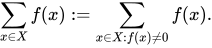
Note that the final series uses the definition of a series over a countable set.
Some authors define an iterated sum 



08Absolute convergence of integrals
The integral 

As a standard property of the Riemann integral, when ![A=[a,b]](https://wikimedia.org/api/rest_v1/media/math/render/svg/6edb111a0369489b1346e0c8d2ea1f44a0fe5c62)


![[a,b]](https://wikimedia.org/api/rest_v1/media/math/render/svg/9c4b788fc5c637e26ee98b45f89a5c08c85f7935)



![\int _{1}^{\infty }{\frac {\sin x}{x}}\,dx={\frac {1}{2}}{\bigl [}\pi -2\,\mathrm {Si} (1){\bigr ]}\approx 0.62,{\text{ but }}\int _{1}^{\infty }\left|{\frac {\sin x}{x}}\right|dx=\infty .](https://wikimedia.org/api/rest_v1/media/math/render/svg/a2b7dd2368a860f7773bff60d986940fc5a59a73)




The situation is different for the Lebesgue integral, which does not handle bounded and unbounded domains of integration separately (see below). The fact that the integral of ![S\subset [a,b]](https://wikimedia.org/api/rest_v1/media/math/render/svg/cbe06fbdade81631d1cc5286c4cf8455947748b1)
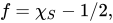


On the other hand, a function
In a general sense, on any measure space 
are essentially built into the definition of the Lebesgue integral. In particular, applying the theory to the counting measure on a set 

Finally, all of the above holds for integrals with values in a Banach space. The definition of a Banach-valued Riemann integral is an evident modification of the usual one. For the Lebesgue integral one needs to circumvent the decomposition into positive and negative parts with Daniell's more functional analytic approach, obtaining the Bochner integral.
Sources and credits
This article is adapted from the Wikipedia article “Absolute convergence”, written by its contributors and licensed under CC BY-SA 4.0. Fathomly has changed the layout, removed citation markers, navigation and maintenance notices, and adjusted punctuation. This adapted version is shared under the same license. For references, see the original article.
Fathomly is not affiliated with or endorsed by the Wikimedia Foundation. Spotted a problem? Tell us.