Root test
Criterion for the convergence of an infinite series
In mathematics, the root test (sometimes called the Cauchy root test or Cauchy's radical test) is a criterion for the convergence (a convergence test) of an infinite series. It depends on the quantity
![\limsup _{n\rightarrow \infty }{\sqrt[{n}]{|a_{n}|}},](https://wikimedia.org/api/rest_v1/media/math/render/svg/fd04e4a2283447fe274e97f7b7573c0377f4716f)
where 
The root test was developed first by Augustin-Louis Cauchy who published it in his textbook Cours d'analyse (1821).
01Root test explanation
For a series
the root test uses the number
![C=\limsup _{n\rightarrow \infty }{\sqrt[{n}]{|a_{n}|}},](https://wikimedia.org/api/rest_v1/media/math/render/svg/2b84b96056bb6ef837f644fe39eb2cd9ea17e4c2)
where "lim sup" denotes the limit superior, possibly +∞. Note that if
![\lim _{n\rightarrow \infty }{\sqrt[{n}]{|a_{n}|}},](https://wikimedia.org/api/rest_v1/media/math/render/svg/55188338135041c09415e8b7fbdecfa62c65cb47)
converges then it equals C and may be used in the root test instead.
The root test states that:
- if C < 1 then the series converges absolutely,
- if C > 1 then the series diverges,
- if C = 1 and the limit approaches strictly from above then the series diverges,
- otherwise the test is inconclusive (the series may diverge, converge absolutely or converge conditionally).
There are some series for which C = 1 and the series converges, e.g. 


02Application to power series
This test can be used with a power series
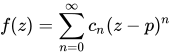
where the coefficients cn, and the center p are complex numbers and the argument z is a complex variable.
The terms of this series would then be given by an = cn(z − p)n. One then applies the root test to the an as above. Note that sometimes a series like this is called a power series "around p", because the radius of convergence is the radius R of the largest interval or disc centred at p such that the series will converge for all points z strictly in the interior (convergence on the boundary of the interval or disc generally has to be checked separately).
A corollary of the root test applied to a power series is the Cauchy-Hadamard theorem: the radius of convergence is exactly ![1/\limsup _{n\rightarrow \infty }{\sqrt[{n}]{|c_{n}|}},](https://wikimedia.org/api/rest_v1/media/math/render/svg/7f62d3aa67a17eacf2f981afd8d225d5b4df71c0)
03Proof
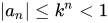
The proof of the convergence of a series Σan is an application of the comparison test.
If for all n ≥ N (N some fixed natural number) we have ![{\sqrt[{n}]{|a_{n}|}}\leq k<1](https://wikimedia.org/api/rest_v1/media/math/render/svg/6a7a3dd4b92955617d9ca0e4e949f13717c87e48)


If ![{\sqrt[{n}]{|a_{n}|}}>1](https://wikimedia.org/api/rest_v1/media/math/render/svg/5c535ba7887a7dcf0f6ce3412cd6e80e94ccc741)
Proof of corollary: For a power series Σan = Σcn(z − p)n, we see by the above that the series converges if there exists an N such that for all n ≥ N we have
![{\sqrt[{n}]{|a_{n}|}}={\sqrt[{n}]{|c_{n}(z-p)^{n}|}}<1,](https://wikimedia.org/api/rest_v1/media/math/render/svg/3163295d4cc4a2bf7961a80c6ee41dcff36c4521)
equivalent to
![{\sqrt[{n}]{|c_{n}|}}\cdot |z-p|<1](https://wikimedia.org/api/rest_v1/media/math/render/svg/1768dd66e43115fcdaa24f6780c55b6560cce050)
for all n ≥ N, which implies that in order for the series to converge we must have ![|z-p|<1/{\sqrt[{n}]{|c_{n}|}}](https://wikimedia.org/api/rest_v1/media/math/render/svg/8c6c5293853a4885d4fc145b610faf3da2bae938)
![|z-p|<1/\limsup _{n\rightarrow \infty }{\sqrt[{n}]{|c_{n}|}},](https://wikimedia.org/api/rest_v1/media/math/render/svg/6b8fefa618da3dd357bdf2dc9389b6605c937b4b)
so ![R\leq 1/\limsup _{n\rightarrow \infty }{\sqrt[{n}]{|c_{n}|}}.](https://wikimedia.org/api/rest_v1/media/math/render/svg/4c4de9a8e9035f94664a292b866f2d12c1c95ea1)
![{\sqrt[{n}]{|a_{n}|}}={\sqrt[{n}]{|c_{n}(z-p)^{n}|}}=1,](https://wikimedia.org/api/rest_v1/media/math/render/svg/ecbc6a7479a47a055713cb08613cdaadef3c8fbc)
(since points > 1 will diverge) and this will not change the radius of convergence since these are just the points lying on the boundary of the interval or disc, so
![R=1/\limsup _{n\rightarrow \infty }{\sqrt[{n}]{|c_{n}|}}.](https://wikimedia.org/api/rest_v1/media/math/render/svg/1d6fe3f00b573a29767f9e9192de8e038e9422bc)
04Examples
Example 1:

Applying the root test and using the fact that
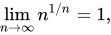
![C=\lim _{n\to \infty }{\sqrt[{n}]{\left|{\frac {2^{n}}{n^{9}}}\right|}}=\lim _{n\to \infty }{\frac {\sqrt[{n}]{2^{n}}}{\sqrt[{n}]{n^{9}}}}=\lim _{n\to \infty }{\frac {2}{(n^{1/n})^{9}}}=2](https://wikimedia.org/api/rest_v1/media/math/render/svg/2c8a3691c81efdb7ea33efb7eb68adf099a3c7a3)
Since 
Example 2:

The root test shows convergence because
![r=\limsup _{n\to \infty }{\sqrt[{n}]{|a_{n}|}}=\limsup _{n\to \infty }{\sqrt[{2n}]{|a_{2n}|}}=\limsup _{n\to \infty }{\sqrt[{2n}]{|1/2^{n}|}}={\frac {1}{\sqrt {2}}}<1.](https://wikimedia.org/api/rest_v1/media/math/render/svg/bbf057c3d1c6b7993f32b2df98633676420b9767)
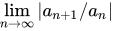
This example shows how the root test is stronger than the ratio test. The ratio test is inconclusive for this series as if 


05Root tests hierarchy
Root tests hierarchy is built similarly to the ratio tests hierarchy (see Section 4.1 of ratio test, and more specifically Subsection 4.1.4 there).
For a series 
Let 


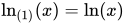


Suppose that ![{\sqrt[{-n}]{a_{n}}}](https://wikimedia.org/api/rest_v1/media/math/render/svg/c813c1b30ab7bbe9d6a09b4a76194f94162be684)
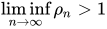
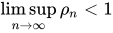
![{\sqrt[{-n}]{a_{n}}}=1+{\frac {1}{n}}+{\frac {1}{n}}\sum _{i=1}^{K-1}{\frac {1}{\prod _{k=1}^{i}\ln _{(k)}(n)}}+{\frac {\rho _{n}}{n\prod _{k=1}^{K}\ln _{(k)}(n)}}.](https://wikimedia.org/api/rest_v1/media/math/render/svg/8f83a41719bab86e1dea150fe329686936480a30)
(The empty sum is assumed to be 0.)
- The series converges, if
- The series diverges, if
- Otherwise, the test is inconclusive.
Proof
Since ![{\sqrt[{-n}]{a_{n}}}=\mathrm {e} ^{-{\frac {1}{n}}\ln a_{n}}](https://wikimedia.org/api/rest_v1/media/math/render/svg/d962a71ad498260244968340d74c69710a633878)

From this,

From Taylor's expansion applied to the right-hand side, we obtain:

Hence,

(The empty product is set to 1.)
The final result follows from the integral test for convergence.
Sources and credits
This article is adapted from the Wikipedia article “Root test”, written by its contributors and licensed under CC BY-SA 4.0. Fathomly has changed the layout, removed citation markers, navigation and maintenance notices, and adjusted punctuation. This adapted version is shared under the same license. For references, see the original article.
Images, from Wikimedia Commons:
- Decision diagram for the root test.svg by Stephan Kulla (Stephan Kulla), CC BY-SA 4.0
Fathomly is not affiliated with or endorsed by the Wikimedia Foundation. Spotted a problem? Tell us.