Direct comparison test
Determining convergence in mathematics
In mathematics, the comparison test, sometimes called the direct comparison test to distinguish it from similar related tests (especially the limit comparison test), provides a way of deducing whether an infinite series or an improper integral converges or diverges by comparing the series or integral to one whose convergence properties are known.
01For series
In calculus, the comparison test for series typically consists of a pair of statements about infinite series with non-negative (real-valued) terms:
- If the infinite series
converges and
for all sufficiently large n (that is, for all
for some fixed value N), then the infinite series
also converges.
- If the infinite series
for all sufficiently large n, then the infinite series
Note that the series having larger terms is sometimes said to dominate (or eventually dominate) the series with smaller terms.
Alternatively, the test may be stated in terms of absolute convergence, in which case it also applies to series with complex terms:
- If the infinite series
for all sufficiently large n, then the infinite series
- If the infinite series
for all sufficiently large n, then the infinite series
Note that in this last statement, the series
The second pair of statements are equivalent to the first in the case of real-valued series because 

Proof
The proofs of all the statements given above are similar. Here is a proof of the third statement.
Let 

Since 



![[S_{N},S_{N}+(T-T_{N})]](https://wikimedia.org/api/rest_v1/media/math/render/svg/b3d1773a744d47205d0634981245aaf506d3f3ca)


02For integrals
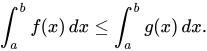
The comparison test for integrals may be stated as follows, assuming continuous real-valued functions f and g on 

- If the improper integral
converges and
for
, then the improper integral
also converges with
- If the improper integral
for
03Ratio comparison test
Another test for convergence of real-valued series, similar to both the direct comparison test above and the ratio test, is called the ratio comparison test:
- If the infinite series
,
, and
for all sufficiently large n, then the infinite series
- If the infinite series
for all sufficiently large n, then the infinite series
Sources and credits
This article is adapted from the Wikipedia article “Direct comparison test”, written by its contributors and licensed under CC BY-SA 4.0. Fathomly has changed the layout, removed citation markers, navigation and maintenance notices, and adjusted punctuation. This adapted version is shared under the same license. For references, see the original article.
Fathomly is not affiliated with or endorsed by the Wikimedia Foundation. Spotted a problem? Tell us.