Asymptotic analysis
Description of limiting behavior of a function

In mathematical analysis, asymptotic analysis, also known as asymptotics, is the development and application of methods that generate an approximate analytical solution to a mathematical problem when a variable or parameter assumes a value that is large, small or near a specified value.
An example of asymptotic analysis is function approximation. For example, the function 


The prime number theorem is an example of an important asymptotic result. For any real number 


Asymptotic analysis impacts on many areas of mathematics. Mathematicians use asymptotic analysis for computing function approximations, implicit functions, integrals, iterated functions, series summation, partial sums, solutions of difference equations. solutions of differential equations and properties of computer algorithms.
01Definition
Formally, given functions f (x) and g(x), we define a binary relation

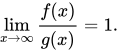
The symbol ~ is the tilde. The relation is an equivalence relation on the set of functions of x; the functions f and g are said to be asymptotically equivalent. The domain of f and g can be any set for which the limit is defined: e.g. real numbers, complex numbers, positive integers.
The same notation is also used for other ways of passing to a limit: e.g. x → 0, x ↓ 0, |x| → 0. The way of passing to the limit is often not stated explicitly, if it is clear from the context.
Although the above definition is common in the literature, it is problematic if g(x) is zero infinitely often as x goes to the limiting value. For that reason, some authors use an alternative definition. The alternative definition, in little-o notation, is that f ~ g if and only if

This definition is equivalent to the prior definition if g(x) is not zero in some neighbourhood of the limiting value.
02Properties
The zero function, 
The little-o relation has the partial ordering property defined as if 


Asymptotic equivalence has reflexive, symmetric and transitive properties.
If these functions are equivalent, 


If these functions are equivalent 

Asymptotically equivalent functions remain asymptotically equivalent under integration if requirements related to convergence are met. There are more stringent requirements for asymptotically equivalent functions to remain asymptotically equivalent under differentiation.
03Examples of asymptotic formulas
- Factorial
, this is Stirling's approximation
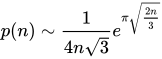
- Partition function
For a positive integer n, the partition function, p(n), gives the number of ways of writing the integer n as a sum of positive integers, where the order of addends is not considered. - Airy function
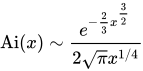
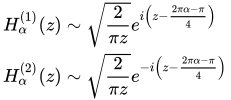
The Airy function, Ai(x), is a solution of the differential equation y″ − xy = 0; it has many applications in physics. - Hankel functions
04Asymptotic expansion
An asymptotic expansion of a function f(x) is in practice an expression of that function in terms of a series, the partial sums of which do not necessarily converge, but such that taking any initial partial sum provides an asymptotic formula for f. The idea is that successive terms provide an increasingly accurate description of the order of growth of f.
In symbols, it means we have 






The relation 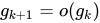



In the present situation, this relation 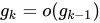



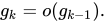
In case the asymptotic expansion does not converge, for any particular value of the argument there will be a particular partial sum which provides the best approximation and adding additional terms will decrease the accuracy. This optimal partial sum will usually have more terms as the argument approaches the limit value.
Examples of asymptotic expansions
- Gamma function
- Exponential integral
- Error function
where m!! is the double factorial.


Worked example
Asymptotic expansions often occur when an ordinary series is used in a formal expression that forces the taking of values outside of its domain of convergence. For example, we might start with the formal power series

The expression on the left is valid on the entire complex plane 



The integral on the left hand side can be expressed in terms of the exponential integral. The integral on the right hand side, after the substitution 
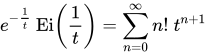
Here, the right hand side is clearly not convergent for any non-zero value of t. However, by keeping t small, and truncating the series on the right to a finite number of terms, one may obtain a fairly good approximation to the value of 


05Asymptotic distribution
In mathematical statistics, an asymptotic distribution is a hypothetical distribution that is in a sense the "limiting" distribution of a sequence of distributions. A distribution is an ordered set of random variables Zi for i = 1, …, n, for some positive integer n. An asymptotic distribution allows i to range without bound, that is, n is infinite.
A special case of an asymptotic distribution is when the late entries go to zero, that is, the Zi go to 0 as i goes to infinity. Some instances of "asymptotic distribution" refer only to this special case.
This is based on the notion of an asymptotic function which cleanly approaches a constant value (the asymptote) as the independent variable goes to infinity; "clean" in this sense meaning that for any desired closeness epsilon there is some value of the independent variable after which the function never differs from the constant by more than epsilon.
An asymptote is a straight line that a curve approaches but never meets or crosses. Informally, one may speak of the curve meeting the asymptote "at infinity" although this is not a precise definition. In the equation 
06Applications
Asymptotic analysis is used in several mathematical sciences. In statistics, asymptotic theory provides limiting approximations of the probability distribution of sample statistics, such as the likelihood ratio statistic and the expected value of the deviance. Asymptotic theory does not provide a method of evaluating the finite-sample distributions of sample statistics, however. Non-asymptotic bounds are provided by methods of approximation theory.
Examples of applications are the following.
- In applied mathematics, asymptotic analysis is used to build numerical methods to approximate equation solutions.
- In mathematical statistics and probability theory, asymptotics are used in analysis of long-run or large-sample behaviour of random variables and estimators.
- In computer science, the analysis of algorithms evaluate the performance of algorithms and is expressed in terms of big O notation.
- The behavior of physical systems, an example being statistical mechanics.
- In accident analysis when identifying the causation of crash through count modeling with large number of crash counts in a given time and space.
Asymptotic analysis is a key tool for exploring the ordinary and partial differential equations which arise in the mathematical modelling of real-world phenomena. An illustrative example is the derivation of the boundary layer equations from the full Navier-Stokes equations governing fluid flow. In many cases, the asymptotic expansion is in power of a small parameter, ε: in the boundary layer case, this is the nondimensional ratio of the boundary layer thickness to a typical length scale of the problem. Indeed, applications of asymptotic analysis in mathematical modelling often center around a nondimensional parameter which has been shown, or assumed, to be small through a consideration of the scales of the problem at hand.
Asymptotic expansions typically arise in the approximation of certain integrals (Laplace's method, saddle-point method, method of steepest descent) or in the approximation of probability distributions (Edgeworth series). The Feynman graphs in quantum field theory are another example of asymptotic expansions which often do not converge.
Asymptotic versus Numerical Analysis
De Bruijn illustrates the use of asymptotics in the following dialog between Dr. N.A., a numerical analyst, and Dr. A.A., an asymptotic analyst:
N.A.: I want to evaluate my function
for large values of
, with a relative error of at most 1%.
A.A.:
.
N.A.: I am sorry, I don't understand.
A.A.:
N.A.: But my value of
A.A.: Why did you not say so? My evaluations give
N.A.: This is no news to me. I know already that
.
A.A.: I can gain a little on some of my estimates. Now I find that
N.A.: I asked for 1%, not for 20%.
A.A.: It is almost the best thing I possibly can get. Why don't you take larger values of
N.A.: !!! I think it's better to ask my electronic computing machine.
Machine: f(100) = 0.01137 42259 34008 67153
A.A.: Haven't I told you so? My estimate of 20% was not far off from the 14% of the real error.
N.A.: !!! . . . !
Some days later, Miss N.A. wants to know the value of f(1000), but her machine would take a month of computation to give the answer. She returns to her Asymptotic Colleague, and gets a fully satisfactory reply.



Sources and credits
This article is adapted from the Wikipedia article “Asymptotic analysis”, written by its contributors and licensed under CC BY-SA 4.0. Fathomly has changed the layout, removed citation markers, navigation and maintenance notices, and adjusted punctuation. This adapted version is shared under the same license. For references, see the original article.
Images, from Wikimedia Commons:
- Asymptotic approximation.jpg by TMM53, CC BY 4.0
Fathomly is not affiliated with or endorsed by the Wikimedia Foundation. Spotted a problem? Tell us.
