Reference articles on history, science, culture and more
Encyclopedia

Exponential integral

Special function defined by an integral

Image credit is listed at the end of this article.

In mathematics, the exponential integral \operatorname {Ei} is a special function on the complex plane. It is defined as one particular definite integral of the ratio between an exponential function and its argument.

01Definitions

For real non-zero values of x, the exponential integral \operatorname {Ei} (x) is defined as \operatorname {Ei} (x)=-\int _{-x}^{\infty }{\frac {e^{-t}}{t}}\,dt=\int _{-\infty }^{x}{\frac {e^{t}}{t}}\,dt.

The Risch algorithm shows that \operatorname {Ei} is not an elementary function. The definition above can be used for positive values of x, but the integral has to be understood in terms of the Cauchy principal value due to the singularity of the integrand at zero.

For complex values of the argument, the definition becomes ambiguous due to branch points at 0 and \infty. Instead of \operatorname {Ei}, the following notation is used, E_{1}(z)=\int _{z}^{\infty }{\frac {e^{-t}}{t}}\,dt,\qquad |{\operatorname {Arg} }(z)|<\pi

For positive values of x, we have -E_{1}(x)=\operatorname {Ei} (-x).

In general, a branch cut is taken on the negative real axis and E_{1} can be defined by analytic continuation elsewhere on the complex plane.

For positive values of the real part of z, this can be written E_{1}(z)=\int _{1}^{\infty }{\frac {e^{-tz}}{t}}\,dt=\int _{0}^{1}{\frac {e^{-z/u}}{u}}\,du,\qquad \Re (z)\geq 0.

The behaviour of E_{1} near the branch cut can be seen by the following relation: \lim _{\delta \to 0+}E_{1}(-x\pm i\delta )=-\operatorname {Ei} (x)\mp i\pi ,\qquad x>0.

Plot of the exponential integral function Ei(z) for complex z
Plot of E1 function (top) and Ei function (bottom).

02Properties

Several properties of the exponential integral below, in certain cases, allow one to avoid its explicit evaluation through the definition above.

Convergent series

For real or complex arguments off the negative real axis, E_{1}(z) can be expressed as E_{1}(z)=-\gamma -\ln z-\sum _{k=1}^{\infty }{\frac {(-z)^{k}}{k\;k!}}\qquad (\left|\operatorname {Arg} (z)\right|<\pi ) where \gamma is the Euler-Mascheroni constant. The sum converges for all complex z, and we take the usual value of the complex logarithm having a branch cut along the negative real axis.

This formula can be used to compute E_{1}(x) with floating point operations for real x between 0 and 2.5. For x>2.5, the result is inaccurate due to cancellation.

A faster converging series was found by Ramanujan: \mathrm {Ei} (x)=\gamma +\ln x+\exp {(x/2)}\sum _{n=1}^{\infty }{\frac {(-1)^{n-1}x^{n}}{n!\,2^{n-1}}}\sum _{k=0}^{\lfloor (n-1)/2\rfloor }{\frac {1}{2k+1}}

Asymptotic (divergent) series

The convergence of the series above is slow for arguments of larger modulus. For example, more than 40 terms are required to get an answer correct to three significant figures for E_{1}(10). However, for positive values of x, there is a divergent series approximation that can be obtained by integrating xe^{x}E_{1}(x) by parts: E_{1}(x)={\frac {\exp(-x)}{x}}\left(\sum _{n=0}^{N-1}{\frac {n!}{(-x)^{n}}}+O(N!x^{-N})\right) The relative error of the approximation above is plotted on the figure to the right for various values of N, the number of terms in the truncated sum (N=1 in red, N=5 in pink).

Asymptotics beyond all orders

Using integration by parts, we can obtain an explicit formula {\begin{aligned}\operatorname {Ei} (z)&={\frac {e^{z}}{z}}\left(\sum _{k=0}^{n}{\frac {k!}{z^{k}}}+e_{n}(z)\right),\\e_{n}(z)&\equiv (n+1)!\ ze^{-z}\int _{-\infty }^{z}{\frac {e^{t}}{t^{n+2}}}\,dt.\end{aligned}} For any fixed z, the absolute value of the error term |e_{n}(z)| decreases, then increases. The minimum occurs at n\sim \vert z\vert, at which point \textstyle \vert e_{n}(z)\vert \leq {\sqrt {\frac {2\pi }{\vert z\vert }}}e^{-\vert z\vert }. This bound is said to be "asymptotics beyond all orders".

Exponential and logarithmic behavior: bracketing

From the two series suggested in previous subsections, it follows that E_{1} behaves like a negative exponential for large values of the argument and like a logarithm for small values. For positive real values of the argument, E_{1} can be bracketed by elementary functions as follows: {\frac {1}{2}}e^{-x}\,\ln \!\left(1+{\frac {2}{x}}\right)<E_{1}(x)<e^{-x}\,\ln \!\left(1+{\frac {1}{x}}\right)\qquad x>0

The left-hand side of this inequality is shown in the graph to the left in blue; the central part E_{1}(x) is shown in black and the right-hand side is shown in red.

Definition by Ein

Both \operatorname {Ei} and E_{1} can be written more simply using the entire function \operatorname {Ein} defined as \operatorname {Ein} (z)=\int _{0}^{z}(1-e^{-t}){\frac {dt}{t}}=\sum _{k=1}^{\infty }{\frac {(-1)^{k+1}z^{k}}{k\;k!}} (note that this is just the alternating series in the above definition of E_{1}). Then we have {\begin{aligned}E_{1}(z)&=-\gamma -\ln z+\operatorname {Ein} (z),&&\left|\operatorname {Arg} (z)\right|<\pi ;\\\operatorname {Ei} (x)&={\hphantom {-}}\gamma +\ln {x}-\mathrm {Ein} (-x),&&x\neq 0.\end{aligned}} The function \operatorname {Ein} is related to the exponential generating function of the harmonic numbers: \operatorname {Ein} (z)=e^{-z}\,\sum _{n=1}^{\infty }{\frac {z^{n}}{n!}}H_{n}

Relation with other functions

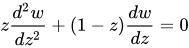
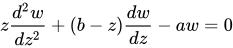
Kummer's equation z{\frac {d^{2}w}{dz^{2}}}+(b-z){\frac {dw}{dz}}-aw=0 is usually solved by the confluent hypergeometric functions M(a,b,z) and U(a,b,z). But when a=0 and b=1, that is, z{\frac {d^{2}w}{dz^{2}}}+(1-z){\frac {dw}{dz}}=0 we have M(0,1,z)=U(0,1,z)=1 for all z. A second solution is then given by E_{1}(-z). In fact, E_{1}(-z)=-\gamma -i\pi +{\frac {\partial [U(a,1,z)-M(a,1,z)]}{\partial a}},\qquad 0<\operatorname {Arg} (z)<2\pi with the derivative evaluated at a=0. Another connexion with the confluent hypergeometric functions is that E_{1} is an exponential times the function U(1,1,z): E_{1}(z)=e^{-z}U(1,1,z)
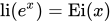
The exponential integral is closely related to the logarithmic integral function \operatorname {li} (e^{x}) by the formula \operatorname {li} (e^{x})=\operatorname {Ei} (x) for non-zero real values of x.

The series expansion of the exponential integral immediately gives rise to an expression in terms of the generalized hypergeometric function {}_{2}\!F_{2}: \operatorname {Ei} (x)=x{\,}_{2}\!F_{2}(1,1;2,2;x)+\ln x+\gamma .

Generalization

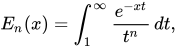
The exponential integral may also be generalized to E_{n}(x)=\int _{1}^{\infty }{\frac {e^{-xt}}{t^{n}}}\,dt, which can be written as a special case of the upper incomplete gamma function: E_{n}(x)=x^{n-1}\Gamma (1-n,x).
The generalized form is sometimes called the Misra function \varphi _{m}(x), defined as \varphi _{m}(x)=E_{-m}(x).

Including a logarithm defines the generalized integro-exponential function E_{s}^{j}(z)={\frac {1}{\Gamma (j+1)}}\int _{1}^{\infty }\left(\log t\right)^{j}{\frac {e^{-zt}}{t^{s}}}\,dt.

Derivatives

The derivatives of the generalised functions E_{n} can be calculated by means of the formula E_{n}'(z)=-E_{n-1}(z)\qquad (n=1,2,3,\ldots ) Note that the function E_{0} is easy to evaluate (making this recursion useful), since it is just \textstyle {\frac {e^{-z}}{z}}.

Exponential integral of imaginary argument

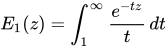
If z is imaginary, it has a nonnegative real part, so we can use the formula E_{1}(z)=\int _{1}^{\infty }{\frac {e^{-tz}}{t}}\,dt to get a relation with the trigonometric integrals \operatorname {Si} and \operatorname {Ci}: E_{1}(ix)=i\left[-{\tfrac {1}{2}}\pi +\operatorname {Si} (x)\right]-\operatorname {Ci} (x)\qquad (x>0) The real and imaginary parts of E_{1}(ix) are plotted in the figure to the right with black and red curves.
Approximations

There have been a number of approximations for the exponential integral function. These include:

Relative error of the asymptotic approximation for different number N of terms in the truncated sum

03Inverse function of the exponential integral

We can express the Inverse function of the exponential integral in power series form: \forall |x|<{\frac {\mu }{\ln(\mu )}},\quad \operatorname {Ei} ^{-1}(x)=\sum _{n=0}^{\infty }{\frac {x^{n}}{n!}}{\frac {P_{n}(\ln(\mu ))}{\mu ^{n}}} where \mu is the Ramanujan-Soldner constant and (P_{n}) is polynomial sequence defined by the following recurrence relation: P_{0}(x)=x,\ P_{n+1}(x)=x(P_{n}'(x)-nP_{n}(x)).

For n>0, \deg P_{n}=n and we have the formula: P_{n}(x)=\left.\left({\frac {d}{dt}}\right)^{n-1}\left({\frac {te^{x}}{\operatorname {Ei} (t+x)-\operatorname {Ei} (x)}}\right)^{n}\right|_{t=0}.

Normalized exponential integral. The value plotted is ⁠Ei(x)/(exp x)/x⁠. The values of x are written above the corresponding point. The horizontal spacing is according to arctan x. The graph is extended "beyond infinity" a little on both the right and the left to show how the normalized function behaves when 1/x is small. (The horizontal spacing for these points corresponds to angles whose tangent is x.)
Bracketing of E1 by elementary functions

04Applications

E1(ix) against x; real part black, imaginary part red.
Watch videos about Exponential integralExplainers and documentaries on YouTube (opens in a new tab)

Sources and credits

This article is adapted from the Wikipedia article Exponential integral, written by its contributors and licensed under CC BY-SA 4.0. Fathomly has changed the layout, removed citation markers, navigation and maintenance notices, and adjusted punctuation. This adapted version is shared under the same license. For references, see the original article.

Images, from Wikimedia Commons:

Fathomly is not affiliated with or endorsed by the Wikimedia Foundation. Spotted a problem? Tell us.