Logarithmic integral function
Special function defined by an integral

In mathematics, the logarithmic integral function or integral logarithm li(x) is a special function. It is relevant in problems of physics and has number theoretic significance. In particular, according to the prime number theorem, it is a very good approximation to the prime-counting function, which is defined as the number of prime numbers less than or equal to a given value x.
01Integral representation
The logarithmic integral has an integral representation defined for all positive real numbers x ≠ 1 by the definite integral
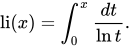
Here, ln denotes the natural logarithm. The function 1/(ln t) has a singularity at t = 1, and the integral for x > 1 is interpreted as a Cauchy principal value,

However, the logarithmic integral can also be taken to be a meromorphic complex-valued function in the complex domain. In this case it is multi-valued with branch points at 0 and 1, and the values between 0 and 1 defined by the above integral are not compatible with the values beyond 1. The complex function is shown in the figure above. The values on the real axis beyond 1 are the same as defined above, but the values between 0 and 1 are offset by iπ so that the absolute value at 0 is π rather than zero. The complex function is also defined (but multi-valued) for numbers with negative real part, but on the negative real axis the values are not real.

02Offset logarithmic integral
The offset logarithmic integral or Eulerian logarithmic integral is defined as

As such, the integral representation has the advantage of avoiding the singularity in the domain of integration.
Equivalently,

03Special values
The function li(x) has a single positive zero; it occurs at x ≈ 1.45136 92348 83381 05028 39684 85892 02744 94930... OEIS: A070769; this number is known as the Ramanujan-Soldner constant.

This is 

04Series representation
The function li(x) is related to the exponential integral Ei(x) via the equation

which is valid for x > 0. This identity provides a series representation of li(x) as

where γ ≈ 0.57721 56649 01532 ... OEIS: A001620 is the Euler-Mascheroni constant. For the complex function the formula is

(without taking the absolute value of u). A more rapidly convergent series by Ramanujan is

Again, for the meromorphic complex function the term 

05Asymptotic expansion
The asymptotic behavior both for 

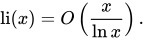
where 
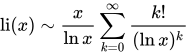
or

This gives the following more accurate asymptotic behaviour:

As an asymptotic expansion, this series is not convergent: it is a reasonable approximation only if the series is truncated at a finite number of terms, and only large values of x are employed. This expansion follows directly from the asymptotic expansion for the exponential integral.
This implies e.g. that we can bracket li as:

for all 
06Number theoretic significance
The logarithmic integral is important in number theory, appearing in estimates of the number of prime numbers less than a given value. For example, the prime number theorem states that:

where 

Assuming the Riemann hypothesis, we get the even stronger:

In fact, the Riemann hypothesis is equivalent to the statement that:
for any
.
For small 
Sources and credits
This article is adapted from the Wikipedia article “Logarithmic integral function”, written by its contributors and licensed under CC BY-SA 4.0. Fathomly has changed the layout, removed citation markers, navigation and maintenance notices, and adjusted punctuation. This adapted version is shared under the same license. For references, see the original article.
Images, from Wikimedia Commons:
- Plot of the logarithmic integral function li(z) in the complex plane from -2-2i to 2+2i with colors created with Mathematica 13.1 function ComplexPlot3D.svg by WalkingRadiance, CC BY-SA 4.0
- Logarithmic integral function.svg by RicHard-59, CC BY-SA 3.0
Fathomly is not affiliated with or endorsed by the Wikimedia Foundation. Spotted a problem? Tell us.
