Singularity (mathematics)
Point where a mathematical object behaves irregularly
In mathematics, a singularity is a point at which a given mathematical object is not defined, or a point where the mathematical object ceases to be well-behaved in some particular way, such as by lacking differentiability or analyticity.
For example, the reciprocal function 


The algebraic curve defined by 


01Real analysis
In real analysis, singularities are either discontinuities, or discontinuities of the derivative (sometimes also discontinuities of higher order derivatives). There are four kinds of discontinuities: type I, which has two subtypes, and type II, which can also be divided into two subtypes (though usually is not).
To describe the way these two types of limits are being used, suppose that 


, constrained by
and
, constrained by
.
The value 
There are some functions for which these limits do not exist at all. For example, the function
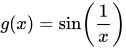
does not tend towards anything as 

The possible cases at a given value
- A point of continuity is a value of
, as one expects for a smooth function. All the values must be finite. If
- A type I discontinuity occurs when both
;
has a defined value, which, however, does not match the value of the two limits.
- Type I discontinuities can be further distinguished as being one of the following subtypes:
- A jump discontinuity occurs when
- A removable discontinuity occurs when
, also regardless of whether
- A type II discontinuity occurs when either
- An infinite discontinuity is the special case when either the left hand or right hand limit does not exist, specifically because it is infinite, and the other limit is either also infinite, or is some well defined finite number. In other words, the function has an infinite discontinuity when its graph has a vertical asymptote.
- An essential singularity is a term borrowed from complex analysis (see below). This is the case when either one or the other limits
.
In real analysis, a singularity or discontinuity is a property of a function alone. Any singularities that may exist in the derivative of a function are considered as belonging to the derivative, not to the original function.
Coordinate singularities
A coordinate singularity occurs when an apparent singularity or discontinuity occurs in one coordinate frame, which can be removed by choosing a different frame. An example of this is the apparent singularity at the 90 degree latitude in spherical coordinates. An object moving due north (for example, along the line 0 degrees longitude) on the surface of a sphere will suddenly experience an instantaneous change in longitude at the pole (in the case of the example, jumping from longitude 0 to longitude 180 degrees). This discontinuity, however, is only apparent; it is an artifact of the coordinate system chosen, which is singular at the poles. A different coordinate system would eliminate the apparent discontinuity (e.g., by replacing the latitude/longitude representation with an n-vector representation).

02Complex analysis
In complex analysis, there are several classes of singularities. These include the isolated singularities, the nonisolated singularities, and the branch points.
Isolated singularities
Suppose that 


- The point
defined on all of
for all
in
The function
- The point
nonzero, and a natural number
such that
for all
- The point

Nonisolated singularities
Other than isolated singularities, complex functions of one variable may exhibit other singular behaviour. These are termed nonisolated singularities, of which there are two types:
- Cluster points: limit points of isolated singularities. If they are all poles, despite admitting Laurent series expansions on each of them, then no such expansion is possible at its limit.
For a simple example, consider the function
: this function exhibits an infinite number of simple poles at
that get ever closer to
, resulting in
- Natural boundaries: any non-isolated set (e.g. a curve) on which functions cannot be analytically continued around (or outside them if they are closed curves in the Riemann sphere).
Examples of functions that exhibit such a set include the lacunary series and the prime zeta function.
Branch points
Branch points are generally the result of a multi-valued function, such as 


03Finite-time singularity
A finite-time singularity occurs when one input variable is time, and an output variable increases towards infinity at a finite time. These are important in kinematics and Partial Differential Equations, infinites do not occur physically, but the behavior near the singularity is often of interest. Mathematically, the simplest finite-time singularities are power laws for various exponents of the form 


An example would be the bouncing motion of an inelastic ball on a plane. If idealized motion is considered, in which the same fraction of kinetic energy is lost on each bounce, the frequency of bounces becomes infinite, as the ball comes to rest in a finite time. Other examples of finite-time singularities include the various forms of the Painlevé paradox (for example, the tendency of a chalk to skip when dragged across a blackboard), and how the precession rate of a coin spun on a flat surface accelerates towards infinite, before abruptly stopping (as studied using the Euler's Disk toy).
Hypothetical examples include Heinz von Foerster's facetious "Doomsday's equation" (simplistic models yield infinite human population in finite time).
04Algebraic geometry and commutative algebra
In algebraic geometry, a singularity of an algebraic variety is a point of the variety where the tangent space may not be regularly defined. The simplest example of singularities are curves that cross themselves. But there are other types of singularities, like cusps. For example, the equation y2 − x3 = 0 defines a curve that has a cusp at the origin x = y = 0. One could define the x-axis as a tangent at this point, but this definition can not be the same as the definition at other points. In fact, in this case, the x-axis is a "double tangent."
For affine and projective varieties, the singularities are the points where the Jacobian matrix has a rank which is lower than at other points of the variety.
An equivalent definition in terms of commutative algebra may be given, which extends to abstract varieties and schemes: A point is singular if the local ring at this point is not a regular local ring.
Sources and credits
This article is adapted from the Wikipedia article “Singularity (mathematics)”, written by its contributors and licensed under CC BY-SA 4.0. Fathomly has changed the layout, removed citation markers, navigation and maintenance notices, and adjusted punctuation. This adapted version is shared under the same license. For references, see the original article.
Images, from Wikimedia Commons:
- Rectangular hyperbola.svg by Qef, Public domain
Fathomly is not affiliated with or endorsed by the Wikimedia Foundation. Spotted a problem? Tell us.