Removable singularity
Undefined point on a holomorphic function which can be made regular

In complex analysis, a removable singularity of a holomorphic function is a point at which the function is undefined, but it is possible to redefine the function at that point in such a way that the resulting function is regular in a neighbourhood of that point.
For instance, the (unnormalized) sinc function, as defined by

has a singularity at 



Formally, if 


01Riemann's theorem
Riemann's theorem on removable singularities is as follows:
Theorem, Let 


- There exists a neighborhood of
-
.
The implications 1 ⇒ 2 ⇒ 3 ⇒ 4 are trivial. To prove 4 ⇒ 1, we first recall that the holomorphy of a function at
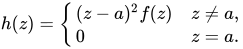
Clearly, 

by 4, hence

We have 


Hence, where 

However,

is holomorphic on
02Other kinds of singularities
Unlike functions of a real variable, holomorphic functions are sufficiently rigid that their isolated singularities can be completely classified. A holomorphic function's singularity is either not really a singularity at all, i.e. a removable singularity, or one of the following two types:
- In light of Riemann's theorem, given a non-removable singularity, one might ask whether there exists a natural number
such that
. If so,
- If an isolated singularity
Sources and credits
This article is adapted from the Wikipedia article “Removable singularity”, written by its contributors and licensed under CC BY-SA 4.0. Fathomly has changed the layout, removed citation markers, navigation and maintenance notices, and adjusted punctuation. This adapted version is shared under the same license. For references, see the original article.
Images, from Wikimedia Commons:
- Graph of x squared undefined at x equals 2.svg by Ben Moore, CC BY-SA 3.0
Fathomly is not affiliated with or endorsed by the Wikimedia Foundation. Spotted a problem? Tell us.