Veronese surface
Rational surface in 5-dimensional projective space
In mathematics, the Veronese surface is an algebraic surface in five-dimensional projective space, and is realized by the Veronese embedding, the embedding of the projective plane given by the complete linear system of conics. It is named after Giuseppe Veronese (1854-1917). Its generalization to higher dimension is known as the Veronese variety.
The surface admits an embedding in the four-dimensional projective space defined by the projection from a general point in the five-dimensional space. Its general projection to three-dimensional projective space is called a Steiner surface.
01Definition
The Veronese surface is the image of the mapping

given by
![\nu :[x:y:z]\mapsto [x^{2}:y^{2}:z^{2}:yz:xz:xy]](https://wikimedia.org/api/rest_v1/media/math/render/svg/06dcedb6f49cb7f310af341cb57ed6785a4043ac)
where ![[x:\cdots ]](https://wikimedia.org/api/rest_v1/media/math/render/svg/386bbe49bb6f75424d240fa8bb457def7bb846fb)

02Motivation
The Veronese surface arises naturally in the study of conics. A conic is a degree 2 plane curve, thus defined by an equation:

The pairing between coefficients 

![[x:y:z],](https://wikimedia.org/api/rest_v1/media/math/render/svg/1a10019501bbdd504759d7c250eb357d96b6f4d4)
03Veronese map
The Veronese map or Veronese variety generalizes this idea to mappings of general degree d in n+1 variables. That is, the Veronese map of degree d is the map
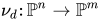
with m given by the multiset coefficient, or more familiarly the binomial coefficient, as:

The map sends ![[x_{0}:\ldots :x_{n}]](https://wikimedia.org/api/rest_v1/media/math/render/svg/a907a6ac3c27e2ede75684e319f497d659c32b69)


For low degree, 


One may define the Veronese map in a coordinate-free way, as
![\nu _{d}:\mathbb {P} (V)\ni [v]\mapsto [v^{d}]\in \mathbb {P} (\operatorname {Sym} ^{d}V)](https://wikimedia.org/api/rest_v1/media/math/render/svg/508408873c6062d950a7abdf40b34781676f9c2e)
where V is any vector space of finite dimension, and 
If the vector space V is defined over a field K which does not have characteristic zero, then the definition must be altered to be understood as a mapping to the dual space of polynomials on V. This is because for fields with finite characteristic p, the pth powers of elements of V are not rational normal curves, but are of course a line. (See, for example, additive polynomial for a treatment of polynomials over a field of finite characteristic.)
Rational normal curve
For 
- For
the Veronese map is simply the identity map on the projective line.
- For
the Veronese variety is the standard parabola
in affine coordinates
- For
the Veronese variety is the twisted cubic,
in affine coordinates


04Biregular
The image of a variety under the Veronese map is again a variety, rather than simply a constructible set; furthermore, these are isomorphic in the sense that the inverse map exists and is regular, the Veronese map is biregular. More precisely, the images of open sets in the Zariski topology are again open.
Sources and credits
This article is adapted from the Wikipedia article “Veronese surface”, written by its contributors and licensed under CC BY-SA 4.0. Fathomly has changed the layout, removed citation markers, navigation and maintenance notices, and adjusted punctuation. This adapted version is shared under the same license. For references, see the original article.
Fathomly is not affiliated with or endorsed by the Wikimedia Foundation. Spotted a problem? Tell us.