Additive polynomial
Topic in algebraic number theory
In mathematics, the additive polynomials are an important topic in classical algebraic number theory.
01Definition
Let be a field of prime characteristic
. A polynomial
with coefficients in
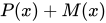
is called an additive polynomial, or a Frobenius polynomial, if
as polynomials in and
. It is equivalent to assume that this equality holds for all
and
in some infinite field containing
, such as its algebraic closure.
Occasionally absolutely additive is used for the condition above, and additive is used for the weaker condition that for all
and
in the field. For infinite fields the conditions are equivalent, but for finite fields they are not, and the weaker condition is the "wrong" as it does not behave well. For example, over a field of order
any multiple
of
will satisfy
for all
and
in the field, but will usually not be (absolutely) additive.
02Examples
The polynomial is additive. Indeed, for any
and
in the algebraic closure of
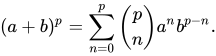
one has by the binomial theorem
Since is prime, for all
the binomial coefficient
is divisible by
, which implies that
as polynomials in and
.
Similarly all the polynomials of the form
are additive, where is a non-negative integer.
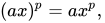
The definition makes sense even if is a field of characteristic zero, but in this case the only additive polynomials are those of the form
for some
in
.
03The ring of additive polynomials
It is quite easy to prove that any linear combination of polynomials with coefficients in
is also an additive polynomial. An interesting question is whether there are other additive polynomials except these linear combinations. The answer is that these are the only ones.
One can check that if and
are additive polynomials, then so are
and
. These imply that the additive polynomials form a ring under polynomial addition and composition. This ring is denoted
This ring is not commutative unless is the field
(see modular arithmetic). Indeed, consider the additive polynomials
and
for a coefficient
in
. For them to commute under composition, we must have
and hence . This is false for
not a root of this equation, that is, for
outside
04The fundamental theorem of additive polynomials
Let be a polynomial with coefficients in

, and
be the set of its roots. Assuming that the roots of
are distinct (that is,
is separable), then
is additive if and only if the set
forms a group with the field addition.
Sources and credits
This article is adapted from the Wikipedia article “Additive polynomial”, written by its contributors and licensed under CC BY-SA 4.0. Fathomly has changed the layout, removed citation markers, navigation and maintenance notices, and adjusted punctuation. This adapted version is shared under the same license. For references, see the original article.
Fathomly is not affiliated with or endorsed by the Wikimedia Foundation. Spotted a problem? Tell us.