Characteristic (algebra)
Smallest integer n for which n equals 0 in a ring
In mathematics, the characteristic of a ring 

That is, 
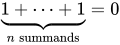
if such a number 
01Motivation
The special definition of the characteristic zero is motivated by the equivalent definitions characterized in the next section, where the characteristic zero is not required to be considered separately.
The characteristic may also be taken to be the exponent of the ring's additive group, that is, the smallest positive integer
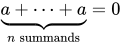
for every element 
Integers, rational numbers and real numbers have characteristic 0.
The integers modulo n have characteristic
Every Boolean ring has characteristic 2.
The characteristic of a field is either 0 or a prime number.
02Equivalent characterizations
- The characteristic of a ring
is the kernel of the unique ring homomorphism from
to
- The characteristic is the natural number
, which is the image of the above homomorphism.
- When the non-negative integers
are partially ordered by divisibility, then
is the smallest and
. If nothing "smaller" (in this ordering) than 0 will suffice, then the characteristic is
is the least common multiple of
and
, and that no ring homomorphism
exists unless
- The characteristic of a ring
for all
implies that
is a multiple of
03Case of rings
If R and S are rings and there exists a ring homomorphism R → S, then the characteristic of S divides the characteristic of R. This can sometimes be used to exclude the possibility of certain ring homomorphisms. The only ring with characteristic 1 is the zero ring, which has only a single element 0. If a nontrivial ring R does not have any nontrivial zero divisors, then its characteristic is either 0 or prime. In particular, this applies to all fields, to all integral domains, and to all division rings. Any ring of characteristic zero is infinite.
The ring 
![\mathbb {F} _{p}[X]/(q(X))](https://wikimedia.org/api/rest_v1/media/math/render/svg/a7b7ebfc51fe60c7bcd21735293a09b291468864)

A 
If a commutative ring R has prime characteristic p, then we have (x + y)p = xp + yp for all elements x and y in R, the normally incorrect "freshman's dream" holds for power p. The map x ↦ xp then defines a ring homomorphism R → R, which is called the Frobenius homomorphism. If R is also an integral domain, the homomorphism is injective.
04Case of fields
As mentioned above, the characteristic of any field is either 0 or a prime number. A field of non-zero characteristic is called a field of finite characteristic or positive characteristic or prime characteristic. The characteristic exponent is defined similarly, except that it is equal to 1 when the characteristic is 0; otherwise it has the same value as the characteristic.
Any field F has a unique minimal subfield, also called its prime field. This subfield is isomorphic to either the rational number field 
Fields of characteristic zero
The fields of characteristic zero are those that have a subfield isomorphic to the field 
Other fields of characteristic zero are the p-adic fields that are widely used in number theory.
Fields of rational fractions over the integers or a field of characteristic zero are other common examples.
Ordered fields always have characteristic zero; they include

Fields of prime characteristic
The finite field 

There exist infinite fields of prime characteristic. For example, the field of all rational functions over 

The size of any finite ring of prime characteristic
Sources and credits
This article is adapted from the Wikipedia article “Characteristic (algebra)”, written by its contributors and licensed under CC BY-SA 4.0. Fathomly has changed the layout, removed citation markers, navigation and maintenance notices, and adjusted punctuation. This adapted version is shared under the same license. For references, see the original article.
Fathomly is not affiliated with or endorsed by the Wikimedia Foundation. Spotted a problem? Tell us.