Reference articles on history, science, culture and more
Encyclopedia

Verma module

Objects in representation theory of Lie algebras

Verma modules, named after Daya-Nand Verma, are objects in the representation theory of Lie algebras, a branch of mathematics.

Verma modules can be used in the classification of irreducible representations of a complex semisimple Lie algebra. Specifically, although Verma modules themselves are infinite dimensional, quotients of them can be used to construct finite-dimensional representations with highest weight \lambda, where \lambda is dominant and integral. Their homomorphisms correspond to invariant differential operators over flag manifolds.

01Informal construction

We can explain the idea of a Verma module as follows. Let {\mathfrak {g}} be a semisimple Lie algebra (over \mathbb {C}, for simplicity). Let {\mathfrak {h}} be a fixed Cartan subalgebra of {\mathfrak {g}} and let R be the associated root system. Let R^{+} be a fixed set of positive roots. For each \alpha \in R^{+}, choose a nonzero element X_{\alpha } for the corresponding root space {\mathfrak {g}}_{\alpha } and a nonzero element Y_{\alpha } in the root space {\mathfrak {g}}_{-\alpha }. We think of the X_{\alpha }'s as "raising operators" and the Y_{\alpha }'s as "lowering operators."

Now let \lambda \in {\mathfrak {h}}^{*} be an arbitrary linear functional, not necessarily dominant or integral. Our goal is to construct a representation W_{\lambda } of {\mathfrak {g}} with highest weight \lambda that is generated by a single nonzero vector v with weight \lambda. The Verma module is one particular such highest-weight module, one that is maximal in the sense that every other highest-weight module with highest weight \lambda is a quotient of the Verma module. It will turn out that Verma modules are always infinite dimensional; if \lambda is dominant integral, however, one can construct a finite-dimensional quotient module of the Verma module. Thus, Verma modules play an important role in the classification of finite-dimensional representations of {\mathfrak {g}}. Specifically, they are an important tool in the hard part of the theorem of the highest weight, namely showing that every dominant integral element actually arises as the highest weight of a finite-dimensional irreducible representation of {\mathfrak {g}}.

We now attempt to understand intuitively what the Verma module with highest weight \lambda should look like. Since v is to be a highest weight vector with weight \lambda, we certainly want

H\cdot v=\lambda (H)v,\quad H\in {\mathfrak {h}}

and

X_{\alpha }\cdot v=0,\quad \alpha \in R^{+}.

Then W_{\lambda } should be spanned by elements obtained by lowering v by the action of the Y_{\alpha }'s:

Y_{\alpha _{i_{1}}}\cdots Y_{\alpha _{i_{M}}}\cdot v.

We now impose only those relations among vectors of the above form required by the commutation relations among the Y's. In particular, the Verma module is always infinite-dimensional. The weights of the Verma module with highest weight \lambda will consist of all elements \mu that can be obtained from \lambda by subtracting integer combinations of positive roots. The figure shows the weights of a Verma module for {\mathfrak {sl}}(3;\mathbb {C} ).

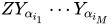
A simple re-ordering argument shows that there is only one possible way the full Lie algebra {\mathfrak {g}} can act on this space. Specifically, if Z is any element of {\mathfrak {g}}, then by the easy part of the Poincaré-Birkhoff-Witt theorem, we can rewrite

ZY_{\alpha _{i_{1}}}\cdots Y_{\alpha _{i_{M}}}

as a linear combination of products of Lie algebra elements with the raising operators X_{\alpha } acting first, the elements of the Cartan subalgebra, and last the lowering operators Y_{\alpha }. Applying this sum of terms to v, any term with a raising operator is zero, any factors in the Cartan act as scalars, and thus we end up with an element of the original form.

To understand the structure of the Verma module a bit better, we may choose an ordering of the positive roots as \alpha _{1},\ldots \alpha _{n} and we denote the corresponding lowering operators by Y_{1},\ldots Y_{n}. Then by a simple re-ordering argument, every element of the above form can be rewritten as a linear combination of elements with the Y's in a specific order:

Y_{1}^{k_{1}}\cdots Y_{n}^{k_{n}}v,

where the k_{j}'s are non-negative integers. Actually, it turns out that such vectors form a basis for the Verma module.

Although this description of the Verma module gives an intuitive idea of what W_{\lambda } looks like, it still remains to give a rigorous construction of it. In any case, the Verma module gives, for any \lambda, not necessarily dominant or integral, a representation with highest weight \lambda. The price we pay for this relatively simple construction is that W_{\lambda } is always infinite dimensional. In the case where \lambda is dominant and integral, one can construct a finite-dimensional, irreducible quotient of the Verma module.

Weights of Verma module for with highest weight

02The case of sl(2; C)

Let {X,Y,H} be the usual basis for \mathrm {sl} (2;\mathbb {C} ):

X={\begin{pmatrix}0&1\\0&0\end{pmatrix}}\qquad Y={\begin{pmatrix}0&0\\1&0\end{pmatrix}}\qquad H={\begin{pmatrix}1&0\\0&-1\end{pmatrix}}~,

with the Cartan subalgebra being the span of H. Let \lambda be defined by \lambda (H)=m for an arbitrary complex number m. Then the Verma module with highest weight \lambda is spanned by linearly independent vectors v_{0},v_{1},v_{2},\dots and the action of the basis elements is as follows:

Y\cdot v_{j}=v_{j+1};\quad X\cdot v_{j}=j(m-(j-1))v_{j-1};\quad H\cdot v_{j}=(m-2j)v_{j}.

(This means in particular that H\cdot v_{0}=mv_{0} and that X\cdot v_{0}=0.) These formulas are motivated by the way the basis elements act in the finite-dimensional representations of \mathrm {sl} (2;\mathbb {C} ), except that we no longer require that the "chain" of eigenvectors for H has to terminate.

In this construction, m is an arbitrary complex number, not necessarily real or positive or an integer. Nevertheless, the case where m is a non-negative integer is special. In that case, the span of the vectors v_{m+1},v_{m+2},\ldots is easily seen to be invariant, because X\cdot v_{m+1}=0. The quotient module is then the finite-dimensional irreducible representation of \mathrm {sl} (2;\mathbb {C} ) of dimension m+1.

03Definition of Verma modules

There are two standard constructions of the Verma module, both of which involve the concept of universal enveloping algebra. We continue the notation of the previous section: {\mathfrak {g}} is a complex semisimple Lie algebra, {\mathfrak {h}} is a fixed Cartan subalgebra, R is the associated root system with a fixed set R^{+} of positive roots. For each \alpha \in R^{+}, we choose nonzero elements X_{\alpha }\in {\mathfrak {g}}_{\alpha } and Y_{\alpha }\in {\mathfrak {g}}_{-\alpha }.

As a quotient of the enveloping algebra

The first construction of the Verma module is a quotient of the universal enveloping algebra U({\mathfrak {g}}) of {\mathfrak {g}}. Since the Verma module is supposed to be a {\mathfrak {g}}-module, it will also be a U({\mathfrak {g}})-module, by the universal property of the enveloping algebra. Thus, if we have a Verma module W_{\lambda } with highest weight vector v, there will be a linear map \Phi from U({\mathfrak {g}}) into W_{\lambda } given by

\Phi (x)=x\cdot v,\quad x\in U({\mathfrak {g}}).

Since W_{\lambda } is supposed to be generated by v, the map \Phi should be surjective. Since v is supposed to be a highest weight vector, the kernel of \Phi should include all the root vectors X_{\alpha } for \alpha in R^{+}. Since, also, v is supposed to be a weight vector with weight \lambda, the kernel of \Phi should include all vectors of the form

H-\lambda (H)1,\quad H\in {\mathfrak {h}}.

Finally, the kernel of \Phi should be a left ideal in U({\mathfrak {g}}); after all, if x\cdot v=0 then (yx)\cdot v=y\cdot (x\cdot v)=0 for all y\in U({\mathfrak {g}}).

The previous discussion motivates the following construction of Verma module. We define W_{\lambda } as the quotient vector space

W_{\lambda }=U({\mathfrak {g}})/I_{\lambda },

where I_{\lambda } is the left ideal generated by all elements of the form

X_{\alpha },\quad \alpha \in R^{+},

and

H-\lambda (H)1,\quad H\in {\mathfrak {h}}.

Because I_{\lambda } is a left ideal, the natural left action of U({\mathfrak {g}}) on itself carries over to the quotient. Thus, W_{\lambda } is a U({\mathfrak {g}})-module and therefore also a {\mathfrak {g}}-module.

By extension of scalars

The "extension of scalars" procedure is a method for changing a left module V over one algebra A_{1} (not necessarily commutative) into a left module over a larger algebra A_{2} that contains A_{1} as a subalgebra. We can think of A_{2} as a right A_{1}-module, where A_{1} acts on A_{2} by multiplication on the right. Since V is a left A_{1}-module and A_{2} is a right A_{1}-module, we can form the tensor product of the two over the algebra A_{1}:

A_{2}\otimes _{A_{1}}V.

Now, since A_{2} is a left A_{2}-module over itself, the above tensor product carries a left module structure over the larger algebra A_{2}, uniquely determined by the requirement that

a_{1}\cdot (a_{2}\otimes v)=(a_{1}a_{2})\otimes v

for all a_{1} and a_{2} in A_{2}. Thus, starting from the left A_{1}-module V, we have produced a left A_{2}-module A_{2}\otimes _{A_{1}}V.

We now apply this construction in the setting of a semisimple Lie algebra. We let {\mathfrak {b}} be the subalgebra of {\mathfrak {g}} spanned by {\mathfrak {h}} and the root vectors X_{\alpha } with \alpha \in R^{+}. (Thus, {\mathfrak {b}} is a "Borel subalgebra" of {\mathfrak {g}}.) We can form a left module F_{\lambda } over the universal enveloping algebra U({\mathfrak {b}}) as follows:

\quad H\cdot v=\lambda (H)v,\quad H\in {\mathfrak {h}};\quad X_{\alpha }\cdot v=0,\quad \alpha \in R^{+}.

The motivation for this formula is that it describes how U({\mathfrak {b}}) is supposed to act on the highest weight vector in a Verma module.

Now, it follows from the Poincaré-Birkhoff-Witt theorem that U({\mathfrak {b}}) is a subalgebra of U({\mathfrak {g}}). Thus, we may apply the extension of scalars technique to convert F_{\lambda } from a left U({\mathfrak {b}})-module into a left U({\mathfrak {g}})-module W_{\lambda } as follow:

W_{\lambda }:=U({\mathfrak {g}})\otimes _{U({\mathfrak {b}})}F_{\lambda }.

Since W_{\lambda } is a left U({\mathfrak {g}})-module, it is, in particular, a module (representation) for {\mathfrak {g}}.

The structure of the Verma module

Whichever construction of the Verma module is used, one has to prove that it is nontrivial, i.e., not the zero module. Actually, it is possible to use the Poincaré-Birkhoff-Witt theorem to show that the underlying vector space of W_{\lambda } is isomorphic to

U({\mathfrak {g}}_{-})

where {\mathfrak {g}}_{-} is the Lie subalgebra generated by the negative root spaces of {\mathfrak {g}} (that is, the Y_{\alpha }'s).

04Basic properties

Verma modules, considered as {\mathfrak {g}}-modules, are highest weight modules, i.e. they are generated by a highest weight vector. This highest weight vector is 1\otimes 1 (the first 1 is the unit in {\mathcal {U}}({\mathfrak {g}}) and the second is the unit in the field F, considered as the {\mathfrak {b}}-module F_{\lambda }) and it has weight \lambda.

Multiplicities

Verma modules are weight modules, i.e. W_{\lambda } is a direct sum of all its weight spaces. Each weight space in W_{\lambda } is finite-dimensional and the dimension of the \mu-weight space W_{\mu } is the number of ways of expressing \lambda -\mu as a sum of positive roots (this is closely related to the so-called Kostant partition function). This assertion follows from the earlier claim that the Verma module is isomorphic as a vector space to U({\mathfrak {g}}_{-}), along with the Poincaré-Birkhoff-Witt theorem for U({\mathfrak {g}}_{-}).

Universal property

Verma modules have a very important property: If V is any representation generated by a highest weight vector of weight \lambda, there is a surjective {\mathfrak {g}}-homomorphism W_{\lambda }\to V. That is, all representations with highest weight \lambda that are generated by the highest weight vector (so called highest weight modules) are quotients of W_{\lambda }.

Irreducible quotient module

W_{\lambda } contains a unique maximal submodule, and its quotient is the unique (up to isomorphism) irreducible representation with highest weight \lambda . If the highest weight \lambda is dominant and integral, one then proves that this irreducible quotient is actually finite dimensional.

As an example, consider the case {\mathfrak {g}}=\operatorname {sl} (2;\mathbb {C} ) discussed above. If the highest weight m is "dominant integral", meaning simply that it is a non-negative integer, then Xv_{m+1}=0 and the span of the elements v_{m+1},v_{m+2},\ldots is invariant. The quotient representation is then irreducible with dimension m+1. The quotient representation is spanned by linearly independent vectors v_{0},v_{1},\ldots ,v_{m}. The action of \operatorname {sl} (2;\mathbb {C} ) is the same as in the Verma module, except that Yv_{m}=0 in the quotient, as compared to Yv_{m}=v_{m+1} in the Verma module.

The Verma module W_{\lambda } itself is irreducible if and only if \lambda is antidominant. Consequently, when \lambda is integral, W_{\lambda } is irreducible if and only if none of the coordinates of \lambda in the basis of fundamental weights is from the set \{0,1,2,\ldots \}, while in general, this condition is necessary but insufficient for W_{\lambda } to be irreducible.

Other properties

The Verma module W_{\lambda } is called regular, if its highest weight λ is on the affine Weyl orbit of a dominant weight {\tilde {\lambda }}. In other word, there exist an element w of the Weyl group W such that

\lambda =w\cdot {\tilde {\lambda }}

where \cdot is the affine action of the Weyl group.

The Verma module W_{\lambda } is called singular, if there is no dominant weight on the affine orbit of λ. In this case, there exists a weight {\tilde {\lambda }} so that {\tilde {\lambda }}+\delta is on the wall of the fundamental Weyl chamber (δ is the sum of all fundamental weights).

05Homomorphisms of Verma modules

For any two weights \lambda ,\mu a non-trivial homomorphism

W_{\mu }\rightarrow W_{\lambda }

may exist only if \mu and \lambda are linked with an affine action of the Weyl group W of the Lie algebra {\mathfrak {g}}. This follows easily from the Harish-Chandra theorem on infinitesimal central characters.

Each homomorphism of Verma modules is injective and the dimension

\dim(\operatorname {Hom} (W_{\mu },W_{\lambda }))\leq 1

for any \mu ,\lambda. So, there exists a nonzero W_{\mu }\rightarrow W_{\lambda } if and only if W_{\mu } is isomorphic to a (unique) submodule of W_{\lambda }.

The full classification of Verma module homomorphisms was done by Bernstein-Gelfand-Gelfand and Verma and can be summed up in the following statement:

There exists a nonzero homomorphism W_{\mu }\rightarrow W_{\lambda } if and only if there exists

a sequence of weights

\mu =\nu _{0}\leq \nu _{1}\leq \ldots \leq \nu _{k}=\lambda

such that \nu _{i-1}+\delta =s_{\gamma _{i}}(\nu _{i}+\delta ) for some positive roots \gamma _{i} (and s_{\gamma _{i}} is the corresponding root reflection and \delta is the sum of all fundamental weights) and for each 1\leq i\leq k,(\nu _{i}+\delta )(H_{\gamma _{i}}) is a natural number (H_{\gamma _{i}} is the coroot associated to the root \gamma _{i}).

If the Verma modules M_{\mu } and M_{\lambda } are regular, then there exists a unique dominant weight {\tilde {\lambda }} and unique elements w, w′ of the Weyl group W such that

\mu =w'\cdot {\tilde {\lambda }}

and

\lambda =w\cdot {\tilde {\lambda }},

where \cdot is the affine action of the Weyl group. If the weights are further integral, then there exists a nonzero homomorphism

W_{\mu }\to W_{\lambda }

if and only if

w\leq w'

in the Bruhat ordering of the Weyl group.

06Jordan-Hölder series

Let

0\subset A\subset B\subset W_{\lambda }

be a sequence of {\mathfrak {g}}-modules so that the quotient B/A is irreducible with highest weight μ. Then there exists a nonzero homomorphism W_{\mu }\to W_{\lambda }.

An easy consequence of this is, that for any highest weight modules V_{\mu },V_{\lambda } such that

V_{\mu }\subset V_{\lambda }

there exists a nonzero homomorphism W_{\mu }\to W_{\lambda }.

07Bernstein-Gelfand-Gelfand resolution

Let V_{\lambda } be a finite-dimensional irreducible representation of the Lie algebra {\mathfrak {g}} with highest weight λ. We know from the section about homomorphisms of Verma modules that there exists a homomorphism

W_{w'\cdot \lambda }\to W_{w\cdot \lambda }

if and only if

w\leq w'

in the Bruhat ordering of the Weyl group. The following theorem describes a projective resolution of V_{\lambda } in terms of Verma modules (it was proved by Bernstein, Gelfand, Gelfand in 1975) :

There exists an exact sequence of {\mathfrak {g}}-homomorphisms

0\to \oplus _{w\in W,\,\,\ell (w)=n}W_{w\cdot \lambda }\to \cdots \to \oplus _{w\in W,\,\,\ell (w)=2}W_{w\cdot \lambda }\to \oplus _{w\in W,\,\,\ell (w)=1}W_{w\cdot \lambda }\to W_{\lambda }\to V_{\lambda }\to 0

where n is the length of the largest element of the Weyl group.

A similar resolution exists for generalized Verma modules as well. It is denoted shortly as the BGG resolution.

Watch videos about Verma moduleExplainers and documentaries on YouTube (opens in a new tab)

Sources and credits

This article is adapted from the Wikipedia article Verma module, written by its contributors and licensed under CC BY-SA 4.0. Fathomly has changed the layout, removed citation markers, navigation and maintenance notices, and adjusted punctuation. This adapted version is shared under the same license. For references, see the original article.

Images, from Wikimedia Commons:

Fathomly is not affiliated with or endorsed by the Wikimedia Foundation. Spotted a problem? Tell us.