Universal property
Characterizing property of mathematical constructions

In mathematics, more specifically in category theory, a universal property is a property that characterizes up to an isomorphism the result of some constructions. Thus, universal properties can be used for defining some objects independently from the method chosen for constructing them. For example, the definitions of the integers from the natural numbers, of the rational numbers from the integers, of the real numbers from the rational numbers, and of polynomial rings from the field of their coefficients can all be done in terms of universal properties. In particular, the concept of universal property allows a simple proof that all constructions of real numbers are equivalent: it suffices to prove that they satisfy the same universal property.
Technically, a universal property is defined in terms of categories and functors by means of a universal morphism (see § Formal definition, below). Universal morphisms can also be thought more abstractly as initial or terminal objects of a comma category (see § Connection with comma categories, below).
Universal properties occur almost everywhere in mathematics, and the use of the concept allows the use of general properties of universal properties for easily proving some properties that would need boring verifications otherwise. For example, given a commutative ring R, the field of fractions of the quotient ring of R by a prime ideal p can be identified with the residue field of the localization of R at p; that is 
Other objects that can be defined by universal properties include: all free objects, direct products and direct sums, free groups, free lattices, Grothendieck group, completion of a metric space, completion of a ring, Dedekind-MacNeille completion, product topologies, Stone-Čech compactification, tensor products, inverse limit and direct limit, kernels and cokernels, quotient groups, quotient vector spaces, and other quotient spaces.
01Motivation
Before giving a formal definition of universal properties, we offer some motivation for studying such constructions.
- The concrete details of a given construction may be messy, but if the construction satisfies a universal property, one can forget all those details: all there is to know about the construction is already contained in the universal property. Proofs often become short and elegant if the universal property is used rather than the concrete details. For example, the tensor algebra of a vector space is slightly complicated to construct, but much easier to deal with by its universal property.
- Universal properties define objects uniquely up to a unique isomorphism. Therefore, one strategy to prove that two objects are isomorphic is to show that they satisfy the same universal property.
- Universal constructions are functorial in nature: if one can carry out the construction for every object in a category C then one obtains a functor on C. Furthermore, this functor is a right or left adjoint to the functor U used in the definition of the universal property.
- Universal properties occur everywhere in mathematics. By understanding their abstract properties, one obtains information about all these constructions and can avoid repeating the same analysis for each individual instance.

02Formal definition
To understand the definition of a universal construction, it is important to look at examples. Universal constructions were not defined out of thin air, but were rather defined after mathematicians began noticing a pattern in many mathematical constructions (see § Examples below). Hence, the definition may not make sense at first, but will become clear when one reconciles it with concrete examples.
Let 


Then, the functor 


A universal morphism from 
For any morphism of the form
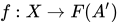
We can dualize this categorical concept. A universal morphism from 
For any morphism of the form 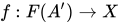

Note that in each definition, the arrows are reversed. Both definitions are necessary to describe universal constructions which appear in mathematics; but they also arise due to the inherent duality present in category theory.
In either case, we say that the pair 

03Connection with comma categories
Universal morphisms can be described more concisely as initial and terminal objects in a comma category (i.e. one where morphisms are seen as objects in their own right).
Let 
- Objects are pairs of the form
, where
is an object in
- A morphism from
is given by a morphism
in
Now suppose that the object 
Note that the equality here simply means the diagrams are the same. Also note that the diagram on the right side of the equality is the exact same as the one offered in defining a universal morphism from
Conversely, recall that the comma category 
- Objects are pairs of the form
where
- A morphism from
is given by a morphism
Suppose 
The diagram on the right side of the equality is the same diagram pictured when defining a universal morphism from

04Examples
Below are a few examples, to highlight the general idea. The reader can construct numerous other examples by consulting the articles mentioned in the introduction.
Tensor algebras
Let 

Given any vector space 

- “Any linear map from
This statement is an initial property of the tensor algebra since it expresses the fact that the pair 


Since this construction works for any vector space 
Products
A categorical product can be characterized by a universal construction. For concreteness, one may consider the Cartesian product in Set, the direct product in Grp, or the product topology in Top, where products exist.
Let 
:
:


such that for any other object 





To understand this characterization as a universal property, take the category 

by 








For the example of the Cartesian product in Set, the morphism 



Limits and colimits
Categorical products are a particular kind of limit in category theory. One can generalize the above example to arbitrary limits and colimits.
Let 


is the functor that maps each object 







Given a functor 

05Properties
Existence and uniqueness
Defining a quantity does not guarantee its existence. Given a functor 

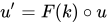

It is the pair
Equivalent formulations
The definition of a universal morphism can be rephrased in a variety of ways. Let
is a representation of
, where its components
are defined by

for each object

The dual statements are also equivalent:
is a representation of
, where its components
are defined by

for each object
Relation to adjoint functors
Suppose 


If every object 


Similar statements apply to the dual situation of terminal morphisms from 
Indeed, all pairs of adjoint functors arise from universal constructions in this manner. Let 

- For each object
is a universal morphism from
there exists a unique
for which the following diagrams commute.
- For each object
is a universal morphism from
Universal constructions are more general than adjoint functor pairs: a universal construction is like an optimization problem; it gives rise to an adjoint pair if and only if this problem has a solution for every object of

06History
Universal properties of various topological constructions were presented by Pierre Samuel in 1948. They were later used extensively by Bourbaki. The closely related concept of adjoint functors was introduced independently by Daniel Kan in 1958.

Sources and credits
This article is adapted from the Wikipedia article “Universal property”, written by its contributors and licensed under CC BY-SA 4.0. Fathomly has changed the layout, removed citation markers, navigation and maintenance notices, and adjusted punctuation. This adapted version is shared under the same license. For references, see the original article.
Images, from Wikimedia Commons:
- Universal morphism definition.svg by Ltrujello, CC BY-SA 4.0
- Universal definition dualized.svg by Ltrujello, CC BY-SA 4.0
- Definition of a morphism in a comma category.svg by Ltrujello, CC BY-SA 4.0
- Connection between universal diagrams and comma categories.svg by Ltrujello, CC BY-SA 4.0
- Definition of a morphism in a comma category 1.svg by Ltrujello, CC BY-SA 4.0
- Connection between comma category and universal properties.svg by Ltrujello, CC BY-SA 4.0
- Universal-property-products.svg by Davidvandebunte, CC BY-SA 4.0
Fathomly is not affiliated with or endorsed by the Wikimedia Foundation. Spotted a problem? Tell us.